Photo Credit: Benjamin Benschneider
Through the ages, art and architecture have always been a reflection of their time. Versailles speaks of an era in French history marked by frivolity and opulence. The Arts and Crafts movement arose in response to the Industrial Revolution and the fear that fine craftsmanship would be lost to machinery.
The same “art reflects life” principle applies today as issues such as fuel costs, climate change, shifting family structures, and the credit crunch reshape the built environment as we know it. For evidence, look no further than the Gold Nugget Awards, the annual PCBC-sponsored competition orchestrated by Peter M. Mayer Productions, that lauds exceptional work in 14 Western states as well as international markets. Many winners this year were compact, green, and affordable. Others were impeccably nostalgic, reflecting a craving for simplicity in these frenetic times.
Beauty is always a fine sight to behold, but when sustainability, social responsibility, and resourcefulness are also part of the package, you’ve really struck gold.—Jenny Sullivan
Model Citizen
Ashworth Cottages, Seattle
This little gem of a project proves that density can be downright delightful when done right. Blending 12 cottages and eight carriage-style units into a turn-of-the-20th-century neighborhood, Runberg Architecture Group and builder/developer Pryde Johnson seamlessly introduced an alternative (and more affordable) housing type to an area dominated by single-family homes—all the while respecting the scale and character of what was there first. Inspired by Danish co-housing, the compact project puts 20 units on .79 of an acre, with homes priced from $689,950 to $869,950.
With their Craftsman façades, these tidy dwellings fit right in, but they are decidedly different from their older neighbors in one fundamental way: As the first project in the state to obtain a LEED Platinum rating, Ashworth Cottages stands as the greenest of green prototypes. For residents, the compact site design and infill location make walking, bicycling, and public transit viable alternatives to driving. Some 95 percent of construction waste was recycled, and many materials salvaged from the original site (bricks, terra cotta tiles, truss beams) were creatively reused as landscape features.

That’s just the beginning. The Energy Star–rated homes also pack in ultra-efficient heating, integrated water conservation systems (including hot water on demand, low-flow plumbing fixtures, rainwater cisterns, and drip irrigation heads for landscaping), FSC-certified wood, formaldehyde-free millwork, recycled composite decking, non–off-gassing paints and finishes, carpet made from 50 percent recycled content and high-performance windows, lighting, and appliances. And because the project made significant use of local materials, the fossil fuels and truck miles required to transport materials to the jobsite were significantly reduced. Each cottage incorporates more than 12 locally sourced products.
Given its charming good looks, this project might easily have won an award on aesthetics alone. But with its sustainable ethics, it wins the personality and talent competitions too, hands down.—Jenny Sullivan
Award: Grand for best sustainable community—detached; Builder/Developer: Pryde Johnson Urban Environments, Seattle; Architect: Runberg Architecture Group, Seattle

Photo Credit: Mark Boisclair
New Frontier
Trappers' Cabins at Promontory, Park City, Utah
Back in the 1800s, this 32-acre stretch of sublime wilderness in the Utah high plains was pretty low density. It had few human inhabitants, save the fur trappers and Native Americans who made their livelihood there.
With their chinked siding, natural stone masonry, and crossbuck-style railings, the 64 homes that make up the Trappers’ Cabins at Promontory give an appreciative nod to that history. Enclaves of up to eight cabins, situated around open-space “camps,” replicate the orientation of old hunting settlements. And the architects at DTJ Design note that the project’s authentic feel was achieved, in part, by defying the modern-day rule that thou shalt not repeat exterior elevation materials on homes that sit next to each other.

Photo Credit: Mark Boisclair
Of all the fine plans in this mountain retreat, the Bridger model topped the judges’ list for good looks and functionality, ultimately earning “Home of the Year” distinction. Its rusticated millwork and exposed truss ceilings evoke the nostalgia of a grand old lodge, yet the dwelling functions as the perfect entertainment house for today’s casual lifestyles. The main floor features a master-down bedroom and a large, communal living space that spills out onto porch and deck areas. Upstairs, an open loft connects a second bedroom, bunkroom, and bath for guests.

And whereas many nearby trophy homes in Park City encompass upwards of 10,000 square feet, this modest outpost settles comfortably into the landscape and packs everything it needs into a mere 2,200 square feet, proving that luxury is entirely possible—and in many ways, preferable—on a smaller scale. Like the trappers and indigenous people who once traversed the land, this project treads lightly and savors the view.—Jenny Sullivan
Awards: Home of the Year; grand for best single-family detached home—under 2,500 square feet (conventional lot); Builder: CSE & Associates, Scottsdale, Ariz.; Developer: Pivotal Group, Park City, Utah; Architect/Land planner: DTJ Design, Boulder, Colo.

Photo Credit: Mark Boisclair

Photo Credit: Cody Andresen
Tall Stack
Forgan Residence, San Francisco
Delicately balancing new construction and existing conditions is the key to successful infill development. That’s exactly what architect/homeowner Strachan Forgan accomplished when he took on a challenging 25-foot-wide-by-42-foot-deep lot with a steep slope. He wedged his modern masterpiece into a hill on two sides and a low-rise residential building on the third.
Situated in the city’s well-established Glen Park Village neighborhood at the entrance to a public recreation area, the custom design responds to the site’s dual personality—urban district meets wooded park. A two-story bay window is a contemporary interpretation of traditional San Francisco townhouse architecture, and a soft, gray and green exterior color palette reflects that of the surrounding eucalyptus grove.
The tall, narrow box is 1,850 square feet in four stories. The living and dining rooms and kitchen are on the second floor, with a mezzanine office, laundry, and guest quarters above that, and a master suite occupying the entire top level. Although the sides of the house are windowless, the double-height projecting bay, along with considerable glazing on the backside, floods the deep plan with daylight.

Photo Credit: Cody Andresen
Accessible, usable outdoor space was a priority for Forgan, who designed a glass wall of accordion doors at the rear of the plan, off the kitchen. When open, the living spaces become one with a private, wood-decked rear terrace. A gray stain to match the home’s exterior and a bed of landscaping, including bamboo, softens the impact of the massive concrete retaining wall.
The walls of glass, along with a dramatic glass staircase, make the ascension to the master suite seem like climbing up to a tree house. Further enhancing the indoor/outdoor relationship, a pair of French doors opens from the master bedroom to a fourth-floor terrace providing views through the trees to the canyon park beyond.
A prime example of infill done right, this gem of a custom home respects the forest as well as the village, striking a perfect pitch to harmonize with both.—Carolyn Weber
Award: Grand for best custom home—under 5,000 square feet; Builder: Bradford Construction, San Francisco; Architect: Strachan Forgan, San Francisco

Photo Credit: Lenny Siegel
Urban Country
The Grove, Healdsburg, Calif.
The challenge facing the architects of The Grove, a 23-unit attached project in Healdsburg, Calif., was pretty straightforward in some ways. They had to figure out how to make the best of a sloping, 2.85-acre site with a protected, wooded natural slough at the low end, oak trees scattered throughout, and a small grove of 50-foot redwood trees in the center. The fact that the site was smack in the middle of a small town in wine country made things more interesting. For the team from Flynn, Craig & Grant Architects, success came from respecting the infill site’s natural amenities and playing up the rural aspects.

Existing trees were preserved, and buildings and roads were stepped down the natural slope of the site with minimal grading. Buildings were squeezed in between tree canopies and the loop road, which was visually narrowed to a rural lane by changing the inner 5 feet of the street to a concrete path. Exterior building forms, finishes, and colors were used to evoke a conglomeration of barns and simple farm structures. Combinations of metal and wood—the barn-like, wood-clad, metal garage doors are a prime example—reflect the area’s rich agricultural history.
Rural as its massing may appear, the project’s five floor plans flow from the architects’ experience with designing urban lofts. Each unit is narrow, deep, and vertical, with 18-foot-high window-walls that frame views of the heritage trees. The modern vibe is continued on the wood decks, some of which feature stainless-steel outdoor fireplaces. Perfect for those move-up and second-home buyers who like their spot in the country to have an urban edge.—Kathleen Stanley

Photo Credit: Lenny Siegel
Award: Grand for best attached project (for sale)—under 18 du/acre; Builder: Nordby Construction, Santa Rosa, Calif.; Developer: Healdsburg Grove Lofts, Healdsburg, Calif.; Architect: Flynn, Craig & Grant Architects, Danville, Calif.

Photo Credit: Benjamin Benschneider
Lofty Position
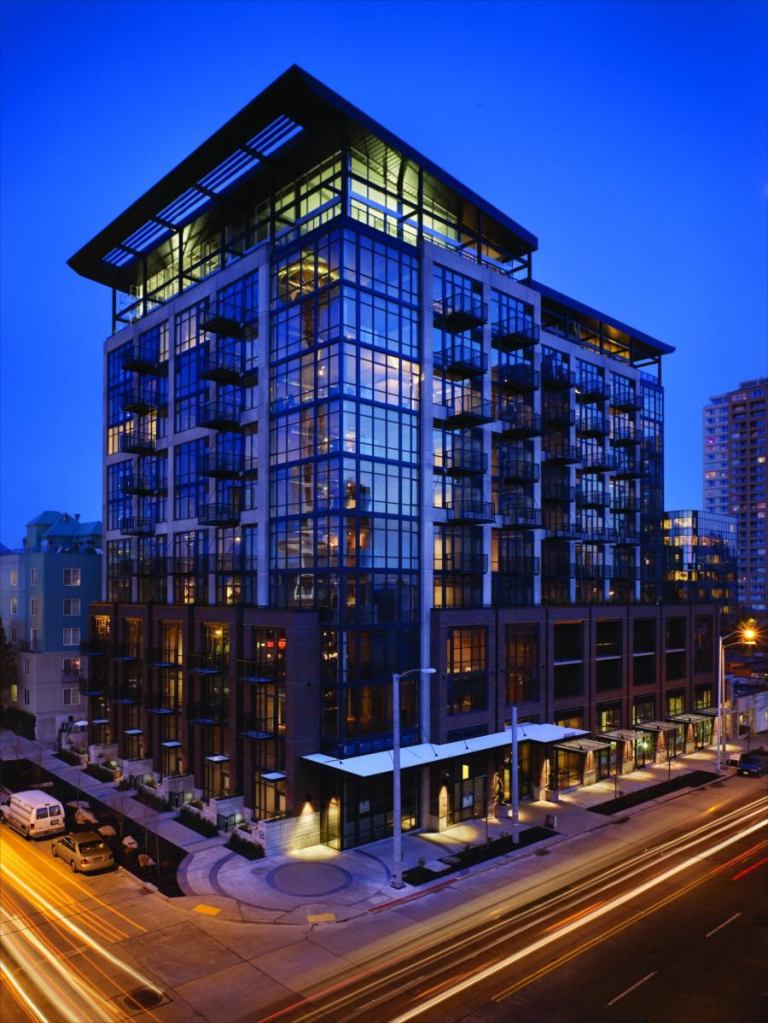
Mosler Lofts, Seattle
This triple award–winning, LEED Silver project is helping to keep the Emerald City green.
It’s just what the young professional and active empty-nester markets ordered: a sophisticated condominium that’s also a model of urban sustainability.
The elegant, 12-story, steel and concrete structure is situated on a 19,384-square-foot lot in the heart of Seattle’s hip Belltown neighborhood, within walking distance of shopping, restaurants, and mass transit. It steps back from the street to reclaim 6 feet of sidewalk space for pedestrians to access the 6,000 square feet of retail on the west side and five street-level townhouse units to the north.
The 150 stylish residential lofts, which range from 500-square-foot studios to spacious 2,000-square-foot units, have classic downtown trappings such as 10-foot-high ceilings, exposed ductwork, concrete pillars, and floor-to-ceiling windows allowing stunning views of the city as well as maximum daylight.

Photo Credit: Benjamin Benschneider
Knowing that large buildings can be major emitters of greenhouse gases, the architects at Mithun wanted this project to be an exception and a model for the future. They specified regional materials, certified wood, low-flow fixtures, and Energy Star appliances. Its roof features a common recreation area and a green roof terrace. Down below, the garage holds reserved parking for bicycles and flex cars, a recycling collection area, a stormwater management system, and a CO2 monitoring system.—Carolyn Weber
Awards: Attached urban residential project of the year; grand for best attached high-rise housing project (for sale); and grand for best attached sustainable community; Builder: JE Dunn, Kirkland, Wash.; Developer: The Schuster Group, Seattle; Architect: Mithun, Seattle

Photo Credit: Benjamin Benschneider

Photo Credit: Jeffrey Aron
Optical Illusion
Morgan Square, Fremont, Calif.
Everything is not as it seems inside this 2,000-square-foot, single-family home in Fremont, Calif. And that’s a good thing.
From the street, the home—located in Morgan Square, a 48-unit infill project in the city’s historic Centreville District—resembles a classic two-story structure, with what looks like a top-floor deck. Perhaps a private porch for the master suite? And that room off the front entrance? Probably the living room, right?
Peek around to the side of the house, though, and things start to come into focus. The handsome, detail-rich home is actually three-stories tall, with the guts of the house—kitchen, living and dining rooms, a home management center, two bedrooms, a bath, and that handsome deck—on the second level. A large master suite is tucked into the unexpected third story, while the ground level boasts a sizable entry, front porch, full bath, laundry room, two-car garage, and a versatile retreat space (perfect for a home office). It’s chock full on the inside, but the exterior illusion of a two-story structure makes the house feel modest and less vertical.

Photo Credit: Jeffrey Aron
Architects from Dahlin Group did as much as they could to offer detached definition within the confines of a pretty high density neighborhood. As a result, this project serves up privacy between homes, an upscale interior, and usable outdoor spaces. The ground-floor porch, patio, and versatile retreat space all bring upscale livability to the ground floor and provide a positive transition to the second level. An open floor plan gives the small residence a big feel, as do arches and plenty of tall windows.—Kathleen Stanley
Award: Grand for best single-family detached home—3,200- to 4,500-square-foot lot; Builder/Developer: SummerHill Homes, Palo Alto, Calif.; Architect: Dahlin Group, Pleasanton, Calif.; Land planner: Ruggeri, Jensen, Azar & Associates, Pleasanton

Photo Credit: Chet Frohlich
Split Difference
The Trails at Brightwater, Huntington Beach, Calif.
Thanks to designs like this one,we’re starting to see viable alternatives to monster garage–dominated front façades. The beach cottage, on a diminutive 45-foot-by-62-foot lot, was designed by the crafty team at Bassenian/Lagoni Architects, who divided the auto storage into split–single-car garages to minimize the impact on the streetscape. Taking focus away from the garages allows the home’s unique entryway to command center stage.
The exterior material mix is also a breath of fresh air, reinforcing the model’s quaint character. Neutral-toned stucco is the primary cladding, with matching wood accents on the roof brackets and gable ends, and red brick to further enhance the entry.
Through the main portal, a brick-paved passageway leads to a sunny, private center courtyard that’s the hub of the house. The 1,755-square-foot, three-bedroom, two-and-a-half bath floor plan revolves around this space, with glass doors on three sides that flood the first-floor living areas with natural light.
A real perk for a house this size is the detached bonus space that has a window to the street and connects to the courtyard via French doors. This type of flex room is a dream for buyers, who can customize it as a home office, craft area, or workout room.
Inside, the laid-back plan features a spacious kitchen with a generous center island, a wide-open family room, and a first-floor powder room. The second-floor master suite boasts amenities usually reserved for larger houses, including a vaulted, beamed ceiling and a walk-in closet. Another surprise is the covered balcony off the hallway, overlooking the courtyard, which provides a cozy perch in this smart seaside retreat.—Carolyn Weber
Award: Grand for best single-family detached home—less than 3,200 square feet (compact lot); Builder/Developer: Hearthside Homes, Irvine, Calif.; Architect: Bassenian/Lagoni Architects, Newport Beach, Calif.; Land planner: FORMA Design, Costa Mesa, Calif.

Photo Credit: Rick Brazil
Desert Pose
Redding Residence at Desert Mountain, Scottsdale, Ariz.
In recent years, the architectureof many homes in the affluent, second-home preserve of Scottsdale, Ariz., has skewed more Tuscan Splendor than Desert Simplicity. The Redding Residence, an 8,300-square-foot beauty in the high Sonoran Desert, is an exception.
Architecturally, the sculptural home is split into two zones. One is a 4,300-square-foot, casual realm occupied by the owners. The other, with two bedrooms, is for extended family and friends, who visit often. The first floor of each zone has its own kitchen, laundry room, and living/family room; a lower level features a play room, media room, and two additional bedrooms.

Photo Credit: Jeffrey Aron
That’s a lot of house, but it fits beautifully into its surroundings in an organic, unassuming way. Solid walls of concrete and rammed earth block out the harsh sun and preserve privacy. At the same time, an almost invisible line of glass, shaded by deep overhangs, breaks down the boundary between indoors and outdoors, framing near and distant views. Capping things off is a dramatic floating roof of locally mined copper. A prime example, no doubt, of what site-sensitive architecture can and should look like—all without a hint of Tuscany.—Kathleen Stanley
Award: Grand for best custom home—5,000 to 10,000 square feet; Builder: The Construction Zone, Phoenix; Architect: Kendle Design Collaborative, Scottsdale, Ariz.

Photo Credit: Rodriguez Associates
Eco Facto
Solara, Poway, Calif.
When a thoughtful developer goes the extra mile to create an environment that’s beneficial to people as well as the planet, it’s bound to be a winner. This attractive and affordable apartment community northwest of San Diego is the first in California to be completely powered by the sun. The 56 units, built on 2.5 acres in the foothills of the Twin Peaks, run on electricity from photovoltaic panels on the roofs and carports.
One- and two-story garden apartments (with one-, two-, and three-bedroom units renting for $557 to $807 per month) were sited to take advantage of passive solar, have deep overhangs to shade where needed, and are equipped with low-E windows, a radiant barrier, and mechanical and lighting systems that exceed the state’s Title 24 energy-saving requirements by more than 15 percent.

Photo Credit: Rodriguez Associates
Water-saving features in this semi-arid climate include dual-flush toilets in every unit, native plantings, no grass to mow, and stormwater that is treated and reused in the greenbelt. Other eco-friendly materials such as fly ash in the concrete and recycled plastic–composite decking were used. Even the play structure and soft surface beneath it are made of recycled tires and bottles.
Improved indoor air quality was also a consideration, and here the team opted for green label carpet, linoleum flooring in the kitchens and baths, low-VOC paints, and ventilation fans with timers to combat mold.

Photo Credit: John Durant
To encourage healthy habits and lifestyles among the residents, developer Community HousingWorks supplies families with shopping carts for walks to the local farmer’s market or other nearby retail. At the community center, renters have access to job, computer, and fitness training, as well as financial education. Public art projects throughout the grounds, made from reclaimed materials, further reinforce the positive environmental message.—Carolyn Weber
Award: Grand for best affordable project—under 30 units/acre; Builder: Sun Country Builders, Vista, Calif.; Developer: Community HousingWorks, San Diego; Architect/Land planner: Rodriguez Associates Architects & Planners, San Diego

Photo Credit: John Trotto
Nature's Best
Talking Rock, Prescott, Ariz.
Mother Nature was dulyhonored in the creation of Talking Rock, a master planned resort community in Prescott, Ariz. Nearly a third of the site’s 3,500 acres is devoted to open space, preserving natural amenities and view corridors. And, as the judges were quick to note, “the developed part is historically sensitive, evoking the spirit of this one-time cattle ranch in its rustic architectural themes and low-slung buildings. The site’s rugged topography was something the planners viewed as an asset (not an obstacle), and it shows.”
In addition to a killer golf course that nestles quietly into the hills, other amenities include a 32,000-square-foot clubhouse and 25 miles of hiking/biking trails. The housing options aren’t too shabby either. They appeal to a variety of buyers, including those looking for a lock-and-leave lifestyle or the flexibility of a custom-designed home.

Photo Credit: Scott Baxter
Homes vary in size from 2,200 to 7,500 square feet and are located on half- to two-acre lots. Traditional ranch architecture themes—expressed through extensive use of stone, wood, and metal—are integrated throughout the project and are part of the design guidelines for custom homes.
Even the name pays respect to what was there first. It comes from the nearly 2,000 American Indian petroglyphs in the ranch’s Inscription Canyon; Talking Rock donated the ancient petroglyph site to the indigenous Yavapai Indian Community for preservation and protection from development.—Kathleen Stanley

Photo Credit: Mark Laverman
Award: Residential project of the year—detached; Builder: Renaissance Cos., Scottsdale; Developer: Harvard Investments, Scottsdale; Architect/Land planner: Swaback Partners, Scottsdale, Ariz.
Click here for a complete list of the 2008 Gold Nugget Award winners.
Click here to see Builder’s 2007 Gold Nugget Awards coverage.