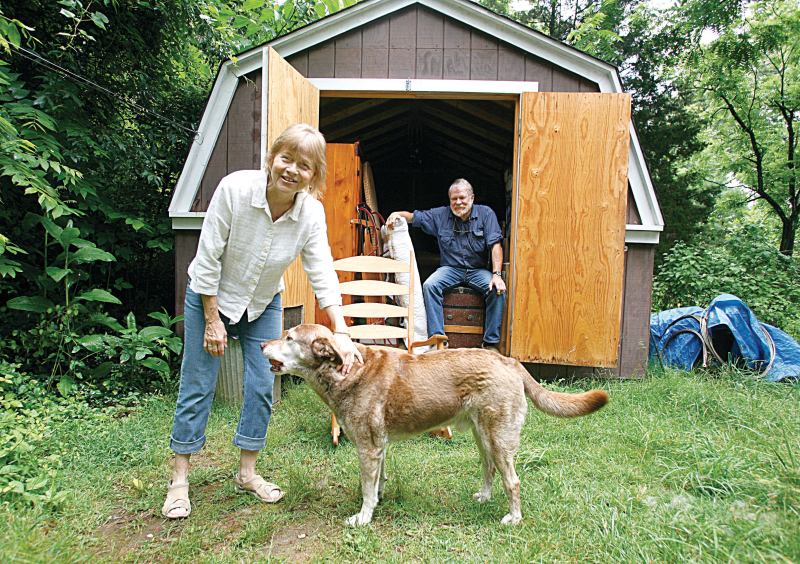
Modest proposal: For Judy Rosen and Brooks Townes (between moves) the ideal house would be small, but high quality.
Credit: Coke Whitworth
Brooks Townes and Judy Rosen are frustrated. After transplanting themselves from the Pacific Northwest to Asheville, N.C., for 12 years to care for an elderly parent, they’re ready to move back home, and they’re looking for a cozy nest no bigger than 1,000 square feet. But even in the peninsulas around Seattle, where progressive zoning reform has paved the way for a wider-than-average selection of jewel-box homes on small lots, the couple, who are 65 and 63, can’t find quite what they’re looking for.
Townes, an active, eco-minded type, imagines the perfect set up as a modest, detached dwelling with one bedroom, a home office, a two-car garage, and a guest cottage in the neighborhood that residents can take turns reserving for visitors. He’d also like a community studio for woodworking, boat-building, and other messy projects.
Some luxuries Townes is willing to share, and some he’s willing to do without. Nice millwork, cabinetry, and finishes are not in the category of things he’ll forgo. “Small spaces can still be high quality,” says the former journalist, who is just slightly ahead of the oldest of the Baby Boomers, who will turn 65 in 2011—a year that, with any luck, will mean happier times for home builders.
“I don’t need to show off, but good solid stuff is important to my generation,” he says. “We don’t like ... pressboard furniture and cheap countertops. A lot of builders have equated small with chintzy, and that’s where they’ve gone wrong.”
Ship Shape
Not everyone born between 1946 and 1964 shares Townes’ retirement dream of a semi-communal lifestyle. But there are enough like-minded voices pleading for a combination of small and high-end that builders are already beginning to make some fundamental shifts in what they are building.
“The impulse buyer does not exist right now, but I think they will come back if we change our product,” says Steve Romeyn, co-founder of Windsong Properties, a builder of active adult communities in the suburbs outside of Atlanta. “If the houses that were selling last year were 2,500 to 2,700 square feet with a finished bonus room, maybe now I need to scale back by 220 square feet. But I can’t switch from tile to vinyl floors or from granite countertops back to laminate. The mature buyer still wants quality. It’s like choosing between the BMW 3 series and the 5 series. If you sit in those cars, the only difference is the size, not the quality of the leather.”
Charlotte, N.C.–based Simonini Builders, which for years specialized in large luxury homes priced in the $800,000 to $4 million range, is similarly realizing that size may be a tipping point that gets some buyers off the fence. Recognizing that the times, they are a-changing—particularly for the loyal Baby Boomers who have counted among its best customers—the builder recently asked architect Dominick Tringali to rethink what might appeal to buyers whose financial means have downshifted post-meltdown, even if their tastes have not. Tringali’s response: the “Classic Yacht Villas,” a series of six house plans ranging from 2,200 to 2,800 square feet, to be priced between $475,000 and $550,000.
Brave New World
-
Community and energy efficiency top their lists of priorities.
-
But where builders and their products fit into that vision differs for each buyer group.
-
By 2011, half of all homeowners will be over 50. But the current housing landscape doesn't necessarily provide what they want -- or need.
-
Millennials make up almost a third of the U.S. population, and they will fundamentally change how you do business.
The tight little plans do away with formal dining and living rooms, but hold the line on ample kitchen/entertainment areas, nice master baths with his-and-hers vanities, and meaningful details such as drop zones and beamed ceilings. The pro forma works because the houses can be built on 55-foot lots, thus allowing the builder to redraw the lines on existing site plans and get more mileage out of its land holdings.
“Yachts take a lot of craftsmanship and sophistication and put it in a small, compartmentalized area,” says Tringali. “People can’t buy like they used to. Now, if someone goes to buy a $600,000 to $700,000 house, the banks are looking for 20 percent down, meaning they need to have $125,000 in cash to get a reasonable mortgage. We realized we needed to get these houses down in price to make them viable for empty-nesters to buy in the next two years.”
Grave New World
One of the paradoxes now defining this massive generation of 79 million is that a disparity exists between what buyers say they want and what they can realistically afford. Even market-corrected prices and record-low interest rates aren’t an easy sell for many 45- to 54-year-olds who, in the wake of the housing bust and Wall Street collapse, have seen their average net worth erode by more than 45 percent, according to a recent study by the D.C.-based Center for Economic Policy Research. For those aged 55 to 64, the losses haven’t been quite as dramatic, but nevertheless amount to a 38 percent drop in net wealth.
“My sense is that before the crash, maybe up to 15 percent of the national market could push and squeeze themselves into million-dollar homes,” says Chris Nelson, director of the Metropolitan Research Center at the University of Utah. “Now that number is more like 5 percent. The high-end home market was jacked artificially high this decade and will correct itself to be artificially low for the next decade.”
This won’t be an easy pill for the so-called “Me Generation” to swallow—particularly in combination with aging. Plenty of Boomers are in denial about their deteriorating eyesight and knees. Now add to that denial about their financial means. A study released by McKinsey Global Institute last November looked at non-mortgage debt, income, and assets, and found 69 percent of Boomers unprepared to maintain their present lifestyles into retirement. Factor in home equity and the ranks of the prepared still add up to only 38 percent.
“This lack of financial preparation will affect not just the poor, but large numbers of middle-class Americans as well,” the study authors concluded. “Less than half of Boomer households earning $60,000 to $90,000 per year are prepared.”
And this new reality will no doubt influence their housing decisions. “Most Boomers probably have stayed in their homes long enough that they still have some equity, but when they move they won’t carry the equity they had planned on with them,” Nelson observes. “Before the crash they would have moved to fancier [homes]. Now more of them will be looking to move to smaller, less-expensive units. And if they want to help their kids buy homes that will mean even more financial stress.”
Trial and Error
Even for buyers with money in their pockets and robust FICO scores, finding that new sweet spot isn’t easy.
When Gary and Karen Brown became empty-nesters last year, they put their 4,000-square-foot detached home on the market and moved into a townhouse just shy of 2,000 square feet. That’s when the couple, who are 55 and 54, realized they’d downsized too much. So they sold the townhouse and notched back up to a 3,100-square-foot, master-down cottage in Somerset, an active adult neighborhood by Windsong Properties in Woodstock, Ga.
“We downsized because it was just the two of us … and we didn’t want to continue paying for the utilities and maintenance on a larger home,” says Karen, a commercial Realtor who continues to work from home (as does her husband). “In our opinion it was silly to pay more money than we needed to. We sold and gave away to charity a lot of things we did not need. The cost of moving ended up being less than the expense of keeping the bigger home for one year. But then we found that [cutting our living space in half] was too much, so we upsized.”
For John and Brenda Herr, both 60, finding a place that felt just right required some similar shuffling. In 2008, the couple left their 4,400-square-foot home in Ohio and moved south to Atlanta to be closer to their kids and grandchildren. After purchasing an 1,800-square-foot rambler in a conventional subdivision, they realized the house in and of itself wasn’t enough. Community mattered, and it wasn’t a year before they moved again—this time to an active adult setting less than a mile away. They now have lease-to-own agreements on their two previous homes and just closed on a 2,200-square-foot home at Blackberry Run, another Windsong neighborhood. Their new place has a casita that connects to the main house via a breezeway, which John uses as an office.
“It’s a good time to buy, but not a good time to sell,” he says. “The leases have taken care of our mortgage payment, and [increased our deductions], but we’re not interested in being in the rental business. Hopefully the economy will come back in 18 months so we can unload those houses.”
No Place Like Home

Old is new: Boni and Jim Lillibridge retrofitted to make their home roomier, brighter, and safer.
Credit: Fabrizio Costantini
Is it possible to make generalizations about what Boomers, those fabled iconoclasts, want in a house? Numerous studies tracking their migration and holding patterns point to a common desire for single-story plans, low-maintenance living, high design, and the ability to live near their kids.
Employment has also become a more prominent factor in their housing choices, given that the ranks of Americans planning to retire at 65 is shrinking. In 2001, 11.4 percent of 55+ buyers who had recently purchased single-family homes cited “close to work” as a reason for moving, according to Census data. By 2007, that number climbed to 16.6 percent. Corroborating this trend, some 85 percent of respondents in a recent McKinsey study said it was “somewhat or extremely likely” they would continue to work beyond traditional retirement age.
But for every Boomer intent on moving (for financial, personal, or career reasons) there are three whose preference is to stay put. In a recent AARP survey, 79 percent of participants said they wanted to “stay in their current home for as long as possible.” These findings dovetail with Census findings from the latest American Housing Survey. When asked to rate their satisfaction with the communities in which they live on a scale of one to 10, nearly 80 percent of 55+ respondents gave a ranking of eight or higher.
The problem is that many of these existing homes and communities were never designed for aging in place. And with the number of persons 65 and older expected to reach 40 million by next year, those shortcomings are becoming more apparent.
Jim and Boni Lillibridge were comfortable in their 1950s ranch home in Shelby Township north of Detroit, and even imagined it as the perfect retirement house, given its single-level plan. That notion changed when Jim, 67, a retired Army sergeant, first class, experienced complications three days after returning home following heart surgery. Narrow hallways left paramedics unable to maneuver a stretcher around a 90-degree turn leading to the master bedroom—a problem that could have proved deadly had Lillibridge not managed to take a few steps by himself to the gurney.
Related Stories:
-
Communities in which universal design legislation is already in effect.
-
Why more Boomers are living with their parents and kids.
-
Interest in age-qualified communities is growing.
-
See two amenity-rich communities that cater to the 55-plus crowd.
Shortly thereafter, the Lillibridges hired builder Bill Borchert, a certified aging-in-place specialist, to retrofit their house. The remodel included reconfiguring and widening hallways to fix traffic flow problems, as well as a new kitchen that is more conducive to family gatherings with increased storage, open seating, and improved lighting. Price tag: about $55,000.
“The Lillibridges were comfortable there and liked the neighborhood,” says Borchert, noting that most of the clients who come to his design build/firm are over 55. “We made it possible for them to stay.”
Demand for similar retrofits is poised to skyrocket as growing numbers of older homeowners opt to stay in their own homes – either out of preference to stay on familiar stomping grounds, financial frugality, or frustration with the limited options in new construction.
“I am 72 years old and would like to find a home I can stay in for as long as possible, including when I might be confined to the use of a walker or wheelchair,” says Jay Eldridge, an urban planner, real estate developer, and advocate with Rebuilding Together, a national organization involved in renovating homes for seniors. “It has proven to be a daunting task; every home I have looked at has had obstacles that would be difficult and costly to overcome. I am sure I’m not the exception to the rule.”
Graying the ’Burbs
When the housing market will truly rebound remains unclear, but the aging of America is quantifiable. The number of people over 55 is expected to reach 76.6 million by 2010 and 85.3 million by 2014.
Many experts say our communities aren’t ready for the sea change. “Aging in the suburbs is not necessarily an easy thing to do in neighborhoods that were originally designed for young families,” notes Elinor Ginzler, director of AARP’s Livable Communities Initiative, an effort dedicated to promoting more senior-friendly building and land-use practices. Current inventories of both new and resale suburban homes are typically larger than older residents need with considerable maintenance, and many areas do not have sidewalks, she notes.
To this end, AARP is plugging model legislation for zoning reform that allows smaller homes, as well as accessory dwelling units such as granny flats, without variances. The organization is also advocating land use that places housing within walking distance of shopping, public transit, and services such as health care.
The question is whether the change will happen fast enough, and whether members of the second largest generation in U.S. history will find the kinds of homes they need—when they need them—in dealing with their increasingly complex life circumstances.
“We have made appropriate choices to achieve the lifestyle we have and have been fortunate thus far,” says home buyer Karen Brown. “We have healthy living parents at this time, and our one child is self-sufficient with positive prospects for the future. Any of those variables could change tomorrow.”