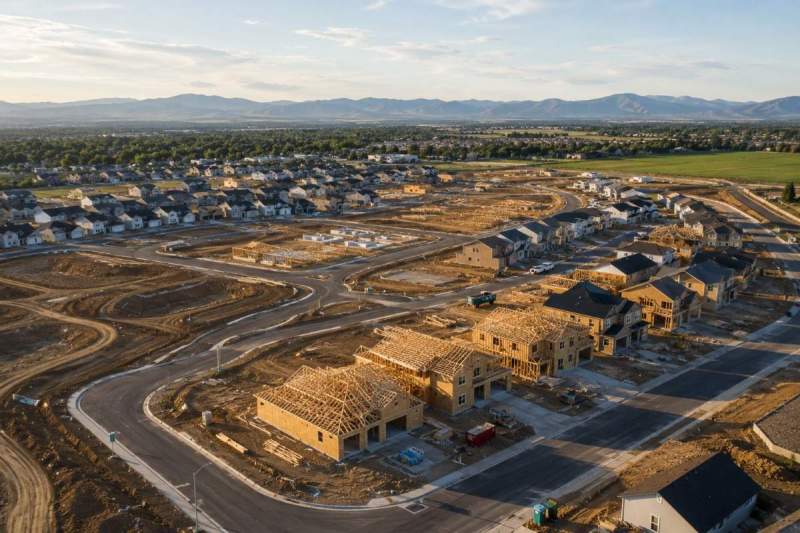
For production builders, the financing landscape has long been fragmented, with construction financing and land acquisition each carrying their own lending dynamics and constraints.
“The challenge today isn’t access to capital—it’s where capital is needed most,” says Dan Gushman, head of Eastern Originations for Anchor Loans. “Financing for vertical construction has become increasingly accessible. It’s the long, drawn-out process of deploying capital into land that’s more challenging.”
For many production builders, that means finding ways to keep investing in future communities without tying up unnecessary equity in today’s land position.
Credit conditions on residential land acquisition, development, and construction loans have tightened for 17 consecutive quarters, according to NAHB’s quarterly AD&C Financing Survey, driven largely by regulatory constraints that have hemmed in traditional bank lenders. For builders who rely on relationships with regional banks, the limitations can hold back their growth. Every dollar tied up in land is a dollar that can’t be used to acquire the next parcel, open the next community, or accelerate production elsewhere.
The Equity Trapped in Land Positions
Builders have historically accepted low-leverage land loans or all-equity land positions as simply the cost of doing business.
“Many don’t realize how much equity is locked up in their land position,” Gushman says. That capital could be instead recycled through multiple projects simultaneously.
While traditional banks often take a more conservative approach to acquisition and development lending, private lenders have greater flexibility when considering financing opportunities. As a result, private lenders can often finance land at higher leverage, allowing builders to preserve more of their own equity.
“The ability to unlock equity and redeploy it across multiple communities has become one of the biggest needs we’re seeing from builders today,” Gushman says. “It’s no longer just about financing one project. It’s about creating flexibility to pursue the next one.”
The Efficiency of Combined Financing
It’s common practice, especially among larger builders, to have bank lines in place that are largely geared towards construction and not land acquisition. Land is often financed separately through a different entity with its own balance sheet. That dual-track approach can cause even experienced builders to make a common mistake: focusing on lower-cost financing options for the vertical, only to end up offsetting it with either a higher-price A&D loan or a low-levered bank loan.
Private lending that covers both is often more efficient and cost-effective than working with two loans from separate lenders, where transferring funding from land to construction can trigger more paperwork as well as transfer taxes and additional fees.
The combined approach is gaining traction, Gushman says: “We’re seeing more builders recognize how much more efficient an integrated financing strategy can be.” As builders scale, financing structures often need to evolve alongside the business.
Gushman has seen successful one-off transactions evolve into long-term programmatic relationships and home builder facilities where builders can “rinse and repeat.” Whereas each new project traditionally requires starting the underwriting process from scratch, programmatic relationships and facilities create greater continuity and allow financing discussions to focus on long-term development rather than a single transaction.
Finding the Right Lending Partner
As more private capital enters the production building space, the range of lending options continues to widen. Knowing what to look for when vetting potential partners is vital. Four questions can reveal a lot about whether a lender is genuinely prepared to see a deal through.
Is your capital ample and truly committed? With private lenders, capital sources vary considerably, making it critical to understand whether a lender’s capital is truly committed. “We’ve seen cases where, last minute, the borrower finds out that capital is actually not available for their project, which puts them into a bind,” Gushman says. Pretium, Anchor’s parent company and a leading specialized investment firm with $67 billion in assets under management, provides the backing behind Anchor’s lending platform. In 2025, Anchor originated a record $5.4 billion in loans. Builders need confidence that today’s financing partner will still be standing behind the project when market conditions inevitably change.
What’s your internal process for vetting a deal? While private lenders can often bypass the regulatory speed bumps faced by traditional lenders, a deal that seems too fast to be true often deserves a closer look. “If a lender promises to rush to get you a term sheet, how can you know they have buy-in from the top to see the transaction through?” Speed matters, he says, but not as much as an executable deal. “We’re fast, but we are also diligent, in that we have investment committees, processes and oversight that we adhere to. Our decision-makers get involved early in the structuring of the deal.”
How experienced is your team? The right team can mean the difference between a lender who understands the business from the inside and one that just sees numbers on a spreadsheet. “We have former home builders, professionals from real estate investment banking, and veterans of private credit,” Gushman says. That perspective allows conversations to begin with the builder’s business objectives, not just the collateral; it shapes how deals get structured—and how problems get solved when they arise.
Can you provide references from existing borrowers? As with many areas of the industry, trust has to be earned. Proven performance matters, and references from borrowers carry weight. “Any lender should be able to connect you with existing borrowers who can speak to their experience,” Gushman says. “In an industry built on long-term relationships, reputation matters. References help validate what a lender says it can do.”
What True Flexibility Looks Like in Practice
The test of a private lender is in how they handle complex deals, being willing to flex while maintaining compliance and integrity.
Gushman recalls a recent transaction outside Nashville that required navigating an assemblage involving multiple land sellers. Mid-deal, the original sponsor passed away, introducing estate complications on top of an already intricate closing and a hard 30-day deadline imposed by one of the sellers. Despite the added complexity, Anchor ultimately brought the transaction to a successful close.
In another transaction in the Mid-Atlantic region, a well-established developer had been working through a five-year entitlement process on a massive project when their land loan approached maturity. Anchor worked closely with the sponsor to structure a refinancing solution that allowed the project to continue moving forward rather than lose momentum at a critical stage.
“Every transaction presents its own challenges,” Gushman says. “The right lending partner isn’t measured by how they perform when everything goes according to plan. It’s how they respond when the unexpected happens.”
Both deals got done because the lender was willing to engage with complex situations, take on risk responsibly, and think creatively. For experienced builders, financing is no longer simply about securing capital. It’s about choosing a partner that can help preserve momentum, protect liquidity and support long-term growth through every phase of the development cycle. A private lending partner like Anchor Loans can provide the flexibility and disciplined execution needed to keep projects moving forward.
For more information, visit: anchorloans.com.