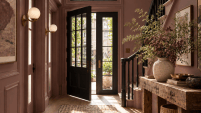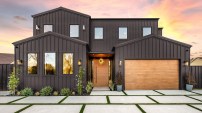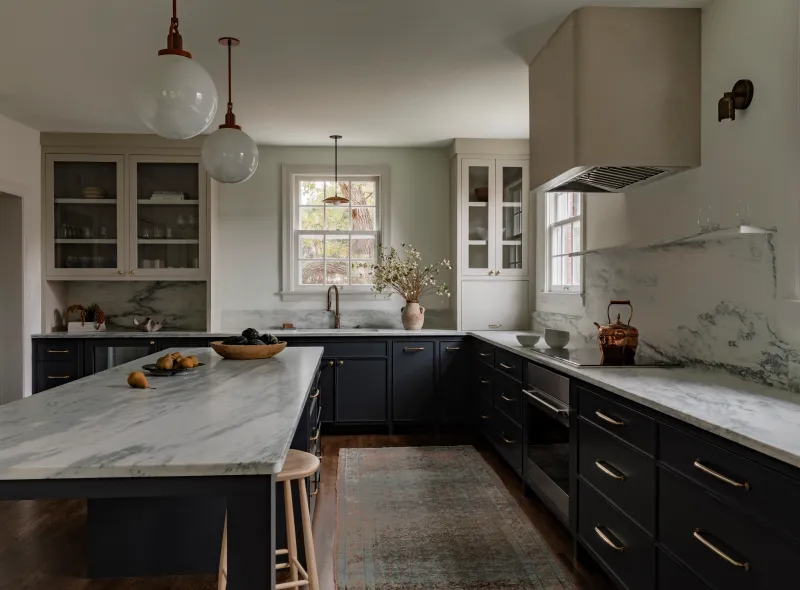
From personal travel to Pinterest boards, global design has never had a greater influence on home building in the U.S. Bolstered by overseas tourism surging past pre-pandemic levels and social media platforms where international design trends are just a screen tap away, the distance between global inspiration and American homes is quickly shrinking.
“It used to be 20 or 30 years ago that all the trends, from fashion to home building from the coasts and beyond would take five to 10 years to finally make it to the Midwest, but social media has completely closed that gap,” says Mark Williams, founder of Mark D. Williams Custom Homes, based in Minnesota.
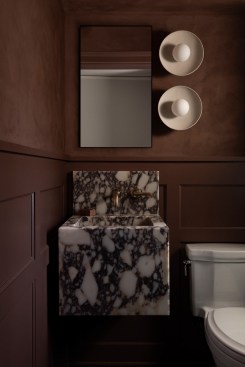
Colonial Charmer in Minneapolis, by Mark D. Williams Custom Homes. Photo by Taylor Hall O’Brien.
Real estate agents have clocked the uptick in travel-inspired interiors with buyers drawn to homes that evoke the feeling of their favorite destinations. Hospitality-driven details top wish lists with features such as wellness-enhanced spaces and natural materials that patina over time.
Form and Function
In the New American Home at the 2026 International Builders’ Show, Alair based its design plan on Scandinavian simplicity and Japanese craftsmanship. “In the kitchen and bath, we prioritized functionality but also used timeless materials and natural light so it feels luxurious in those areas,” says John Altman, co-founder of Alair Homes, based in Orlando.
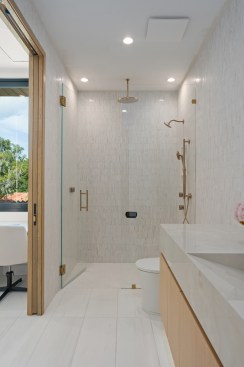
New American Home 2026 in Winter Park, Florida, by Alair Homes.
From warming rods, self-touch faucets, and digital showers to smart toilets and cold plunges, bathrooms are becoming spa-like wellness centers, Altman says. Kitchens, too, are evolving, becoming more streamlined and task-specific. Scullery kitchens are on the rise, recalling European households where messy chores were contained in a separate space. “Before, kitchens were getting kind of bulky with just tons of cabinet space,” Altman says. “Lately, we’re starting to see more concealed storage; we’re seeing a lot of prep kitchens.”
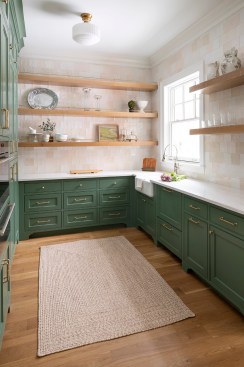
Deephaven Dream in Deephaven, Minnesota, by Mark D. Williams Custom Homes. Photo by Troy Thies.
Near Minneapolis, Williams was inspired to build a shower made of plaster after seeing a photo of a similar one in Portugal. Lime plaster naturally resists mold and bacteria and balances humidity, which played into the wellness-focused home designed by Oho Interior Design. “I brought that to the design team and asked if they could find a way to make an all-plaster shower, yet make it Scandinavian style-wise,” he says.
Materials with History
As a material, plaster also tells a story, Williams says. A plaster artist’s visible brushstrokes on the bathroom walls give a new house instant history. Likewise, the beauty of zellige tile from Morocco comes from its handmade imperfection. “You can think in geographic terms, but you can also go back in time and find out what they were using 200 years ago,” Williams says.
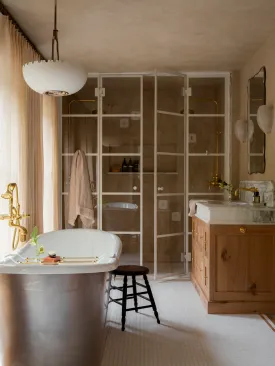
Mysa Hus in Cottagewood, Minnesota, by Mark D. Williams Custom Homes. Photo by Taylor Hall O’Brien.
Materials with a living history are also timeless. The rise in unlacquered brass fixtures and Carrara marble draw influences from the natural imperfection of English country houses. A recent Houzz predictions report found a swing toward traditional style led by English country and modern Tudor influences. Dallas-based Mallach & Company Real Estate noted a rise in Mediterranean-inspired architecture and design, with key elements including arched doorways and soft curves, natural woods and travertine, and “spaces that feel lived-in, meaningful, and unique, not mass-produced.”
Expertly integrated, timeless materials naturally trend-proof homes. Other imports, Altman warns, arrive already expired. “Highly specific tile patterns and trendy cabinet colors are going to be very fast to age,” he says. Altman’s workaround is to steer clients toward moves that are easy to undo, such as a bold light fixture over a permanent tile floor, and choices that never seem to leave, like a white shaker cabinet.
“You don’t see mahogany cabinets coming back at all,” he says. “But white cabinets— they’ve been around for decades and decades, and every couple of years they come right back around.”
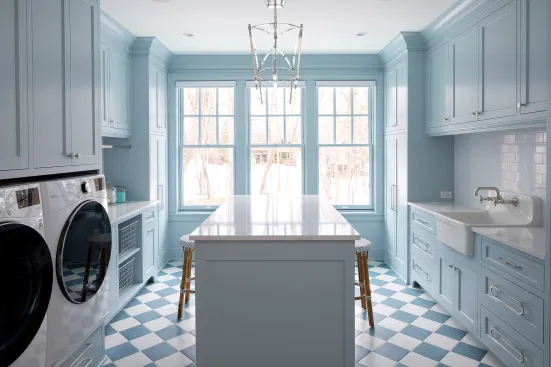
Deephaven Dream in Deephaven, Minnesota, by Mark D. Williams Custom Homes. Photo by Troy Thies.
Williams emphasizes the beauty of age. “I want things to age and to patina because we do as humans,” he says. “You can buy a really nice pair of leather shoes, and if you take care of them, oil them, maybe re-sole them, but there’s no reason why those shoes shouldn’t last. That’s what I want the house to be, to age because that’s what makes it unique.”
Knowing What Lasts
Global influence cuts two ways: Some imports settle in for good, while others cycle through as fast as a Pinterest board refreshes. Builders say part of their job now is helping clients see the difference.
Shiplap—first used to build Viking ships long before HGTV and Magnolia Network stars Joanna and Chip Gaines entered the scene—is undergoing an edit rather than a disappearance. Altman’s clients now ask for a crisper, more tailored nickel-gap version instead of the curved, farmhouse-style boards popularized a decade ago.
Williams sees the trend-versus-timeless question less as a style problem than an authenticity one. In a market increasingly saturated with AI-generated imagery and mass production, he says clients are drawn to materials and craftsmanship with a visible human hand behind them. “There’s a real call for artistry,” he says.
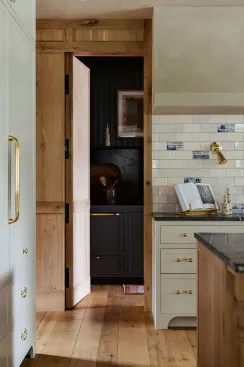
Mysa Hus in Cottagewood, Minnesota, by Mark D. Williams Custom Homes. Photo by Taylor Hall O’Brien.
In the wellness-focused home Williams built outside Minneapolis, he finished the French white oak floorboards from Belgium in linseed oil. “Nordic countries use linseed oil for their floor finishes because it doesn’t have polyurethane,” he says. The design team aesthetically enhanced the floors with inlaid eight-pointed unlacquered brass stars as “a nod toward unity and being inspired by Nordic design elements.”
A similar instinct sent him looking for a Duluth, Minnesota, artist to hand-paint the Delft-style tiles in a kitchen backsplash, borrowing a centuries-old Dutch art form with a local adaptation of Minnesota scenes. “We took a style that’s not common here, but we used a local artist to tell local stories,” he says.
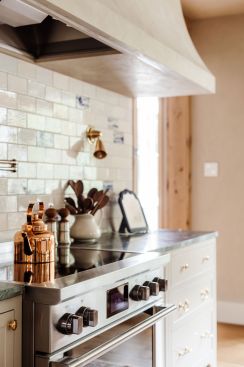
Mysa Hus in Cottagewood, Minnesota, by Mark D. Williams Custom Homes. Photo by Taylor Hall O’Brien.
As designer Scott Maddux wrote in a House & Garden essay, adapting a global idea to the local vernacular is key to integrating inspiration as if it’s always been there. “It is not about imitation, but about evolution,” he writes. “There is nothing more exciting that finding something for the first time and understanding why it works in its original setting and how it can then be translated—not replicated—into a new context.”
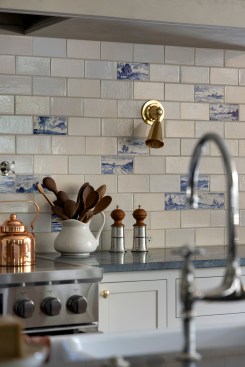
Mysa Hus in Cottagewood, Minnesota, by Mark D. Williams Custom Homes. Photo by Taylor Hall O’Brien.
In that way, global design influences that transcend trends are more about larger movements, Williams says. “As home builders, we have a huge influence about how people feel in their homes,” he says. “If you only stick to the culture you’re in, then you’re only ever going to do what’s been done there. What’s unique about that?”