
For decades, the housing market has been built around a predictable lifecycle of married couples progressing from entry-level homes to move-up opportunities and eventual downsizing. While that framework still holds relevance, it no longer reflects the full spectrum of demand. A growing share of U.S. households now consists of individuals living alone, a shift that is changing how housing demand forms and where opportunities emerge.
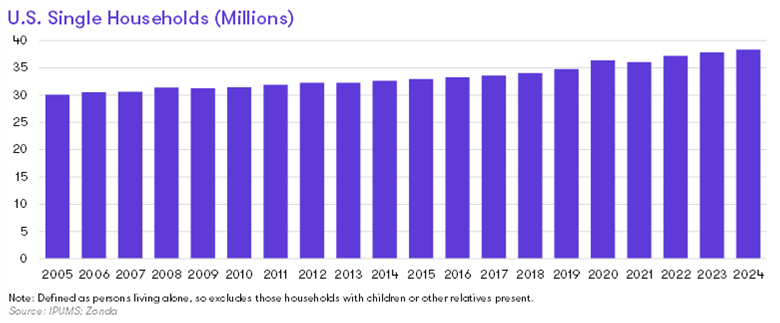
Recent analysis of Census Bureau data shows that adults living alone with no children accounted for 38.3 million households in 2024, or nearly three in 10 households nationwide. This expansion is not driven by a single factor. Instead, it reflects a mix of delayed marriage, increasing longevity, higher levels of education and career attainment, particularly among women, and evolving cultural norms that make solo living more common and accepted.
Historical Trends
The significance of single-person households becomes even clearer when looking at growth trajectories. Over the past decade, this segment expanded at a faster pace than the overall household base, increasing by 17.6% between 2014 and 2024 compared to 11.1% growth in total households. As a result, individuals living alone have accounted for a disproportionate share of new household formation.
Builder Implications
Importantly, each new single-person household represents demand for its own housing unit, but the types of units desired may differ from traditional family housing. Builders should consider how product offerings can better serve this segment, including smaller footprints, lower maintenance options, and proximity to employment centers, amenities, and transit.
As the number of individuals living alone continues to rise, the housing market will become less dependent on traditional family-based demand cycles. Instead, it will increasingly reflect a diverse mix of lifestyle preferences and financial constraints. Builders and investors who recognize and adapt to this shift will be better positioned to capture demand in both established and emerging markets.
The insights in this article were taken from more in-depth research reports published in Zonda’s National Outlook.