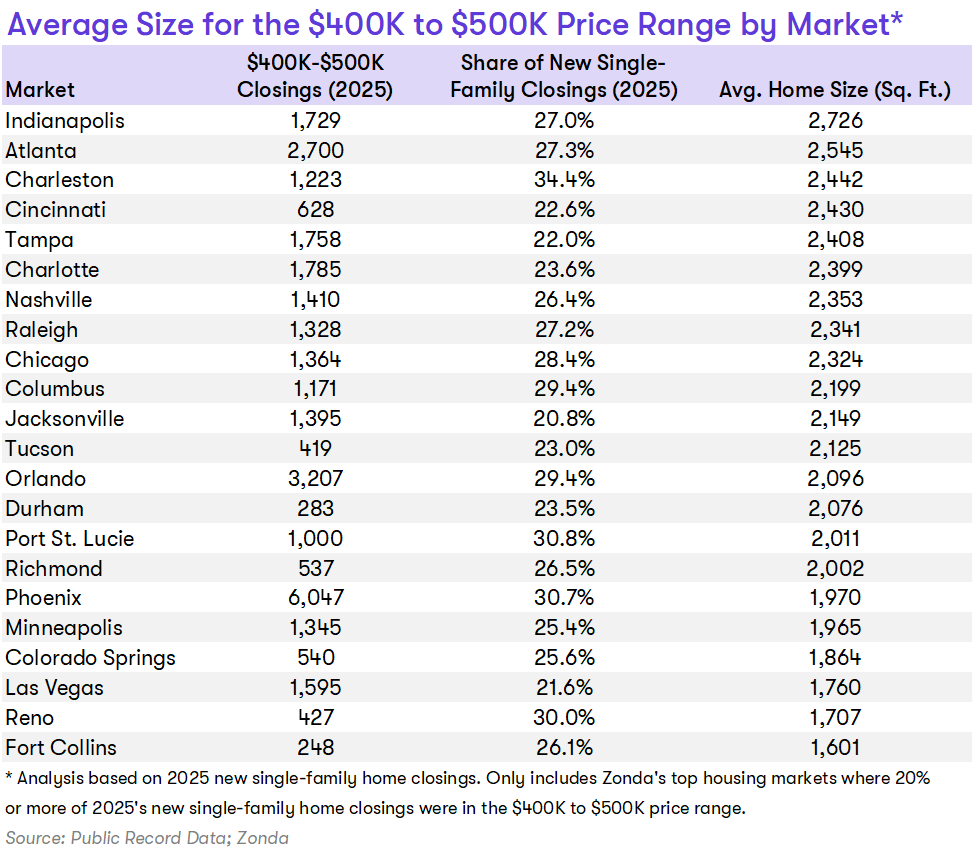
Using Zonda’s proprietary housing data, this analysis examines average home sizes for new single-family closings in the $400,000 to $500,000 price range across top U.S. housing markets in 2025. To ensure relevance, the analysis is limited to markets where this price band accounted for at least 20% of all new single-family home closings.
The results are tabled below and give a clear look at how builders are balancing price points, land costs, regulation, and buyer expectations in markets where this range represents a meaningful share of activity.
Size Premiums Persist in Midwest and Select Southeast Markets
Among the markets analyzed, Midwestern metros continue to deliver the highest square footage for the price. Indianapolis leads the list with an average home size of 2,726 square feet for closings in the $400,000 to $500,000 range. Cincinnati, Chicago, Columbus, and Minneapolis also rank near the top, with average sizes comfortably above 2,000 square feet.
These markets benefit from relatively lower land and construction costs, allowing builders to offer larger homes while still hitting midrange price points. For buyers, this often translates into more bedrooms, flexible living spaces, and home offices, features that remain in demand even as affordability pressures persist.
Several Southeast markets also post above average sizes. Atlanta, Charleston, Nashville, Raleigh, and Charlotte all record average home sizes between roughly 2,350 and 2,550 square feet in this price range. In these metros, strong in-migration and sustained job growth continue to support demand, while builders adjust product to remain competitive amid rising costs.
Sunbelt Affordability Shows up in Smaller Footprints
At the other end of the spectrum, many Western and high growth Sunbelt markets show noticeably smaller homes for the same price range. Phoenix, Las Vegas, Reno, and Fort Collins all report average sizes below 2,000 square feet, with Fort Collins averaging just over 1,600 square feet.
These markets face higher land prices, stricter development constraints, or both. As a result, builders are often forced to trade square footage for location, amenities, or community features. The data suggests that buyers in these markets are increasingly accepting smaller homes in exchange for access to employment centers, lifestyle appeal, and newer product.
Florida presents a mixed picture. Tampa, Orlando, Jacksonville, and Port St. Lucie all meet the 20% threshold, but average home sizes cluster closer to the national middle. While still smaller than Midwestern counterparts, these homes generally remain above 2,000 square feet, reflecting Florida’s balance of affordability pressures and buyer expectations for space.
What the Data Means for Builders
Value for money is becoming a stronger priority for consumers amid elevated costs across the economy. Markets that still offer relative affordability are best positioned to capture in‑migration and rebound more quickly as consumer confidence improves. In lower cost markets, larger home footprints remain a competitive advantage. In higher cost metros, efficient layouts, thoughtful design, and amenity driven communities are increasingly critical to sustaining absorption.
Similar insights to this article can be found on Zonda’s National Outlook portal.