
Household Formation Is Changing
The long-running decline in U.S. fertility is not a new story, but the composition of families has evolved in more nuanced ways than a simple drop in birth rates. Comparing women ages 40 to 44 in 1980 versus 2024 highlights how the share of women with children, and the number of children they have, has shifted across demographic groups, with important implications for housing demand and product strategy. These 1980 versus 2024 comparisons are shown below.
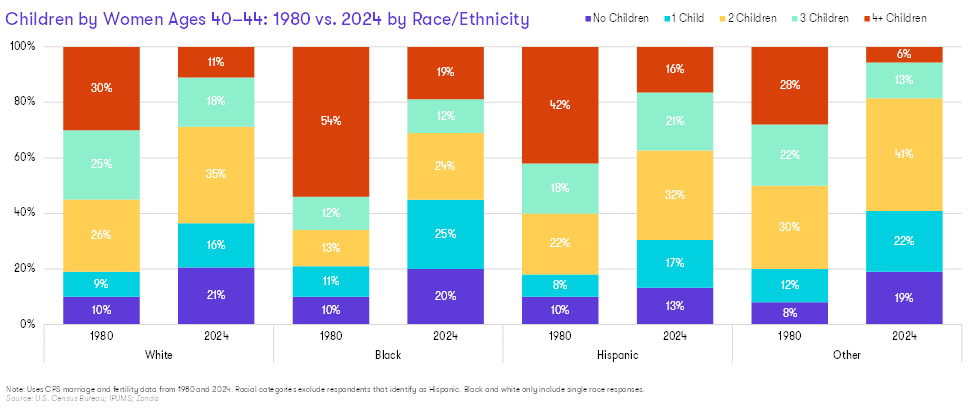
Across all groups, the share of women reaching their early 40s without children has increased meaningfully. For builders, this reinforces the idea that household formation is no longer synonymous with family formation. More households are being created without children, supporting demand for smaller homes, attached product, and rental housing even at older ages.
Smaller Families Across Groups
Among white women, the share with no children roughly doubled between 1980 and 2024, while the share with three or more children declined. Two-child households remain common, but they now account for a smaller portion of the population than they did four decades ago.
Black women show a similar shift toward smaller households. Larger families were more common in 1980, but by 2024, one- and two-child households had become far more prevalent alongside a noticeable increase in childlessness. This points to smaller average household sizes over time, even in groups that historically supported larger households.
Hispanic women continue to have higher fertility overall, though family sizes are moderating here as well. Larger families remain more common than among other groups, but the share with four or more children has declined since 1980. Two-child households now represent the largest share, while one-child households have also increased.
The “other” race and ethnicity category reflects a similar story of convergence: higher childlessness, fewer large families, and greater concentration in one- and two-child households.
Why This Matters for Builders
For the home building industry, these trends reinforce several realities. Demand for large homes designed around four or more children will likely continue to narrow as a share of the market (though regional differences are important here). Flexible floor plans that can accommodate home offices, multigenerational living, or lifestyle uses will become increasingly important as fewer rooms are dedicated solely to children.
At the same time, household formation can remain healthy even as fertility declines, supporting housing demand in a lower-birth environment. Understanding not just how many households are forming, but what those households look like, will be increasingly important for builders planning communities over the next decade.
Similar insights to this article can be found on Zonda’s National Outlook portal.