
As builders look to capture growing demand from older homeowners, the assumption is often that active adult buyers want a fundamentally different product than the broader market. New-home data suggests the reality is more nuanced.
A comparison of active adult and conventional new-home listings from September 2025 through August 2026 on NewHomeSource shows that builders largely rely on the same housing formats across both segments. Detached homes accounted for 82% of active adult listings and 83% of conventional listings. The differences begin to emerge in size, pricing, and floor plan configuration.
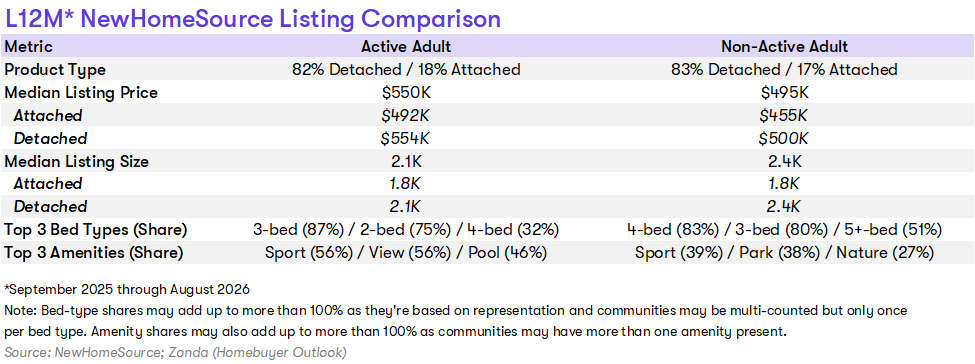
Active adult homes carried a median listing price of $550,000 during the 12-month period, compared with $495,000 for conventional new construction. At the same time, active adult homes were smaller, with a median size of 2,100 square feet versus 2,400 square feet for conventional listings.
Rather than maximizing home size, active adult communities appear to focus on offering the right amount of space while pairing homes with lifestyle-oriented amenities and community features.
The clearest distinctions show up in bedroom counts.
Three-bedroom homes were the most common active adult offering, appearing in 87% of communities analyzed. Two-bedroom homes also had a significant presence, while four-bedroom homes appeared less frequently.
Conventional communities, meanwhile, remained heavily oriented toward larger family households. Four-bedroom homes were the most widely represented product type, and homes with five or more bedrooms appeared in more than half of communities.
“Amenities may ultimately be where active adult communities create the greatest separation,” said Ali Wolf, chief economist for Zonda and NewHomeSource. Sports amenities, views, and pools appeared most frequently among active adult listings, while conventional communities were more likely to emphasize parks and nature-oriented features.
The insights in this article were taken from more in-depth research reports published in Zonda’s National Outlook subscription.