Today’s home builders face increasing pressure to deliver higher-performing homes on tighter timelines amidst an ongoing labor crunch. At the same time, evolving energy codes and homeowner expectations are driving more complex building assemblies, from deeper floor systems to larger HVAC runs and improved insulation requirements.
“One of the big challenges that builders face today are schedule constraints. So, days under construction is a very key metric that builders are tracking,” says Phil Harms, vice president of building solutions for MiTek.
Traditional stick-built framing often adds a lot to that metric, because it requires crews to make adjustments in the field, where jobsite conditions, weather, and trade coordination can introduce variability and delays.
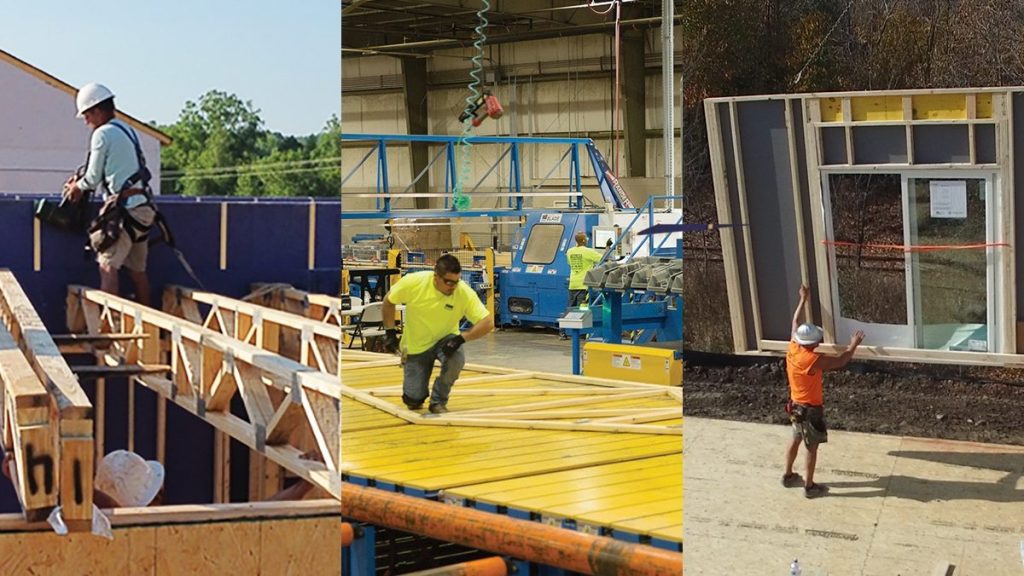
That’s why many home builders are increasingly turning to off-site framing systems, such as open web floor trusses (OWFT) and other manufactured components, including wall panels and roof trusses. These solutions are engineered for efficiency and predictability, helping builders move away from the “field-engineering” mindset that slows projects down.
Along with digital collaboration tools, these integrated off-site systems lead to:
- 60% faster framing.
- 33 times less jobsite waste.
- 33% few hangers.
- 20% faster MEP installation.
- 25% less wood product.
- $830 in floor savings per home.
“With off-site framing, you can put up floors, roofs, and walls in a matter of days, versus a matter of weeks with traditional framing,” Harms says.
Here are five ways off-site framing systems help achieve those outcomes—and how they’re helping builders improve efficiency, quality, and predictability across the home building process.
1. Greater Predictability and Quality
Prefabricated components like OWFT deliver consistency and quality that field-built framing simply can’t match. Factory-controlled manufacturing reduces variability such as weather, crew differences, and site conditions. Trusses are manufactured off-site to the exact dimensions, which means no on-site cutting, making the job much safer for the framer. Other features, like top-chord bearings, can simplify and speed up installation.
Unlike field-built framing, prefabricated components are manufactured in a controlled factory setting to exact engineered requirements. This allows builders to rely on standardized processes and repeatable quality. Factory-built components then arrive on site ready to install, reducing uncertainty and helping framing crews work more efficiently.
“The walls, the roofs, and the floors are all built to precision versus having multiple carpenters out in the field yelling down a measurement from the second story down to a carpenter on the ground making the cuts,” Harms says. “It’s much more efficient all around.”
2. Faster Jobsite Cycles and Reduced Field Rework
Today’s home builders still rely heavily on “field engineering”—leading to a lot of conflict and rework. But off-site framing across floors, walls, and roof structures allows early collaboration among engineers, architects, construction managers, and mechanical trades, which surfaces those problems before they turn into rework and delays. Combining that process with integrated product design (IPD) improves quality, reduces waste, and allows for seamless integration of high-performance, sustainable, and smart-home features.
By contrast, traditional framing often requires adjustments once mechanical, plumbing, and electrical trades begin installation. These conflicts typically slow progress and lead to costly rework.Prefabricated components shift many of these decisions upstream, allowing teams to resolve design issues before materials arrive on the jobsite.
“It really comes down to improved collaboration between the builder and trades and allowing everybody to have a voice so that the field execution goes flawlessly,” Harms says.
3. Better Accommodation for Modern Mechanical Systems and Codes
Shifting energy codes and comfort expectations require larger ducts, deeper floor systems, and more insulation. OWFT and prefabricated trusses provide more predictable mechanical routing, sound, and vibration performance along with more flexibility to meet code requirements than stick-built approaches.
The reality is that larger HVAC ducts, increased insulation requirements, and growing expectations around comfort and energy efficiency all place greater demands on floor assemblies.
Open web floor trusses are designed to address these challenges by creating open pathways for mechanical systems to accommodate the variability of code requirements and comfort demands. This approach helps trades route ductwork, plumbing, and wiring more efficiently—reducing installation time while protecting the structural integrity of the framing system.
“It really helps to give you that flexibility to meet the comfort needs, which then also translates down to a better-performing house for the homeowner,” Harms says.
4. Earlier Collaboration and Coordination Across the Building Team
Builders measure cycle time and direct costs, but framing efficiency and hidden design/rework time across trades are rarely quantified. Prefabrication moves decisions upstream and resolves many choices digitally, cutting field improvisation—and significantly improving productivity and quality.
That’s because off-site framing encourages earlier collaboration among project partners. By coordinating framing layouts with engineers, architects, component manufacturers, and mechanical trades during the design phase, builders can address potential conflicts before construction begins.
“If you can solve the problem digitally up front on where the different trades are going to run their respective product or activity through the different floors and walls, it really eliminates the need for rework in the field,” Harms explains. “You solve it with the mouse instead of a saw.”
5. Smarter, Faster Decision-Making With Digital Tools
Modern design software and 3D coordination allow engineers to test options instantly and expose conflicts earlier. Components and 3D modeling reinforce each other to increase predictability and reduce costly surprises in the field.
Using these 3D modeling systems allows builders and engineers to quickly evaluate variables such as mechanical chase locations, floor depths, and framing layouts well before any field work begins.
“For example, in a 3D model, you can see if your plate height is different than what is drawn. You’re able to solve for those discrepancies before a single board shows up on the jobsite,” Harms says. “When you solve it digitally, you’re solving it in a matter of minutes or hours versus days or weeks.”
A Broader Shift in Home Building
Off-site framing systems are not simply about moving construction into a factory. They represent a broader shift toward earlier collaboration, digital coordination, and system-based thinking across the home building process.
And builders don’t need to manufacture components themselves to capture these benefits. In many cases, strong partnerships with component manufacturers can provide the expertise and coordination needed to successfully integrate off-site framing into the building process.
“There is an extremely large network of very talented and value-added component manufacturers in the marketplace,” Harms says. “As more builders adopt off-site framing, the speed, affordability, and quality it produces will increasingly become a competitive differentiator. It’s just a better way to build.”
For more information, visit https://www.mii.com/builder/