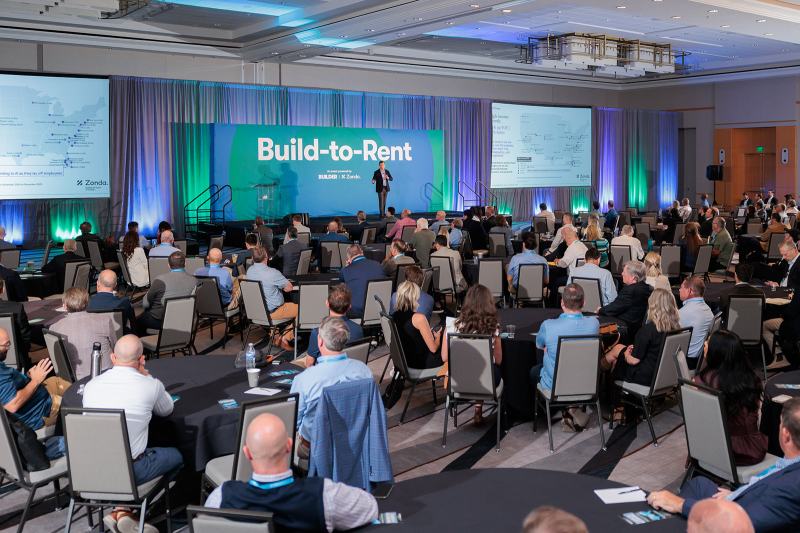
Zonda’s annual Build-to-Rent (BTR) conference couldn’t have come at a more interesting and critical time for the industry. As the House mulls the 21st Century ROAD to Housing Act, with provisions that could dramatically impact the BTR pipeline, Zonda’s vice president of economic research, Sean Fergus, sat down with National Rental Home Council (NRHC) president and CEO Adrianne Todman. With policy risk rising both nationally and locally, advocacy has become a central focus of Todman’s work on behalf of the industry.
Below we’ve distilled some of Todman’s key takeaways, as well as other themes that recurred throughout the BTR conference from other industry leaders.
- House versus Senate dynamics. There’s been more reception on the House side to remove or exempt BTR from the disposition concept, with advocacy efforts focusing on legislative language that keeps the broader bill pro‑supply.
- State-level risk is not a side show; it’s the next front. Todman and multiple panelists highlighted a “precedent fear” that if one restrictive template passes anywhere, it can travel quickly across states. Georgia, Tennessee, and North Carolina have toyed with anti-BTR legislation.
- Policy uncertainty is now the dominant pricing input, often outweighing market fundamentals in investment committee discussions. Multiple speakers described capital as willing to engage with the sector but unwilling to accept underwriting assumptions without clearer policy rules.
- Lawmakers misunderstand BTR/SFR financing and hold periods. Several speakers noted policymakers incorrectly assume rental homes can simply be sold off individually after a fixed term, underestimating how community operations, financing, and business plans are structured.
- Conditions need to change for the supply pipeline to rebound. The most repeated catalysts for reopening capital flows were: reduced legislative uncertainty and visible improvement in rent growth via decreased concessions.
What Industry Leaders Can Do Now
With the current level of uncertainty, advocacy remained a consistent theme throughout the conference. Speakers emphasized that district-based touchpoints and coordinated trade group engagement have proven effective in shaping how lawmakers perceive the industry.
To influence the conversation, Todman encouraged all attendees to contact their House representatives directly. For those uncertain of the best approach, organizations like the NRHC provide advocacy resources, including sample letters designed to streamline communication with legislators.
For those who believe this policy would do more harm than good, messaging to lawmakers should focus on the following core objectives:
- State clearly that you are calling regarding the 21st Century ROAD to Housing Act because you support efforts to increase national housing supply. Use this opportunity to explain your specific role in the housing industry and how your work provides Americans with more diverse housing options and affordability solutions.
- Step one is to encourage the bill to move to an informal conference. From there, express your support to have the disposition requirement removed entirely. At the very least, the language must be amended to perfectly exempt BTR housing from this requirement.
- It is vital to clarify to lawmakers that BTR homes do not take opportunities away from first-time home buyers. Instead, these communities add much needed supply for families across the country who require flexibility in their housing. By positioning BTR as a secondary engine for supply rather than a competitor to traditional ownership, the industry can better align with broader legislative goals for affordability and availability.
Taken together, the themes from Zonda’s BTR conference underscore a pivotal moment for the sector. Capital is not gone, demand fundamentals have not disappeared, and the supply need remains acute; what has changed is the weight of policy risk in decision making. Successful advocacy efforts will be important for stabilizing investment expectations, protecting future housing supply, and ensuring that BTR remains part of the solution to America’s longer-term housing shortfall.