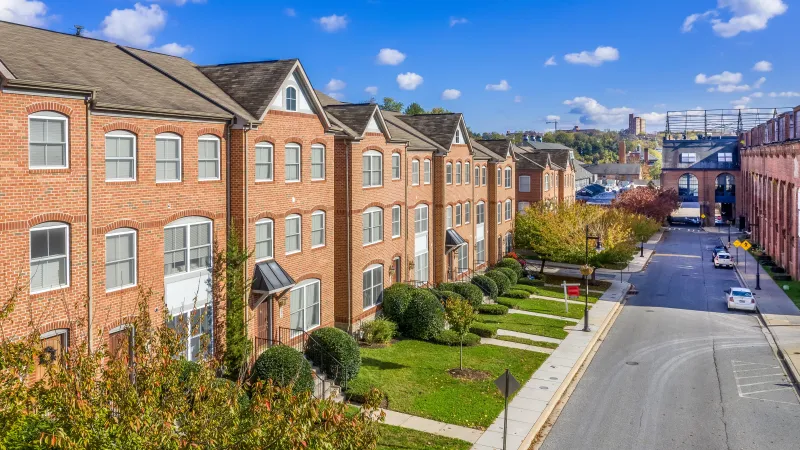
Annualized new-home sales declined 5.2% in September to 2,613 units. Attached housing accounted for 1,951 sales versus 662 detached sales during the period. However, the Baltimore market is sending mixed signals as 2026 winds down. By comparison, the market’s average new-home sales rate of 2.4 homes per project matched Maryland and remained above the national rate of 2.0.
That aforementioned product split is one of Baltimore’s defining characteristics. Annualized attached sales fell just 0.9% year over year compared with a 16% decline for detached homes as of September data. The strongest sales activity also sits toward the more attainable end of the new home market, with attached homes priced from $350,000 to $450,000 experiencing the most closing activity over the past year.
Related, affordability remains a constraint. As of July, the median new-home closing price stood at $555,337, down 2.9% year over year, compared with $420,000 for existing homes.
The economic backdrop adds another layer. Total nonfarm employment in the Baltimore metro declined 0.6% year over year in August, while the unemployment rate was 4.1%. Households are estimated to decline 0.1% in 2026 and post flat annual growth through 2028.
One potential longer-term catalyst comes from defense manufacturing. Anduril Industries announced a $3.7 billion investment in a high-tech shipyard at Baltimore County’s Tradepoint Atlantic industrial center. The project is expected to create 3,100 direct jobs and support more than 11,000 indirect jobs, while generating more than $2 billion in annual economic output.
Baltimore’s opportunity is therefore less about broad based growth and more about positioning. Ideal locations, attainable price points, and disciplined starts stand out in a market where buyers are still active but increasingly selective.
The insights in this article were taken from more in-depth market reports published in Zonda Enterprise.