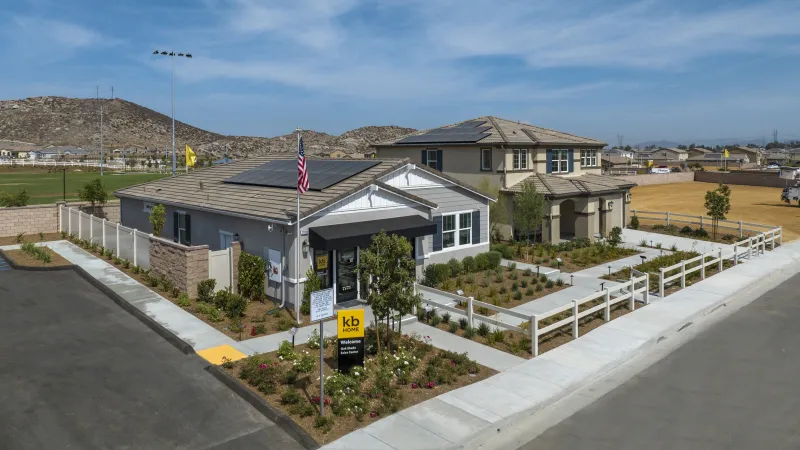
Against the backdrop of affordability challenges, demand uncertainty, and weak consumer confidence, KB Home’s shift toward a higher built-to-order (BTO) mix is providing cost visibility, delivery certainty, and limiting risk. Despite year-over-year declines in deliveries, revenue, and profit, KB Home achieved its target of a greater BTO mix in the third quarter, with nearly three-quarters of quarterly deliveries coming from BTO homes.
“Our built-to-order model was designed to perform in exactly these conditions. While we are not immune to the pressures in the operating environment, our approach did what it was supposed to do in the third quarter,” CEO Rob McGibney told investors during the builder’s third quarter earnings call. “It enabled us to sell before we build, know our costs before we commit capital to vertical construction, and keep our inventory risk low as demand softened.”
The shift in mix helped drive sequential margin improvement and deliver KB Home’s first year-over-year backlog increase in four years, ending the quarter with 4,398 homes in backlog. However, the builder noted that conditions weakened through the quarter, with resilient June sales turning to soft July and August traffic. As a result, net orders declined 12% year-over-year to 2,604 homes.
BTO Model and Emerging Tailwinds
BTO homes accounted for 74% of third-quarter deliveries for KB Home, up from 60% in the prior quarter and achieving the company’s 70-30 mix target ahead of expectations. The builder now expects future delivery mixes to remain within its targeted historical range as divisions have increasingly aligned around the BTO-heavy strategy.
By selling homes before starting vertical construction, McGibney said KB Home can lock in buyers and gain greater visibility into demand before committing capital. The approach also allows the builder to determine costs before breaking ground and avoid carrying large amounts of spec inventory into a slower demand period.
“We build the home the buyer wants with the features, finishes, and ultimately a sales price that reflect the buyer’s preferences for what they value and want to pay for,” McGibney said. “Those choices are key differentiators relative to an inventory home and also give our buyers a real tool to manage affordability, which is one reason our homes do not require heavy incentives to sell.”
While also delivering a value-add to buyers, the BTO approach also protects KB Home’s business, according to McGibney. The builder’s total unsold inventory represented 26% of production in the third quarter, down from 41% a year ago. Finished unsold homes represented just 9% of total inventory, down from 16% the year-prior.
“We also have roughly 1,110 homes sold but not yet started. That illustrates our BTO approach at work, building homes for buyers who have already committed, not for buyers we hope to find,” McGibney said.
Construction cycle times also improved during the quarter, with BTO homes averaging 99 days from start to completion during the quarter, down 23 days year over year. The faster build times shorten the waiting period for buyers, helping lock in mortgages with greater certainty and improve inventory turns. McGibney said the company is targeting a long-run goal of 90 day cycle times for BTO homes.
“At just over three months, our buyers are not waiting long for a home built the way they want it, and they can more cost-effectively lock in their interest rate than they could when build times were longer,” McGibney said.
At the same time, KB Home is also experiencing lower direct construction costs on started homes, attributing the improvement to supplier relationships, contract rebidding efforts, and simplified design studio offerings. However, increasing cost pressure from fuel, inflation, and tariff risks are likely to provide upward pressure on costs in the fourth quarter.
Difficult Backdrop Challenges Results
Despite operational gains and tailwinds from a BTO model, executive chairman Jeffrey Mezger reiterated the market factors challenging results and the housing market. Higher interest rates, persistent inflation, and broader economic uncertainty all worked against the sector during KB Home’s fiscal third quarter.
“Affordability is under further pressure due to rising mortgage rates. Inflation remains persistently high, driven in part by fuel prices, which prompted the Federal Reserve to raise interest rates last week,” Mezger said. “These factors, as well as geopolitical uncertainty and broader economic headwinds, have resulted in consumers becoming more cautious about buying a home.”
During the quarter, revenue fell 20% to $1.3 billion while deliveries declined 19% to 2,732 homes. The builder’s profit dropped 41% to $65.3 million while profit per share fell to $1.05 from $1.61. In addition to a contraction in orders, monthly orders per community fell to 3.1 from 3.8 in the prior-year period.
Mezger and McGibney also both highlighted the growing challenge the resale market is presenting. Mezger noted the increase in resale inventory and declining existing-home prices, particularly in Texas and Florida markets, are both emerging headwinds for KB Home.
“I think in a lot of cases for the last couple years, there have been a lot of listings on the market, depending on what part of the country you’re in, but they’re listed at really high prices, probably not realistic,” McGibney said. “I would call them the ‘make me move’ type of price. I think we’re starting to see maybe the sellers get a little less patient with that and starting to adjust.
“We certainly have to stay tethered to that with our pricing because it has and likely always will be one of the biggest competitors that we have out there for our product,” McGibney continued.