Fresh off its July public listing, Boxabl is expanding beyond manufacturing and making a deeper push into development, installation, and potentially acquisitions. The Las Vegas-based company is evolving is product portfolio into a second phase as it preps for another factory that will ramp up mass production even further.
BUILDER caught up with founder and co-CEO Galiano Tiramani to discuss the company’s direct-to-consumer ADU strategy, a reported 1,500-box order, plans for a larger product lineup, and how Boxabl hopes to drive down housing costs through greater vertical integration
One of the things that caught our attention recently was Boxabl’s push into development and contracting. What’s driving that move?
That’s always been part of the plan. Sometimes our customers are builders who want our product to make their process easier, and sometimes they’re people who want the full package because they have a specific use case.
What really encouraged us to move faster was our direct-to-consumer ADU business was that we realized the only way we were going to push costs down was to take over more of the installation process.
So, we hired our own general contractor, which gives us the ability to legally hire subcontractors. We’re diving into that process now, and I think we’re going to see significant savings.
Do you have any projects underway yet, or is this still in the planning stages?
We’ve been ramping up direct-to-consumer ADU sales, and that’s been going well. We’re getting more and more deposits, almost every day now. That side of the business is scaling up, and we’re adding employees to support it.
We’ll probably have a few more announcements on the contracting side. Eventually, we’ll also look at acquiring companies that perform related functions, whether that’s crane operations, trucking, or other services we need to continue lowering costs.
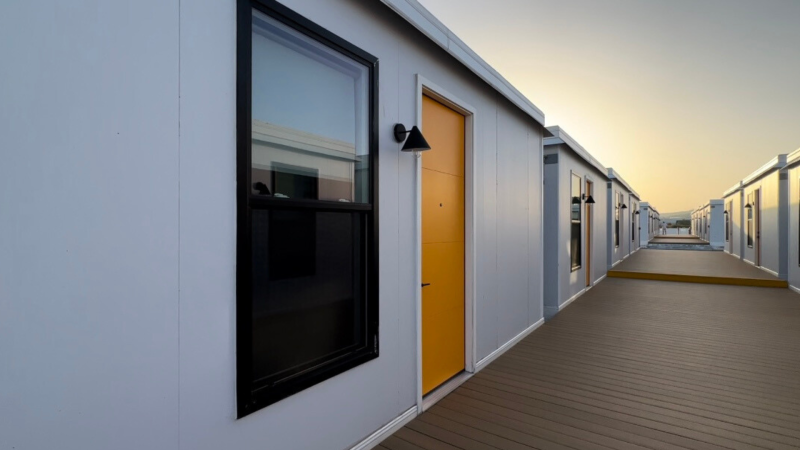
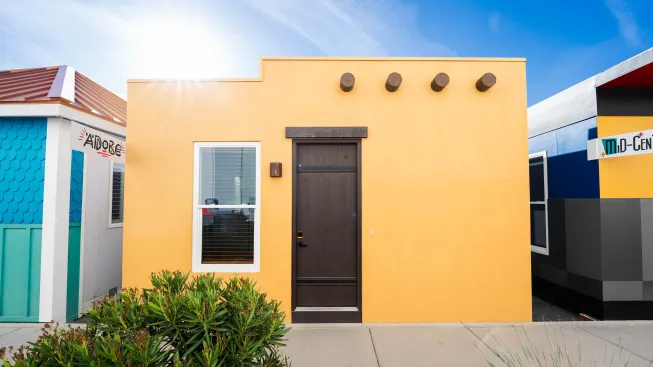
We also have a new product that hasn’t really been launched yet. It’s on the developer page of our website, but people don’t realize we’re planning to offer it as a backyard ADU. It will be a two-bedroom product and it’s going to be significantly cheaper.
Courtesy Boxabl
What kind of efficiency gains and cost savings do you expect as this kicks off?
There are two sides to it. On the product side, we’re transitioning into what we call Phase Two. That involves the additional module sizes that connect together to create different building types, as well as changes to how we build, the equipment we use, and the materials we use.
Then there’s the installation side. When you combine those efficiencies over the next few months, the impact will be really significant. We plan to reprice everything, and I think it’s going to be pretty crazy. I don’t think anyone will be close.
If you want to buy an ADU in California, you’ll either use Boxabl or pay roughly double because you want something more custom. Most people are price-sensitive, especially when the difference is that large.
How does the contracting rollout work given the regulatory environment and state-by-state approvals?
It’s tricky because in some states we can’t even hire a contractor without being a general contractor ourselves. In those cases, the customer has to hire the contractor.
We’re starting in California. That’s where we’re focusing our ADU efforts. We don’t advertise in other states right now because California is simply easier. The state wants ADUs, they’ve changed the rules, they’re encouraging them, and there’s less friction.
As other states pass laws that support ADUs, we’ll focus on those markets, obtain contractor licenses where necessary, and expand. If this rollout goes well and we learn what we need to learn, we’ll start ramping up in other approved states.
Boxabl went public in July. What does that change for the company?
Going public was a lot of work. It took a lot of time and it was very expensive, but now we have far more resources available to scale.
One major change is capital raising. I think it will be easier, and more importantly it will require less of my time. Previously I got pulled into fundraising constantly, which took focus away from other priorities.
The other big benefit is being able to use public-company stock for acquisitions. A lot of business owners want liquidity, and an acquisition by a public company can be a shortcut to that.
Is mergers and acquisitions activity a priority moving forward?
Absolutely. We want to go hard on mergers and acquisitions because we want to grow inorganically and acquire the functions needed to solve housing beyond manufacturing alone.
Courtesy Boxabl
Where do larger homes and the broader product lineup stand today?
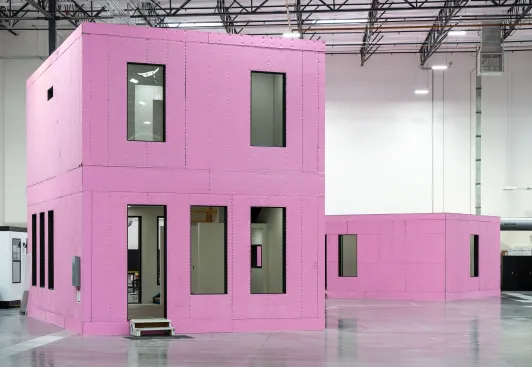
We’ve built out the rest of the system that has always been part of the plan. We now have three box sizes and predefined configurations on our website, but customers can also create many other configurations.
We’ve already received our first orders. One order was for 1,500 boxes and another was for 200. As more orders come in, we’ll start production on that product line.
Internally, when we look at the numbers, we think we’re far ahead even at our current scale. We think it’s only a matter of time before the market recognizes that we can deploy housing much more cheaply than anyone else.
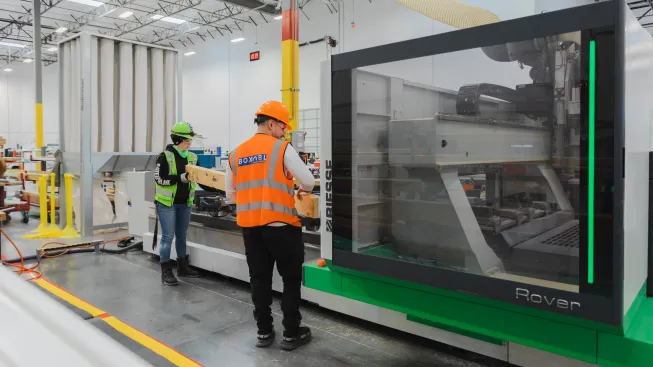
Right now, we’re adjusting the factory and moving equipment around so we can build those different box types at scale.
Remind us about the manufacturing footprint.
We have three buildings next to each other in Las Vegas totaling 400,000 square feet.
Can you talk about that 1,500-box order and what kinds of opportunities developers are bringing to you?
We get inquiries from all kinds of people, but the group behind that order has done billions of dollars in real estate development. They’re a customer we take very seriously.
It’s still early-stage. Nothing is fully locked in until permits are complete and everybody is ready to move forward. We view it as more of a partnership. They evaluated our system, ran the numbers, and concluded they wanted to find a project that works with our product.
Even if a specific project falls through, we’ll pursue others with that customer because they genuinely believe there may be a better way to build. The goal is to get that first project live, make it successful, and then double down from there.
How do you see Boxabl fitting into the home building ecosystem? Are you focused on partnerships, competition, or both?
Initially, partnerships are important. Selling a construction product isn’t easy because there aren’t that many people building compared with the number of people buying homes.
If we develop relationships with builders and support successful projects, that’s great. But if we want to reach the scale we’re targeting, which is automobile-style mass production, eventually we’ll need more demand than outside customers alone can provide.
At that point, I think we’ll end up buying land and developing large subdivisions ourselves. We’d feed those projects with a much larger factory, one that’s perhaps 10 times bigger than what we have today, with more automation, lower labor costs, and greater efficiencies.
We could also potentially acquire a home builder that already has lots, projects, and development infrastructure in place.
Courtesy Boxabl
If you could eliminate one regulatory hurdle slowing housing production in the U.S., what would it be?
The biggest one is zoning. It’s hard to justify telling property owners what they can and cannot build on their own land. It slows things down tremendously. That said, zoning isn’t going away.
What could realistically change things is a pathway to approve factory-built homes one time for the entire country. We already have something close to that through the ROAD to Housing Act. The HUD code exists, but historically homes had to be built on a chassis. Now that requirement has been removed.
We’re actively pursuing approval of a HUD-code home without a chassis. Once approved, we think that could create opportunities in places where traditional manufactured housing would not be allowed. If that interpretation holds, it could significantly reduce our costs, approval timelines, and regulatory friction.
Looking out five years, what does success look like for Boxabl?
In the next one to two years, we fully ramp up and sell out our current factory, producing thousands of homes annually. Then we begin construction on a much larger and more automated factory that removes a significant amount of labor through a larger assembly line.
From there, we start deploying into our own subdivisions and large multifamily projects across the country at extremely low cost. The numbers we’re seeing internally are very exciting.
What’s one misconception builders and developers still have about factory-built housing?
One common misconception is that factory-built automatically means HUD-code manufactured housing or mobile homes. We have to explain that our products are built to the same code as other buildings.
Another difference is that our system is based on configurable rooms that can create custom homes. Most modular manufacturers offer a fixed set of models. Our approach allows far more customization.
Anything else builders should be paying attention to?
We recently released information about AI data centers. There’s a huge amount of construction happening in that market, and we think factory production could be a good way to reduce labor requirements and improve efficiency.