
It’s not exactly breaking news: Building contractors are still facing workforce challenges, and they’re not going away anytime soon. Per an Associated General Contractors (AGC) survey in late 2025, 92% of contractors report having a hard time filling open positions.
From fewer new workers entering the trades to increased immigration enforcement, the root causes of the skilled labor shortage are ongoing, creating a situation that permeates many business decisions and facets of operations. With no significant relief on the horizon, builders are looking for any and all strategies to help them cope with current conditions and stave off disruptions and negative repercussions.
One such strategy is identifying easy-to-install, straightforward products that can help alleviate that lack of skilled labor, says Tom Baiada, product manager at Henry, a Carlisle company. “If you can minimize questions around installation techniques and compatibility with other products, that makes it easier for crews to install without wasting time or impacting quality.”
Marshall Costner, president of Costner Building Group, agrees. He recalls a time in Charlotte, North Carolina, where ICE crackdowns spooked crews and his project was at a standstill for three weeks. “We needed to be able to work quickly once it was lifted and they moved on to somewhere new.”
The Perils of Building Envelope Installation Errors
One of the most undesirable places for an inexperienced crew to make a mistake is during the installation of the building envelope. “The single biggest risk is water intrusion,” Baiada says. “That can cause a lot of damage, a lot of potential callbacks, and unfortunately a lot of litigation too.”
Common causes of envelope failure include products that are incompatible with each other, installation sequences too complex for the crew on hand, and components that are difficult to visually confirm once installed.
The Importance of Forgiving Materials
A simpler, less exacting product that makes correct installation intuitive—and can compensate and perform reliably even when it isn’t installed absolutely perfectly—can reduce exposure on all three fronts.
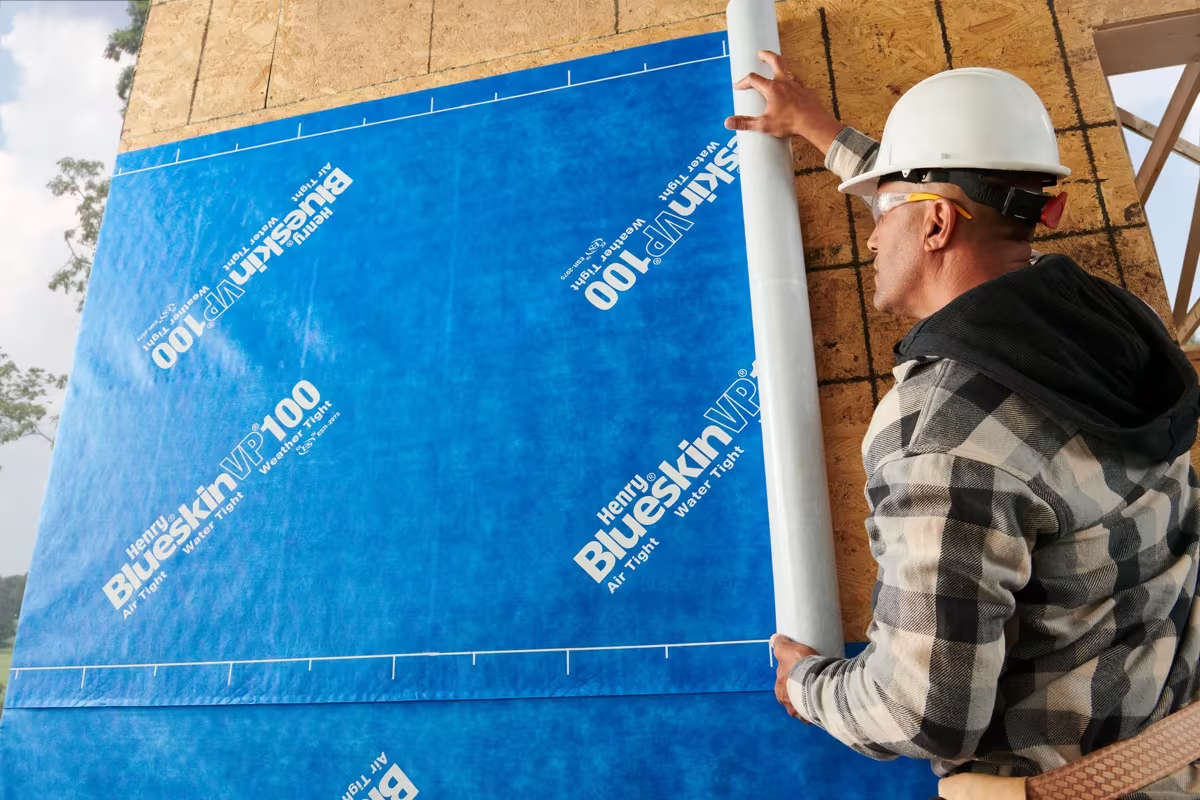
Consider what happens during cladding installation when a fastener misses a stud. Those “shiners” can go through the wall and puncture the sheathing, and each one is a potential leak point. With Henry’s Blueskin VP100, a vapor-permeable water-resistive air barrier, the self-adhering membrane seals itself around fasteners. “Without skilled trades knowledgeable and experienced enough to understand why that’s a risk factor, Blueskin VP100 provides ‘forgiveness’ for those type of mistakes,” Baiada says. “It helps mitigate the risk of moisture intrusion into the wall assembly.”
Blueskin VP100 is also a forgiving material when it comes to providing drying potential and drainability for any water that does get in, an important feature especially in warm humid climates where even a well-installed wall assembly will encounter some moisture.
In colder climates, condensation in the wall cavity is another concern. Blueskin VPTech addresses both issues in a single panel, combining a high-performance water-resistive barrier (WRB), continuous insulation, and integrated seam-sealing overlaps that create a continuous air barrier.
More Speed, Less Worries
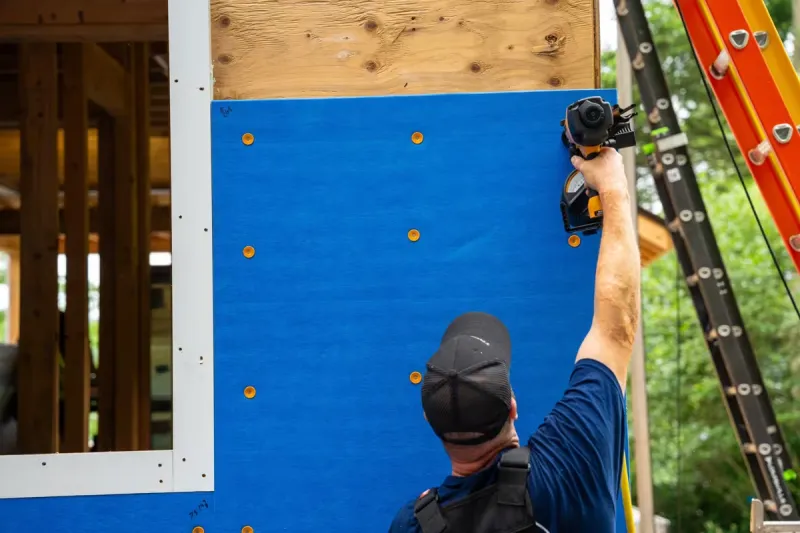
Blueskin VPTech’s integrated design also helps keep time-strapped crews from falling behind by simplifying tasks. “Instead of having two trades going around the house, I have one trade taking care of it,” Costner says. Without the need for a separate tape step, the Blueskin VPTech panel installs up to 30% faster than installing those three components separately, according to independent testing commissioned by Henry.
Checking the quality of a tape job on an upper story often means getting up close. Costner previously used a sheathing product whose tape-based sealing wasn’t easy to verify from a distance. “That made checking it from the ground harder,” he says. With Blueskin VP100, the verification is visual and can often be done from the ground. For a construction management firm like Costner Building Group, which manages installation rather than self-performing it, that ground-level visibility is a big advantage.
“The Henry products are much more forgiving than some of the other water and air barriers because it’s really easy to see whether it’s properly bonded or not,” Costner says. “If it’s adhered to the wall, it’s there.” If a section hasn’t bonded—from a dirty substrate, insufficient rolling, or incidental damage—it shows. “If it’s flapping in the wind, you know that is not right.” (The fix is straightforward, he says; cut the section off, apply a new one with the specified overlap.)
Training That Sticks
Even at the best of times, staff turnover and the rotation of crews touching the envelope make it imperative for installers to get up to speed quickly. Costner experienced the benefits of effective onboarding when a Henry rep did an on-site training for his team. “They understood what to do and were able to get up there and get going—from never having used the product to being able to install—in two or three hours,” Costner says.
The short training became something his team could replicate and pass along. “Crews are always changing out, but my construction manager was able to easily model that training to anyone who’d be doing punch and would need to seal around a penetration, including the plumber, the electrician, and the mechanical guy.”
One Manufacturer, One Call, One Warranty
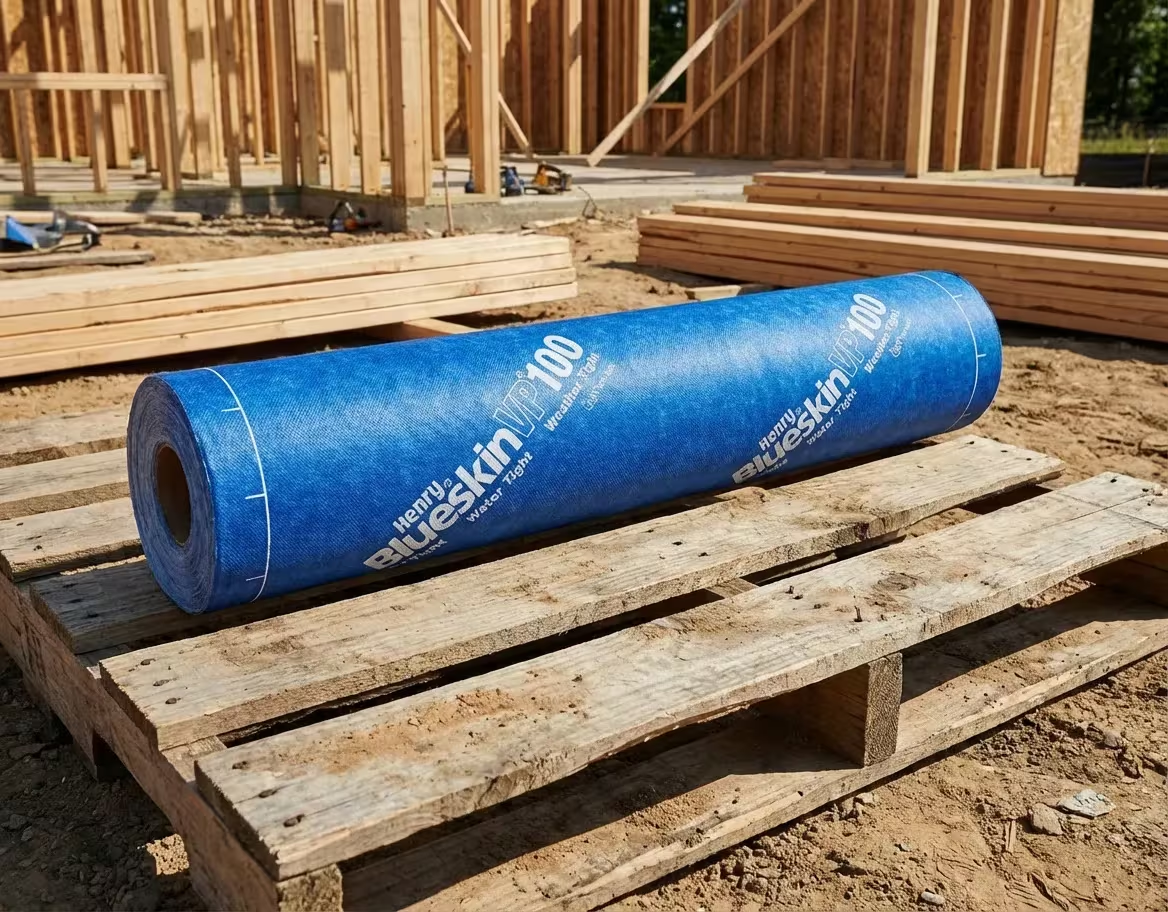
Because Henry offers a complete portfolio of weatherization products—WRB, flashing, sealant, and insulation—builders working within the system have one set of installation guidelines to follow, one contact for technical questions, and one source for material availability.
“You know up front that they’re designed to work together,” Baiada says. “You’re not trying to piece together whether this sealant needs to be installed this way from this manufacturer, and is it compatible with this other manufacturer’s product?” When a question does come up—an unfamiliar window type, a tricky penetration detail—there’s one number to call.
Costner has put that to use directly. When a crew member repaired a gash in the membrane with an off-brand tape found in the supply trailer, Costner sent photos to Henry to ask whether it needed to be replaced. “They were able to answer my question promptly.”
That single-source relationship includes the Henry 1-2-3 Moisture Control System warranty—a 15-year materials-and-labor warranty that covers the full WRB, flashing, and sealant system and includes a Henry rep job site observation to confirm proper installation. Costner considers the on-site support to be a selling point with clients. “We have premium manufacturers that come and say that we installed this properly. Clients really like that peace of mind. And it also gives a peace of mind to the builder.”
An Envelope Built for Today’s Realities
Products designed to be forgiving ease some of the burden put on smaller, less experienced crews. The skilled labor shortage isn’t going away, and the building envelope is too high-stakes a system to leave dependent on finding perfect installers. Learn more about Blueskin VP100 and Blueskin VPTech at henry.com.