Population and household growth across the Wasatch region remain positive, though the pace has clearly shifted between counties. Salt Lake County is no longer the primary growth engine it once was, especially when compared with faster growing areas such as Provo and Ogden. Household formation continues at a healthier clip than population growth, underscoring ongoing demand for housing across product types.
Employment growth is forecasted to average roughly 1.5% annually across the region, providing a stable foundation for housing demand and growth. However, attainability pressures remain elevated, shaping where and how households choose to live and pushing the market toward smaller, denser formats.
Demand Shows Signs of Life, With Caveats
Demand started 2026 in line with 2025 on an average sales per neighborhood basis. The current best sellers include the Inverness community by D.R. Horton, Sunrise Ranch by Visionary Homes, and Parkway Fields by Flagship Homes.
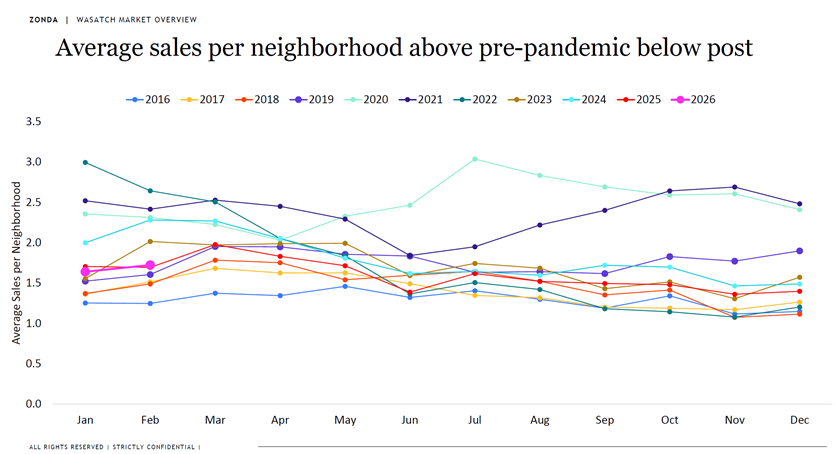
While overall foot traffic is low, the conversion rate locally is strong. This is telling us that shoppers that are stepping foot in the sales offices are typically more serious and more qualified. It further tells us that shoppers have started their sales search online making sales strategies shift for home builders targeting shoppers.
The resale market, though, poses some challenges as supply rises. Active listings have risen compared with recent years, providing buyers with additional choices and reducing overall urgency. It should be noted that pending resale contracts remain low further exhibiting that product is important in the marketplace.
While consumers generally prefer single-family detached homes, new-home supply is increasingly shaped by attached housing based on land prices, land availability, and an effort to provide an attainable base price with potential options for variation. Townhomes and other higher density formats account for a growing share of starts, pushing overall months of supply higher due to development timetables, even as detached inventory remains relatively tight. This shift has helped keep the market near equilibrium, though it has also introduced some potential mismatches by price point and product type while providing others opportunity to target specific in-demand or under-supplied products into the marketplace.
What’s Next for Salt Lake City
As growth moderates, context matters. Utah continues to outperform many metros across the West. That does not mean the market is strong today, but employment growth and in-migration remain more favorable than in most markets west of Texas. For builders operating along the Wasatch Front, success increasingly hinges on understanding today’s evolving homebuyer and staying highly responsive to pricing sensitivity and providing a personal sales experience that targets each potential shopper on-site.
The insights in this article were taken from our recent Salt Lake City Frame presentation.