
As job growth cools and international migration pulls back, new U.S. Census Bureau data highlights a housing market increasingly influenced by where Americans are choosing to move within the country. The latest domestic migration rankings point to a mix of opportunity, normalization, and growing competition across top markets.
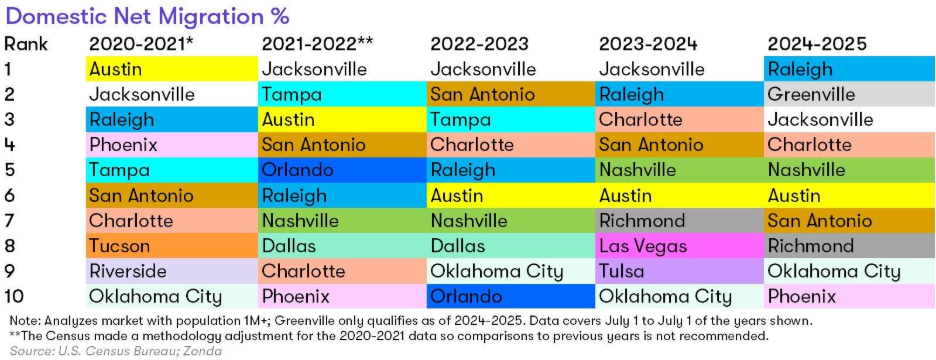
Here are Zonda’s five key takeaways based on markets of one million people or more:
- Raleigh rises to the top. Raleigh claimed the No. 1 spot for domestic migration this cycle, ending Jacksonville’s multiyear run at the top. The metro’s strength reflects a balanced combination of broad-based job growth, expanding high-income employment, and relative affordability compared with other tech and life sciences hubs.
- Greenville reaches a tipping point. Greenville officially crossed the one million population threshold in 2025, qualifying it for the rankings for the first time and immediately placing second nationally. If the metro had reached scale sooner, Greenville would have ranked near the top for several years, proving that smaller, fast-growing markets can deliver durable demand well before they reach traditional size benchmarks.
- Former highflyers are correcting. Las Vegas fell out of the top 10 as its housing market continues to correct, validating concerns raised last year. Tulsa also dropped from the rankings. These shifts reinforce that markets that run ahead of fundamentals often face periods of recalibration tied to affordability, supply, and local economic conditions.
- Growth is slowing almost everywhere. Among this year’s top five markets, only Raleigh posted faster growth than the prior year. None matched their 2022 to 2023 pace, mirroring the decline builders are seeing nationally.
- Phoenix shows how momentum can return. After slipping in recent years, Phoenix re-entered the top 10 for the first time since the 2021 to 2022 cycle. Comparative affordability, steady employment growth, and enduring climate appeal have helped the market regain traction. Phoenix illustrates how large metros can rebound once pricing and supply realign, particularly when supported by a diverse economic base.
Taken together, the data points to a more nuanced growth story. As Ali Wolf, Zonda’s chief economist put it, “this cycle isn’t about finding the fastest growing market, it’s about finding the markets that can grow steadily without breaking affordability or overshooting demand.”
The insights in this article were taken from a webinar for Zonda’s National Outlook clients.