Facts and figures about the use of information technology in the housing industry are interesting, but often builders' comments are the best source for understanding how IT can make a difference in a construction company's success. For the 2006 Builder IT Survey—our second annual—the message in our readers' comments is clear: Information technology is gaining in importance among more and more of you. In fact, 42 percent of our 532 respondents say IT is more important to them now than it was previously. And the vast majority of those who list IT as a priority for 2007 say they plan to make the most of the ongoing downturn by streamlining their operations with the technology.

The builders in this group are on the right track. They think of their IT people less as a cost center and more as their own personal efficiency experts.

“For the past three years, we've been working so hard on growth that there hasn't been much time to add efficiencies,” says Mark Sochar, vice president of operations at Bradenton, Fla.–based Neal Communities, which closed 340 homes in 2005 but was on target for only 240 in 2006. Now that the builder is facing slower times, however, it's focusing more on cutting out wasted effort—with the help of IT. Neal's plan for this year is to improve the company's NewStar back-office system by having all options flow from the design center to the purchasing department. That way, purchase orders can be cut without human intervention.

“In the past, the options would come on a disk from our design center and would be manually entered into the purchasing system,” Sochar says. “The idea [now] is that when the customer selects an upgraded cabinet, the information goes directly to a vendor P.O.”

Another builder looking to add efficiencies this year is Hubble Homes in Boise, Idaho. Jason Huszar, Hubble's director of management systems, says the company has spent a lot of time evaluating business management software from NewStar, FAST, Oracle, and Mark Systems and plans to deploy one of those systems in 2007. Huszar says Hubble builds about 850 homes a year but that it has seen a marked slowdown in its Idaho trade area.

“While we have a backlog we can build from, we want to put in a system and the accompanying processes to make sure we get the most efficiency out of [our] business,” Huszar says. “We don't want the lack of a system to be an inhibitor to growth once the market comes back.”

WORK TO BE DONE

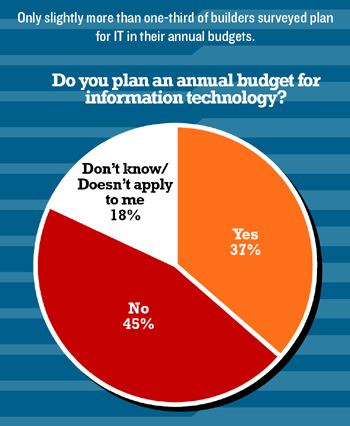
Based on our survey results, it's pretty clear that, as a group, home builders have a lot of work yet to do in deploying technology in their businesses. For starters, the majority of builders still spend considerably less than 1 percent of sales on information technology, and only 37 percent of our group plan for IT in their annual budgets.

IT research firm Forrester Research, based in Cambridge, Mass., says such low IT spending is typical of an industry in which materials account for a large percentage of the cost of the product. Nonetheless, home building is still well behind manufacturing, which averages IT spending of around 1.8 percent of annual sales. In contrast, in the services sector, Forrester says that insurance and health care average about 3 percent and 3.5 percent in IT spending, respectively, and that the financial industry averages well over 7 percent of annual sales.

The cliché about builders is that they are technology laggards, and our survey data generally support that notion. Fifty-five percent of respondents say they don't use smartphones; 86 percent don't use Tablet PCs; 73 percent have no opinion on customer relationship management software; and a whopping 42 percent say they don't use CAD software.

“That's the most disturbing number of all,” says Craig Schweikart, a senior consultant with Shinn Consulting who is based in the Seattle area. “If they don't use CAD software, I wonder what they do for their drawings. What do they submit for a permit?”

Schweikart says he thinks it's hard to believe that builders wouldn't use CAD software today, especially since so many local governments want to see plans in an electronic format.

Builders may not be on the bleeding edge, but most at least are trying to be more efficient. A full 99 percent of the group say a majority of their company's PCs have Internet access. And 74 percent say most of their company's laptops have wireless access, though that number may merely reflect the fact that just about every laptop comes with a built-in wireless card these days.

Home builders also aren't simply accessing the Internet: Seventy-three percent of them maintain a public Web site, as well. All of our 89 big builder respondents—those that build 300 or more homes a year—have a public Web site, while about 68 percent of our 443 smaller builder respondents run one.

Operating a Web site doesn't necessarily translate into savvy IT use, however. “The vast majority [of builders] has Internet access and a public Web site, but only a small fraction has a corporate Web strategy,” says Schweikart. “By Web strategy, I mean a strategic plan with goals outlined one, three, and five years out.”

HOMING IN

This lack of strategic planning and broader goals for IT and the Web has stymied many builders, says David Thikoll, a partner with Phoenix-based Cardamel Consulting, though that may be changing.

“It's starting to dawn on builders that the by-product of using technology for the sales and construction process is tremendous insight into the business, which they can then use for strategic planning,” Thikoll says. “Builders are starting to realize that they can use the data to help them decide what to build, where to build, and how they will build. In the past, too many builders saw the dirt, bought it, and worried about what to build later on.”

One builder who took the time to re-engineer his processes and now benefits from the business intelligence that software can deliver is Jason Kaplan, president of Kaplan Cos. in Highland Park, N.J. The builder had been using FAST for about seven or eight years, but about a year ago, Kaplan went a step further: He brought a FAST consultant on site, locked his top people in a room, and had them write out how the different departments interact with one another.

The company's major departments are construction, purchasing and estimating, and the FAST department, a group that generates purchase orders. What they discovered was that there was a point person in each department, a worker who could cause a bottleneck if he or she wasn't available to answer a question at any given time.

Kaplan decided that it made more sense to flatten the operation by aligning the company's workers by project or community. Every employee in the three departments then became the main contact for a specific set of projects.

“Now, we're not as reliant on any one person to know everything,” Kaplan says. “We looked at how we were functioning, and it became clear that the FAST department was taking charge of the FAST system and no one else knew how it worked.”

Once they flattened out the departments, Kaplan says it became easier to automate the company. “FAST touches every piece of the workflow today,” he says. “We wouldn't have been able to roll out FAST across all the departments if we weren't organized in a more efficient way.”

By improving its processes, Kaplan says, the company now has a much better handle on costs, information that helps the builder make better business decisions. For example, a cost analysis on a three-story townhome project the company was building in north and south New Jersey revealed that while the costs were roughly the same in both regions, Kaplan could get a higher sales price in the New York metro area than it could get in the Philadelphia market. The company decided to stop building the model in Philly.

“The real payoff for Kaplan comes in insights into making future decisions,” says Thikoll. “What I'm finding is that builders who have been working on back-office systems all along will have a huge advantage when the market comes back.”

METHODOLOGY

The findings of the 2006 Builder IT Survey are based on responses to questionnaires that were e-mailed to 47,871 readers of BUILDER and BIG BUILDER magazines. A total of 443 small builders and 89 big builders (those building 300 or more homes a year) responded to the survey. Online research firm Specpan worked closely with the magazines to design the online questionnaire, collect the data, and deliver final reports.

WHAT CHANGED?

Here's a quick analysis of how our 2006 survey data compare with 2005's results.

It's easy to slam home builders for not being tech savvy, but the industry has made some progress. One of the most positive developments is that the percentage of small builders that offer home buyers a Web progress report on their home jumped to 34 percent in 2006, up from just 22 percent the year before.

“We've had great results from updating the progress of the house with pictures on the Web,” says Ed McDowell, president of McDowell Construction in Myrtle Beach, S.C. “Our home buyers use it, and a lot of their friends and relatives get on and watch the progress of the house.”

Web-based collaboration, also, is growing somewhat. Forty-five percent of big builders say they use the Web to communicate with subs and suppliers, compared with 34 percent in 2005. And 17 percent of small builders are using the Web to collaborate, versus just 13 percent two years ago.

“I'd like to see those numbers expand,” says Craig Schweikart, a consultant with Shinn Consulting. “There's really no barrier to entry for home builders to collaborate with subs and suppliers on the Web.”

While they aren't lighting up the market, Tablet PCs grew in use among big builders last year, to 34 percent, up from 22 percent in 2005. Tablet PCs still aren't catching on with small builders, though: Only 7 percent of small builders used them in 2006, the same as in 2005.

CAD software usage, too, is growing. Eighty-two percent of big builders said they used the software in 2006, up from 71 percent the year before. Among small builders, however, usage jumped to only 54 percent, compared with 51 percent in 2005.

One real disappointment: The number of small builders that maintain a public Web site is still pretty low, at only 68 percent. That's up from 59 percent in 2005, but even though builders that have Web sites are doing more with them, there's still about a third of the group that have yet to jump in.

SALES HELP NEEDED

Builders aren't spending a lot of money on CRM software. One big builder explains why.

One confounding survey result that persists from 2005 to 2006 is that our group isn't doing much with customer relationship management (CRM) software, typically referred to as a sales front end, or simply sales software.

When asked which CRM software their company uses, 73 percent of respondents answered “don't know/don't use CRM software.” That breaks out to 81 percent among small builders but only 35 percent among big builders.

One reason for such high numbers is that many small builders outsource the sales process to Realtors. Another reason is that a good CRM system can cost several thousand dollars, and many builders don't want to spend more than a couple hundred dollars on a QuickBooks accounting package. Still, Mike Rulli, director of information systems for Drees Homes in Fort Mitchell, Ky., offers another explanation.

“We looked at the available sales software and found that they are mostly order-taking tools,” says Rulli. “What we're looking for is something that will be customer focused that can be integrated with part of our Web site.”

What Rulli has in mind is putting a link up on the Drees Web site that would let a home buyer select a house plan and elevation, a lot, and structural options. By structural options, he means family-room extensions, media rooms, or a two-story foyer instead of a one-story.

“Side-entry garages take wider lots, so some of the lots may not allow for that option,” Rulli says. “The tool will tell the customer that, and we'll provide a place on the site where the customer can save that information. When the customers come in for a visit, the salesperson can retrieve that data and bring it into Drees' sales tool.”

What's interesting is that Rulli says Drees has no plans to let home buyers make upgrade selections on the Web for items such as appliances, countertops, and carpeting.

“We're really more interested in producing a tool and catalog that showcases our products, not GE refrigerators or Whirlpool dishwashers,” Rulli says.

“On larger homes, [buyers] still have to come into the design center and make selections on carpeting and flooring and paint colors,” Rulli says, adding that Drees' main goal is to simplify the process so that when customers meet with a salesperson, they have a ballpark idea of what the home price will be.

VISIT OUR TECH BLOG

Builders have a long-standing reputation for being unwilling to spend money on information technology. Part of the reason for this reluctance is the high number of IT failures in our industry. On the other hand, some home building companies have successfully deployed sales, back-office, and warranty systems. Home builders mired in paper-based systems face a serious challenge from such competitors.

Can a builder compete in 2007 without IT? Please share your thoughts on home builders and information technology on senior editor Steve Zurier's Z-Tech Blog at www.builderonline.com.