TY CHIVERS WATCHES THE real estate frenzy in South Florida and remembers a similar scene from another era. “Years ago, when you stood in line to get rock concert tickets, people would turn around and resell them,” says the Jupiter, Fla.–based real estate agent. “These guys are scalpers.”

There is a notable difference, however. The concert ticket scalper paid the full price of the ticket upfront before trying to sell it for a profit. Investors usually pay only earnest money upon signing the contract. Then they often resell their houses the day they close, making tens of thousands of dollars from price appreciation that occurred during the lag time of construction between contract and closing. Or, particularly in the case of condominiums, speculators hand over a few thousand dollars for a preconstruction deposit and then sell the unit for a profit before it's even built.

The difference between investors and speculators can be subtle. Investors may buy and resell a property or hold it to rent out for a long-term return on their investment. Speculators are interested only in flipping, and flipping can be profitable. “A lot of people are doubling their money,” notes Chivers.

Chivers says he sees how an onslaught of investor buyers could affect a builder's business. Builders sell a lifestyle with amenities and social activities, and “if you have 80 percent of the people [not] move in, it defeats the purpose of the pitch.”

Still, Chivers says he doesn't quite understand the beef with investor buyers. After all, builders set their own prices, they're making plenty of sales, and they're making a profit. “If [the builders] have their money, why do they care?” he asks.

MAKING A COMMITMENT

But they do care, and that concern goes up with the number of houses a builder sells. According to a July 2005 Builder nationwide reader survey, only one in five builder respondents restricts the sales they make to investors, and respondents selling up to 250 houses a year generally are happy to sell to anyone with the money to do a deal. Above that volume, builders are far more likely to crack down on investors, citing such issues as competition in their communities while they're still selling new homes, the creation of an artificial perception of housing demand, a lower profit margin because investors don't buy options and upgrades, and the effect on the ability to build a sense of neighborhood.

“It's important [to limit investor activity],” says Leslie Kratkoski, spokesperson for Beazer Homes USA. “When we build communities, we want them to be stable. We don't want a lot of turnover. It's to our benefit to have people who want to make a long-term commitment.”

The efforts of single-family builders to keep investors at bay appear to be working. Several recent surveys by the NAHB and data from the National Association of Realtors (NAR) point to relatively low interest in new single-family homes among investors. The NAHB surveys, which included builders of all sizes in a variety of markets, revealed that only 3 percent of single-family homes sold in the previous six months were for investment. Similarly, the NAR reported this past summer that only 3 percent of home buyers sell their houses in less than a year.

MARKET-FOCUSED

BUILDER'S survey confirmed that investor activity is highly market specific. Respondents building in markets including California, Nevada, Phoenix, Washington, and Florida more often restrict investors than those in the Midwest, Texas, the Northeast, Atlanta, and Seattle, possibly due to tight land supply, rapid price appreciation, or pent-up demand.

And restricting investors in these hotter markets is a smart move, because in markets with high investor activity, such purchases obscure underlying demand and often lead to overbuilding, says Celia Chen, director of housing economics for Economy.com.

Anticipating a correction in housing prices toward the end of 2006 or the beginning of 2007, Chen says that heavy investing in a market will make the correction more severe “because investors will walk away faster than homeowners. If they walk away in droves, it will drive down prices even faster.”

Some builders recognize that today's commonplace policies, such as limiting individuals to buying only one house or forcing investors to spend thousands on options, won't fly in a soft market or a less desirable location.

“Not selling to investors is not a problem in this market, and we can afford to be selective,” says Fred Rothman, owner of Paramount Residential in Boca Raton, Fla. “I dare say that if the market slows down, our policy—and the policies of many of my peers—will likely change and we will once again provide discounts to investors who buy a number of units at one time.”

GUARDING THE GATE

Builders who do opt to restrict investors are challenged daily to keep them from sneaking through the process. Salespeople are trained to make the policy clear from the outset. Contracts clearly state that the sale can be canceled if the builder uncovers another purchase. In addition, within a year after purchase, buyers are limited to selling their homes only for certain hardship exceptions or back to the builder at the original purchase price.

To ferret out investors posing as owner occupants, builders often limit sales to a single unit per family name or cross-reference customer lists from previous sales. A buyer who doesn't want any options or upgrades is instantly suspect, as is a buyer whose credit report shows multiple mortgages.

But once the sale is closed, restrictions on rentals or resales can be tough to police. Builders say it's easier if they still have a sales center in a community and can patrol the neighborhood for yard signs. Beyond that, it's often only discovered when a neighbor calls to complain. Even then, a builder who wants to enforce a post-closing restriction may not win. There currently is no case law testing the legality of the restrictions, and, in general, courts are reluctant to limit the rights of property owners.

INVESTORS AS PARTNERS

Investor restrictions are mind-boggling to Mike Golden, president of Chicago-based @properties, a real estate brokerage specializing in marketing new construction.

“If a builder can [invoke restrictions] and get their product sold, great,” he says. “[But] investors are a necessary part of the market here. Our pricing is less expensive than in most other parts of the country; our demand is great, but it's not overheated. We don't sell out in eight minutes at any price. You'll be hard-pressed to put up a 250-unit building without some investors to get pre-sales rolling.”

Nathan Halsey hasn't seen a swarm of investors in Dallas. The president of Bishop Abbey Homes says he wouldn't sell to speculators who flip houses because of their role in overinflating a market, but he does partner with investors to finance spec houses, sharing the profits with them. It's a good deal for the investor—it's typically a low-cash, high-yield investment—and it helps Halsey out “as a home builder that hasn't been in business over 10 years [and doesn't have] real strong banking relationships.”

It's not inconceivable that Dallas eventually could attract the same kind of investor attention as Tucson, Ariz., where KB Home's decision to stop selling to investors earned it the 2005 President's Trophy from the Better Business Bureau (BBB) of Southern Arizona. The BBB's president, Tom Collier, says KB was the first national builder to put on the brakes; when it did, others followed suit.

That helped stem the tide of investors from California, who saw Arizona pricing as a bargain compared with what they paid at home.

“It's a documented phenomenon here that we have a lot of what we scornfully call ‘California money,' ” Collier says. “We had brand-new subdivisions with for-rent signs in yards and a general deterioration of the visual [appearance] of communities because [investors] were renting the houses out. Nothing against renters, but they don't tend to take care of the property as much. ... KB recognized this was not in the community's best interest. Taking money for money's sake would have been in KB's best interest. It was in the better interest of the community to not sell to investors.”

First Home Builders of Florida, which builds in the hot Fort Myers market, does not see it that way. Investors account for about a third of its 3,000 annual sales. But there's a twist: The builder, which was bought in August by Hovnanian Enterprises, has partnered with investors to help serve its first-time home buyer market, says COO Bruce Robb. All its investor buyers take out a construction loan and go to closing. “With us, there's no such thing as cancellation, because they own the lot,” Robb says.

As part of the effort, First Home Builders teamed up with a local real estate office to create an updated version of a lease-to-own program. Under the arrangement, the builder's investor clients have a buyer who will purchase the home 12 or 24 months after closing, at a predetermined price. Or the investor can put the unit in a rental pool for customers who want to buy but aren't quite ready because of credit issues. Every month buyers make their rental payment on time, they get a $150 credit to use for options and upgrades if they buy a house from First Home Builders.

“All in all, it's a fabulous opportunity,” says Robb. “It's a good business strategy that protects our risk and differentiates us in the marketplace.”

TO LEARN MORE ABOUT THE IMPACT OF INVESTORS ON HOME BUILDING, VISIT OUR WEB SITE AT WWW.BUILDERONLINE.COM, CLICK ON “THE MAGAZINE” TAB, AND THEN CLICK ON “BUILDER ARTICLE LINKS.”

INVESTOR PROFILE

Miami Heat

Where seasoned investors compete with the pizza guy.

When Ricardo Aue started house hunting in Miami about three years ago, the financial adviser saw how quickly the prices were going up. He realized it was a good investment and started buying. He since has bought and sold about 20 houses, townhouses, and condos.

Aue says that houses and townhouses are better investments because there's always a demand for them. “I don't want to live in a condo,” he says, offering his reasoning for the results. “I want a family environment.”

When he first started investing, Aue could buy four or five houses in the same development, assign the contract to another buyer, or resell as soon as he closed. Now, he can't do any of those things due to builders' restrictions. “The restrictions are no good if you're in the business to make money,” he says.

But the speculative fervor in Miami has gotten so bad—a pizza delivery guy recently tried to sell him a house—that Aue sees a benefit to the restrictions: “The prices will be more stable. Lower- or medium-income families will be able to afford a house.”

Aue is out of the high-end, preconstruction condo market now. The market is saturated with inventory, he says, and investors aren't thinking the purchases through.

“Right now, [investors] don't care what kind of contract they sign,” he says. “They don't care how much they have in the property. [They're] thinking of [the investment] as a sure thing, and it's not.”

INVESTOR IMPACT

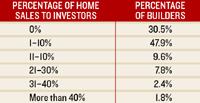
Many builders find that real estate investors play a role in a successful business plan.

For builders who sell to investors, those sales can constitute a significant part of their annual closings. Almost half the builders surveyed said investor sales account for as much as 10 percent of volume. A small percentage of builders build more than 40 percent of their homes for people who will never live in them.

SOURCE: BUILDER READER SURVEY, JULY 2005

CLAUSE AND EFFECT

With no legal precedent to work from, builders and attorneys ponder whether investor restrictions will hold up in court.

Every day, builders give buyers contracts with restrictions on their ability to sell or rent out the property. The most common restriction is a ban on selling or renting the property for a year, or the buyer can only sell it back to the builder at the original purchase price.

Walnut Street Development, a Washington-area builder/developer, restricts selling or renting units for a year. If a buyer sells within that time, it has to be sold to Walnut Street Development at the purchase price.

“I wanted to put some teeth in my contract as a way to fight [speculators],” says founder Bobby Montagne. “The teeth could be sharper.”

But can builders legally do this?

Builders and their attorneys say that, eventually, the contracts will be challenged in court. Lacking state law and legal precedent for guidance, even attorneys writing the contracts don't know if they'll pass legal muster.

Newport Beach, Calif., attorney Mark Himmelstein, who has written articles for the NAHB on how to draft anti-investor clauses, says the restrictions help create a stable neighborhood and keep prices from being artificially inflated. But even with a noble cause as a premise, Himmelstein acknowledges, there is a serious lack of case law on which to draw.

“The courts' view is that an owner of property can do pretty much whatever he wants with the property as long as it doesn't violate the law or public policy,” Himmelstein says. “Courts have only allowed reasonable restraints.”

Those restraints include a reasonable time-frame restriction, generally a year; a hardship clause to give buyers a way out in case of unexpected events such as a serious illness or a job transfer; and a stated goal related to public policy, such as maintaining affordable housing. In addition, builders need to put the clause in a prominent place in the contract—Himmelstein recommends using a separate document or a clause that has to be initialed—and provide uniform enforcement.

University of Miami adjunct real estate law professor Rick Zelman says he has concerns about spelling out “reasonable restrictions.”

“In the absence of reported case law and no statutory law, you're really winging it,” Zelman says. “You could be attacked for listing those reasons.”

NOT SO FAST: At Walnut Street Development's Rainbow Loft, buyers can't sell to a third party or rent their units for one year.

Fellow Miami real estate lawyer Hal Lewis has told builders that he thinks the restrictions are enforceable because the buyer agreed to them, but without case law for guidance, he says, he can't be sure.

If builders are patient, they should get their chance to see how the clauses play in front of a judge, Lewis says. “If prices drop,” he says, “you'll see all you need to ever see on the court cases.”

SIZE MATTERS

Bigger builders may be able to be picky about their clientele, but small-volume builders rarely restrict investor buyers.

Small builders generally aren't willing to walk away from any sale. Our survey respondents reported that it isn't until a builder sells 250 houses or more a year that the thought of investor sales becomes much of an issue.

SOURCE; BUILDER READER SURVEY, JULY 2005

PROFITS IN PERIL

The average profit margin on a home built for an investor is lower than one built for a primary resident.

Investors may want to buy as many units as a builder will sell them, but they also want to keep their costs to a bare minimum. As a result, they tend to go with the standard selections and skip the options and upgrades that help builders increase their profits margins.

SOURCE; BUILDER READER SURVEY, JULY 2005

INVESTOR PROFILE

Midwest Savvy

Investors are valued in steady-growth Chicago.

Dan Frisch knows his real estate. A full-time investor, Frisch owns Chicago-based Duke Management Co., which buys preconstruction condominiums (“those have gone very well for me”), invests in other people's condo conversions, buys apartment buildings to hold or convert to condos, and, “just for fun,” also appraises property.

With a preconstruction condo, Frisch says, flipping is always the first option, either right before or right after the closing. If the market is soft, though, there's always a Plan B, which generally translates into buying the units and holding them. “The people who are the most flexible make the most and do the best,” he says.

He's heard how builders are refusing to sell to investors in Miami and understands how flipping could be an issue in markets with significant price appreciation year over year. In Chicago, where appreciation ranges from 5 percent to 12 percent a year, condo developers see investors as a critical part of their business model.

“If you're going to put up a 200-unit condo building, this is going to take a while,” he says. “If the lender requires 20 percent to 30 percent presales, who exactly is going to buy? These are binding contracts; it's not a game. They're valid contracts with money down in escrow. Who will do that two to three years out? I submit to you, investors.”

California Hip

An L. A. real estate broker understands builders' concerns.

Steve Aguilar had it all figured out. The president of Los Angeles–based Boardwalk Realty had pulled together the financing to buy 50 new houses in a Phoenix development to flip or rent them. It was a gold mine. “You put the order in, and six to eight months later, the builder is offering the same house in the next phase for $40,000 to $80,000 more. ... We could undercut the builder, and he would be stuck sitting on inventory.”

At least, it worked that way on paper. By the time Boardwalk was ready to do the deal, the market had changed dramatically.

“When we went out to pull the trigger, the builders said you couldn't buy more than one house,” says Aguilar. “They shut us down.”

Having been a builder and developer himself, Aguilar says he doesn't blame builders for turning investors away. “I'm all for making money, but it's not something [investors] should be able to do. ... If investors don't like it, let them go build 50 homes, have the stress, and see how they like it.”

Aguilar says he thinks investors will disappear as market conditions shift. “When the market turns, they turn,” he says. “Here in California, interest rates are low and there's no inventory. When those two things change, the market will change.”