IF YOU HAPPEN TO SHELL OUT $75 to get your hands on the 2004 National Association of Realtors home buyer profile, you might be disappointed—but probably not surprised. After scanning its 30 pages, you come away thinking today's buyers are fickle, superficial creatures who don't care about anything but big garages, high ceilings, bathrooms, and closet space.

But is it possible that studies like this simply reinforce stereotypes by not asking the right questions? In recent years, many builders have proved that “invisible” features and amenities such as R-values, durability, and air quality can play a major role in closing the deal. Yet these critical issues are often ignored in consumer-preference studies.

1. REVEAL HIDDEN ASSETS

For example, Mercedes Homes has a community with great stealth features under way in Melbourne, Fla. Bill Zoeller, a senior architect with Steven Winter Associates in Norwalk, Conn., has been working with Mercedes on the project.

“There were three builders in this particular subdivision,” notes Zoeller. “We helped Mercedes configure their homes to be more energy efficient and built a little mock-up wall to compare the standard construction with our poured walls. They have been outselling their competitors by six to one, just killing them.”

ABOVE AND BEYOND: Pre-engineered wall studs and I-joists, hot water recirculating pumps, radiant-floor heating systems, and roof deck ice and water shields are just a few of the quality materials and systems employed by Ernst & Ernst.

Zoeller says that one of the keys to selling behind-the-walls amenities is simply learning how to talk about them. And there are certain hot buttons that get a buyer's attention.

“First of all, if the builders don't know what they have to sell, there's no way they can train their salespeople to sell it. If you have a superior product, you have to know it, to know that these are the features that make your houses better,” Zoeller explains.

2. KEEP IT SIMPLE

The next trick, he says, is to “simplify the pitch.” In most cases, builders need to talk about a home's systems in a nontechnical way and tie it to lifestyle benefits.

“Comfort is very big,” Zoeller notes. “So is indoor air quality. When you talk about indoor air, you talk about the benefits of tight construction, of a properly sized air conditioning system to control mold. The trick is to tie it into the home's [lifestyle] attributes.”

3. DESCRIBE LONG-LASTING EFFECTS

Joe Ernst, a co-owner of Ernst & Ernst, a residential builder/developer in Philadelphia, says that he doesn't try to sell infrastructure on its own. Instead, he focuses in on the fact that customers want things to look new for as long as possible.

This provides an opening for discussions about hidden quality, he says. He simply reminds them how a home's cosmetics will be impacted by construction choices.

“For example,” he says, “we tell them that because we use pre-engineered wall studs and I-joists, they will have less shrinkage. They won't be seeing drywall tape separating.

“For I-joists,” he adds, “we let them know that a solid wood joist could shrink by a quarter of an inch, leaving a gap between the floor and their baseboard. When they hear that, they're usually willing to spend more, if they have the budget.”

4. SELL ENERGY EFFICIENCY

Other features, such as energy savings, can be sold the same way, Ernst says. Consider recirculating pumps in a home's hot water piping. These help sell the house because buyers can get hot water to all bathrooms much more quickly. They also lower the home's water heating demands. Ernst uses the same pitch to sell efficient radiant floor heating systems, focusing on comfort, with the bonus that the system is energy efficient.

5. DON'T SACRIFICE QUALITY

At the 2005 International Builders' Show, NAHB economist Gopal Ahluwalia reported that the five most desired amenities in new homes were walk-in pantries, kitchen islands, extra storage, filtered drinking water, and a built-in microwave.

Given such research, builders may be tempted to emphasize cosmetic upgrades and sacrifice overall construction quality. Zoeller says builders have been pushed in that direction by market forces.

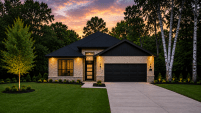
BARING ALL: This concrete wall mock-up (right), a component in homes such as the one above in Melbourne, Fla., has helped Mercedes Homes sell its product at six times the rate of other builders in the same development.

“What the builders are up against are land costs increasing by 25 percent a year,” he says, “so they're cramming as much house as possible onto a lot. The more product they can sell, the more money they make.”

But Zoeller says that builders may be missing an opportunity by assuming that the only amenities buyers will pay for are the shiny, pretty things in the kitchen or bath.

“One really easy thing to do is to go with Energy Star construction,” he notes. “The builder gets a third-party certification, and that's something he can sell. Then you can get into regional details.”

For example, he says, builders in the Southeast have had great success recently in selling hurricane-resistant building techniques. Homes built this way are more durable and command a premium.

Ernst has discovered the same formula for selling a better-built house. Some of it, such as energy-efficient fluorescent recessed lighting, he simply includes because it makes economic sense. But other details, such as covering every inch of roof deck on homes he builds near the New Jersey shore with ice and water shields, are above-and-beyond quality measures that mean something to consumers.

“In that area, you get hard-driven rains,” he says. “When we explain things like that to our customers, about 90 percent of them will upgrade. “Our customers vary in what they want, in how environmentally concerned they are,” Ernst continues, “but one trend we've definitely seen is that people want the building to last longer. They will definitely spend more if they know they can get more life out of the systems.”

“Our customers vary in what they want, in how environmentally concerned they are, but one trend we've definitely seen is that people want the building to last longer. They will definitely spend more if they know they can get more life out of the systems.”

THE HARD SELL

How can you convince the typical client to upgrade to a super-efficient HVAC unit when he or she is not at all concerned about energy efficiency?

  • Promise more control. A properly sized unit affords better control of temperature and humidity in each zone of the house.
  • Tie the unit to air quality. For example, include an integral air cleaner—such as the Infinity HVAC system from Carrier (shown below)—that removes potential allergens. You might also consider adding a heat recovery ventilator to bring in fresh air from outside.
  • Emphasize longevity. A properly sized unit will last longer. You don't want to deal with the hassle of replacing it in a few years.
  • Don't forget mold. It's a bit of a low blow, but any mention of mold usually gets a buyer's attention these days.
  • Get Energy Star certification. Include the unit as part of the certification, which will improve the resale value of the home.
  •