By the first year or two of this decade, many home builders had soured on the Internet. The fraud case surrounding Enron and the wave of dot-com crashes in the late '90s widely discredited the Web as a business model. The building industry even had its own homegrown dot-bomb: the ill-fated BuildNet.

Now that the Enron case is almost closed and the hangover from the tech crash has receded, it's a perfect time for builders to refocus on their Web sites.

Many of the 10 points outlined in this “tune-up” don't have to cost a lot of money. Smaller builders with limited budgets can easily add simple text sections supported by clip art to post loan information, explain the buying process, and fully detail the case for buying a new home.

It's worth doing, especially since the National Association of Realtors reports that 77 percent of home shoppers used the Internet to search for a home in 2005, a figure that is sure to increase in the years ahead, if it hasn't already. In addition, experts say that the average user spends six to eight minutes on a builder Web site shopping for new homes.

The question we pose to the industry, then, is this: If the majority of home shoppers are using the Internet to look for a new home, why do so many builder Web sites miss the mark?

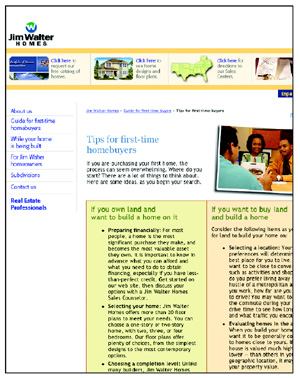
THE BASICS: Spelling out the home buying process is a must for Jim Walter Homes, an “on-your-lot” builder of affordable homes. The company caters to first-time  buyers, who value the information.

THE BASICS: Spelling out the home buying process is a must for Jim Walter Homes, an “on-your-lot” builder of affordable homes. The company caters to first-time buyers, who value the information.

Even among big builders, many company sites are hard to navigate, lack consistent maps and directions, and often don't even offer easy-to-find contact phone numbers and e-mail addresses. It should never take several clicks to find something as simple as a corporate phone number.

Sure, Toll Brothers won a Webby award this year from the International Academy of Digital Arts and Sciences for its Web site (www.tollbrothers.com), and John Laing Homes (www.johnlainghomes.com) won a Gold Award at The Nationals for its Home-finding ToolKit, which lets home shoppers draw up a list of all the features they'd like to have in their new homes. And a review of the Web sites of the top 50 companies on the BUILDER 100 indicates that most big builders have workable “find a home” sections that link home shoppers to information about new communities within a few clicks. But despite these successes, there's still a lot of room for improvement, especially among smaller builders, many of whom just throw up basic text with limited graphics and don't offer much more than a contact page and a few photos of the builder's favorite projects.

“People want pictures, floor plans, and prices,” says Blair Kuhnen, a consultant with Realty InfoLinks, a Dallas-based Web marketing firm for home builders. Kuhnen advises builders to make sure their content is complete and accurate. This means that prices, directions, phone numbers, floor plans, elevations, and basic contact information must be easy to find.

“Nothing turns away Web traffic faster than poor usability and incomplete content,” Kuhnen says. For builders who think they are missing opportunities to connect with viewers of their sites, Kuhnen suggests permission marketing, a technique in which the builder gives away something for free in exchange for some detailed information about the buyer. A good example is the Arthur Rutenberg Homes site (www.arhomes.com), where shoppers are asked to fill out a form in exchange for a free copy of the fall 2006 issue of the builder's Legendary Homes magazine.

Builders who scorn the Web should look again. The Internet lives on and is stronger than ever. There are now more than 1 billion Internet users worldwide, according to www.internetworldstats.com, more than 227 million of them in North America. If you want to reach the buying public, especially in this softer market, you need a viable Web site. Use these 10 tips to start tuning yours up.

1. Make the case for new homes.

Why not use your Web site to tell customers the advantages of buying a new home? Posting the argument for buying new would be inexpensive, since most of the information is text, and it could put you way ahead of your competitors, since few builders offer such details.

Lennar's Web site (www.lennar.com), for example, explains how today's new homes are built with improved materials such as fiber-cement siding, high-grade insulation, and truss beams. It also talks about how new homes are prewired to support home theaters, high-speed Internet access, multiple telephone lines, security alarm systems, and time-controlled sprinkler systems.

Explain to site visitors that home-tech goodies and other upgrades, such as granite countertops and higher-priced appliances, can be rolled into the mortgage.

“We realized that it's become a very competitive market,” says Courtney Alexander, Lennar's Web site manager. “Lennar competes against other builders, but we also compete against the resale market,” she explains.

DIY DESIGN: Home buyers who visit KB Home's site can use an interactive personalization  tool to try out different color schemes for the kitchen, the master bathroom, and  the family room.

DIY DESIGN: Home buyers who visit KB Home's site can use an interactive personalization tool to try out different color schemes for the kitchen, the master bathroom, and the family room.

Existing-home buyers spend thousands of dollars on home repairs replacing old appliances, patio doors, windows, and HVAC systems. Even if your new homes are more expensive than some of the existing homes in your trade area, make it your business to show prospects how they'd be saving money in the long run by spending less on home improvement costs.

2. Explain the buying process.

Many builders have at least some information posted that explains the full buying process—from signing a contract to submitting a warranty claim. This is especially true for builders who target first-time buyers or who don't fit the standard mold of a production or custom builder. First-time buyers unfamiliar with real estate and home building issues may need some extra handholding, and niche builders may want to post a bit more background information to ward off extraneous phone calls.

Jim Walter Homes (www.jimwalterhomes.com), which has seven divisions in 16 states, offers prospects home-buying tips, building-related definitions, answers to frequently asked questions, and a mortgage calculator. The Tampa, Fla.–based builder specializes in building affordable housing for people who already own lots, a business model that's slightly different from the average builder's.

“Because we are different, we feel it's important to communicate as much information as possible,” says Roger Crabb, the company's director of marketing. “We don't want people calling about a subdivision in Houston when that's not what we do.”

If you don't have the time or patience to explain the full process, start by posting some background financing information. It won't cost you a lot of money to offer details on different loan types or add links to Web sites that explain how loans work. Visit Standard Pacific's Web site (www.standardpacifichomes.com) to see how it posts loan information. Visitors to your site will appreciate that all the financial information is available in one convenient place.

3. Focus on usability.

On so many builder sites, it's still too hard to find information about a branch office, find the corporate phone number, or make a warranty request. When you sit down to plan site content, focus at least 50 percent of the discussion on usability issues.

“A lot of Web sites are marketing-heavy,” says Kris Ellis, director of marketing for Melbourne, Fla.–based Holiday Builders, which spent the better part of this year refreshing its Web site (www.holidaybuilders.com). “When we redesigned, we looked at usability as well as marketing,” Ellis says. “We gave 50–50 importance to each.”

It may sound slightly compulsive, but think in terms of saving clicks. On Holiday's home page, visitors used to click on the map of the U.S. and get yet another map of the country. At press time, the company was streamlining the site so a visitor could click on a state on the home page and drill right down to communities in a specific trade area.

“Even one click is worth saving,” says Ellis.

Try out Holiday's site. Everything there, from finding a new home to filling out a warranty claim, takes only a couple of clicks. And locating a specific county or region is typically very easy.

Other builders that do a great job with usability are KB Home (www.kbhome.com) and Toll Brothers. Each posts a map of the U.S. with shaded areas for the states the company does business in. A simple click on a state takes the user to a listing of communities in that state. Regional maps that let the user drill down to communities in specific regions are just one additional click away.

Ellis has a background in human-factors engineering and worked as a Web developer before signing on with Holiday Builders. If you don't have such a person on staff, hire a usability expert to sit in on your initial planning sessions. You can pack your Web site with glitzy graphics and expertly produced corporate videos, but the value of the site goes way down if people can't navigate it easily and execute simple tasks.

4. Provide clear maps and directions.

Home shoppers need to be able to locate your company and your communities. Include a metro area map, a local street map, and text driving instructions so buyers can find their way. You can often link to free Yahoo, Google turn-by-turn, or MapQuest directions.

It's also important to make the maps and directions easy to use for home buyers from other parts of the country. Too often, builder Web sites assume viewers are local. Another problem on big-builder Web sites is that maps and directions are often left up to the local divisions to create, so there's a range in quality.

Brown Family Communities (www.homebfc.com), Van Metre Homes (www.vanmetrehomes.com), and Toll Brothers offer excellent regional and local maps as well as clear driving directions. Some builders offer great maps but give vague driving directions. Others offer excellent directions but fall down on providing simple maps that anyone can use. Your site needs to have both.

5. Jazz up your floor plans.

Along with pictures and prices, home shoppers want to see floor plans. Unfortunately, too many builders post floor plans that are virtually unreadable.

Consultant John Rymer of Rymer Strategies in Tampa, Fla., recommends using Flash to develop floor plans. Flash is software from Adobe (which bought Flash's maker, Macromedia) that is typically used to design online videos. Because it supports vector drawings efficiently, however, it can also be used to create an overlay that lets site visitors drag and drop images of beds, sofas, and tables into the rooms on the vector floor plan.

“I know it's not the normal use of Flash,” says Rymer. “But by using it as an overlay, home shoppers can get a sense of what a room would look like furnished,” he explains, adding that builders can also use Flash to let buyers add structural options such as dens, bonus rooms, and bay windows.

Plan on roughly $3,000 per community and $400 per floor plan to do an overlay in Flash in which home buyers can manipulate furniture. While it may be too expensive for small builders to use extensively, it might be worth doing for one of your developments to see what kind of response it gets.

6. Sharpen your search engine traffic.

Builders typically complain that they don't get much traffic from the major search engines, such as Google and Yahoo. Of course, paying a few cents to a few dollars a click for a “Sponsored Link” on Google or Yahoo increases your odds, but there are other, low-cost ways to drive more traffic to your site. Here are a couple of tricks:

First, make sure your site notes the locations you build in, whether you're a custom or a production builder, and the type of product you sell. For example, a production builder may want to post that it builds “affordable starter homes in Osceola County.” A custom builder might say it builds “fine custom homes in Marin County.” Large real estate aggregators, such as www.move.com, do a great job of indexing by location and type of builder, so it's critical to have those descriptions on your site.

A second traffic-driving tactic is to post marketing slogans as text instead of as graphics or images. If a slogan such as “Orlando's Affordable Builder” is posted as an image, most search engines won't pick it up because they can't read images.

A CLICK AWAY: Toll Brothers posts a map of the country on its home page that shows all the  states it builds in. Information about available new homes in any one state  is just one click from the home page.

A CLICK AWAY: Toll Brothers posts a map of the country on its home page that shows all the states it builds in. Information about available new homes in any one state is just one click from the home page.

Rymer Strategies did a usability study among new-home shoppers and found that 42 percent started their search on one of the major search engines. The lesson: Don't hold your Web efforts back by not using the right computer language.

7. Use sales promotions creatively.

Advertising special deals on builder home pages is becoming practically automatic in this down market. If you want to take it a step further, learn from Holiday Builders, which combines print advertising and online promotions successfully.

During the early summer, Holiday was offering home shoppers in Florida a year's worth of free gas (valued at $2,000) if they purchased a home between June 1 and June 30. The promotion was on the company's Web site, but ads also ran in nearly 30 newspapers across Florida. All the ads were similar, but readers were advised to key in a unique uniform resource locator (URL) that was specific to the region they were interested in.

Once the shopper clicked on the unique page, the newspaper ad came up online and the site visitor could click on local communities in the newspaper's trade area. All the hits were recorded in a Web log, which reports which newspapers are generating the most traffic.

Once Holiday saw the initial reports on the gas promotion, the company determined that some of the more competitive regions could use a tweak. So it changed the wording of the ads from “fuel your interest in a Holiday home” to a much more specific “get a year's worth of free gas.” The result: The hit rate went up 25 percent.

8. Post recent company news.

Except for the major public builders, which feature financial results on their sites every quarter, most builders go several months between postings of important company news.

If you're going to have a news section on your Web site, do it right. You don't want a prospective buyer to see that according to your site, the last time your company did anything significant was in 2002. It will make them think you've lost interest in your Web site.

Spend some time on the “From the News Desk” portion of the Habitat for Humanity site (www.habitat.org) for an example of an excellent news section. All the articles are reasonably fresh (about a week or two old), can be accessed quickly, and are posted prominently on the site. Habitat also includes links to portions of the site that describe the organization's most recent and noteworthy projects.

One negative with Habitat is that it doesn't list a contact person on its press releases. Reporters depend on press releases for basic content and background information. Don't make their jobs harder by making them wade through the company directory on your corporate voice mail. Even if you're a mom-and-pop shop, put a cell phone number on the press release so the reporter can contact someone directly.

9. Offer a Spanish-language version.

This certainly makes sense for a company such as Jim Walter Homes, which targets first-time buyers seeking affordable homes.

According to Crabb, Spanish-speaking families will make up a significant portion of the affordable homes market in the Southeast during the next 10 years. While this is also true in the Southwest and California, builders doing business elsewhere may also want to consider posting Spanish editions, since the influx of Hispanics into the country is no longer a regional trend. Visit the KB Home site for another take on how to create a Spanish version.

Small builders may not want to support an entire version of their site in Spanish, but they might think about posting some basic marketing points and directions in the language. Of course, if you're going to cater to the Hispanic market, you also have to have salespeople and possibly even construction managers on staff who are fluent in Spanish.

10. Do something fun.

Some big builders are trying to make visiting their Web sites a fun experience.

John Laing Homes starts site visitors off with an image of a very cute dog and cat sleeping in front of a fireplace while a folksy, upbeat blues tune plays. Taylor Woodrow Homes, meanwhile, recently became one of the first builders to post podcasts of promotional videos (www.realestatepodcasts-taylorwoodrow.com; clicking on the Taylor Woodrow logo takes visitors to the company's North American site, (www.taylorwoodrowna.com). And Lennar has the Kid's Community, a page designed to make young children feel more comfortable about moving.

“One of the most traumatic things for a child is a move,” says Lennar's Alexander. “The [page] is a warm fuzzy that lets parents tell their kids, ‘We're going to live in a Lennar home, and you can come and play here.' ”

Development for the Kid's Community cost Lennar about $5,000. Taylor Woodrow says production costs for the podcast videos start at $1,500 per segment. If you can't afford thousands of dollars on slick sections for kids or podcasting videos, think about starting your site with a Flash slide show of your best five or six homes and supporting the show with audio. It may still cost you about $2,000, but that's a bit more affordable for smaller builders. One caveat: A Flash slide show is a one-shot deal and would require an update every couple of years. But more buyers looking at your site might make it worth it.