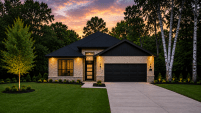
THE ROAD INTO MYSTIC RIDGE IN Hamburg Township, Mich., winds between tall trees. Driving through the woods, you can hear the hammering of rare woodpeckers and see pheasant, fox, and deer scooting along the paths. As the road leads to a clearing in the 277-acre property, you see model homes and the first residences on the hills. Although 183 acres of this development are dedicated open space, the remaining 94 are being transformed by a team of three building companies that have banded together to create the community of Mystic Ridge.
Small builders who typically erect 10 to 12 houses a year, Tumolo Building of Saline, Mich., and Fenton, Mich.–based Majestic Partners are working together on Mystic Ridge with the slightly larger Ann Arbor Builders of Ann Arbor, Mich. To do so, they must drop a formerly competitive stance. By working together, they are creating a brand, doing more marketing than each could otherwise afford, and assuming a new way of looking at what they do.
“Different builders putting up spec homes generates activity in the neighborhood faster,” says Betsy de Parry, the wife of Ann Arbor Builders president Alex de Parry who is filling the role of Mystic Ridge marketing manager. “That drives faster sales, and that helps everybody.”
Instead of losing such a large parcel of untouched land to the big guys, these companies came together to “control the site,” according to Alex de Parry. Controlling undeveloped land is something that small builders, by definition, only dream about.
It used to be that small builders bought parcels of land only when they needed to. Not so anymore. Today, the scope of the building market is much broader, as national corporations elbow their way onto the last undeveloped ground and scoop up hundreds of home sites without batting an eye.
Ten years ago, Jim Haeussler, president of Peters Building Co. in Saline and Mystic Ridge's developer, began inviting small builders to take part in his projects.
“We thought the bigger builders were going to be coming into the area, and if we wanted to develop land, which is the end of the business I like most, we would have to be an active player,” Haeussler says. “Before that, you went out and bought the next parcel because there wasn't anyone else around. [Now, any] excess land we acquire, we sell to other builders that might not have the ability to attract capital because land keeps getting more expensive.”
Costs increase because there is less and less undeveloped land around. Also, metropolitan builders are moving into rural areas such as Hamburg Township because they have already developed the vacant land in their own neck of the woods.
For Haeussler, it wasn't so much the approach of national companies as it was bigger builders from Detroit. “You're competing against more-established builders that build 100 to 300 houses a year,” he says.
At Mystic Ridge, the best benefit of combined efforts has to be the marketing advantage, says Laura Mason, a Tumolo principal. The de Parrys agree.
“You put your ego aside and market the [whole] subdivision,” says Betsy de Parry. “Everybody wins bigger. It's like a good marriage: When it works, you accomplish more together than you can individually.”
With an annual budget of $100,000, Mystic Ridge puts up expressway signs, takes out ads in all local newspapers (the development pulls from four surrounding counties), and staffs a model, marketing efforts that none of the companies could handle alone.
“We have historically been competitors for buyers,” says Mason. “It's a strategic change in mind-set for everybody.”
It's common practice nowadays for small builders to carve out a niche to help themselves compete against larger companies. But working together in such a way that everyone has their own mark of distinction is a novel approach.
At Mystic Ridge, a mixed-use development, each builder offers a slightly different product. They don't compete here because each attracts a different consumer. That offers the maximum for the market without diluting each builder's ability to succeed.
The first model went up in February 2004; as of January 2006, the trio had sold 20 homes. They range in price from condos that start in the $240,000s, to single-family residences priced between $270,000 and $400,000, to custom estate homes, where the sky's the limit.
“These builders might be competitive in a sub[division] down the road, but in this one, they're cooperating,” says Haeussler. “It's better than getting nothing [or than] having a larger entity come in and take the whole thing.”
Although it's becoming more common for small builders to buy into larger projects, it's rare to find some that truly work together, says Gopal Ahluwalia, staff vice president for research at the NAHB in Washington.
“In most places, there are four builders, and each one is doing his own advertising,” Ahluwalia says. “Twenty years back, one builder would build 200 lots. Now, there are five or six builders doing different types of houses. You subdivide your risk. They are still competitors—don't tell me they are not. It is a healthy competition, not cutthroat.”
Russ Redmer, a co-owner of Majestic Partners, agrees. His company is involved in a number of developments, several of which offer the same residential product built by three or four companies. In a tight market, Redmer says, that can mean stiff competition and fewer sales.
“When the market goes down, everybody's fighting for the same buyer, and they have virtually the same product,” says Redmer. His company is building attached condominiums at Mystic Ridge. “It can be quite cutthroat,” Redmer continues. “You start giving things away to spur the limited number of buyers. [At Mystic Ridge,] we're not pulling one from the other because we have a totally different product line. I think it's a great idea.”
Mystic Ridge is an open-space community concept developed together by Peters Building and the township seven years ago. When it is completed, ideally by 2009, the de Parrys say there will be the three types of residences plus athletic spaces, miles of walking trails, and a commercial component that evokes a sense of community—an old-time ice cream shop, for example, where neighborhood kids can charge purchases like in days gone by.
“[Alone,] we do not have the means to take over a 177-lot subdivision,” says Mason, let alone navigate the conservationist approach to open space or the development's commercial components.
“What we are trying to do by bringing in more builders is speed up the process,” says Alex de Parry. That means more land is being cleared and more houses are being built because of the trio's simultaneous efforts.
And the combined efforts build momentum in sales, says Mason. Multiple spec homes go up, and consumers see voluminous activity, a reassuring sight for buyers in a tight market.
“Activity breeds activity,” Mason says. “Especially in the early stages of a subdivision. The small builder covets sold jobs. By having to be friends with your competitors, you're pulling the market to you in a way you can't in one-off lots.”
Lynne Meredith Schreiber is a freelance writer based in Southfield, Mich.