Go With the Flow
The Drees Co. flirts with evenflow production scheduling through Web-enabled communication with trade partners and its field staff.
This April, The Drees Co. should complete the rollout, to all 13 of its divisions, of a program that allows its trade partners and site superintendents to submit field purchase orders (FPOs), with changes to original POs, through a Web-based portal, payment for which is vouchered automatically without the need for further approval or data entry. By streamlining its order-variance and accounts-payable activities, Drees expects to save $800,000 per year once its auto-voucher system is fully operational.
The FPO program, which began last August, is the latest twist to what has been a six-year-long journey by the Fort Mitchell, Ky.–based builder to make production more efficient and paperless by arming its contractors, suppliers, and its field staff with real-time scheduling and construction information they can access easily online. Along the way, Drees has weighed the pros and cons of applying evenflow construction theories to a company that last year started 3,105 homes and generated more than $1 billion in revenue.
Evenflow means different things to different builders, though few implement it under its classic definition of starting the same number of homes all the time and not letting starts exceed production capacity. “Most companies don’t have systems in place that tell them what their production capacity is,” observes Mahesh Bhupalam, president of Totally Productive Group, a Coral Gables, Fla.–based process improvement consultant.
No problem there for Drees, an avid investor in technology that two years ago installed a J.D. Edwards operating system. (J.D. Edwards is a division of Oracle.) But so far the company has cherry-picked different aspects of evenflow without taking the full leap, partly because Drees allows its buyers considerable leeway to customize their homes, which can gum up scheduling. Its 150 to 180 site superintendents—which it calls “builders”—can still override start and finish dates.
Nevertheless, evenflow, as an ideal, informs Drees’ production goals, says Ron Colyer, the company’s operations resource manager. Drees was all set to initiate a rigorous evenflow regimen at its Marquis Homes division last year until buyer demand softened. “We haven’t given up on that,” says Colyer. But after attending one of Bhupalam’s two-day seminars last summer, Colyer concluded that “evenflow isn’t some rigid marching order; it’s about balancing and planning starts, and managing your backlog.” Reducing cycle time, then, is less important to Drees than the fact that “we’ve become a lot more consistent.”
UNCLOGGING BOTTLENECKS The American poet and essayist Ralph Waldo Emerson once mused that a foolish consistency is the hobgoblin of little minds. But Drees, to be sure, isn’t foolish. It isn’t about to let scheduling restrain sales. Last summer, it accelerated production in Nashville, Tenn., to 40 starts per month—versus one start every three days, a company-wide target—to meet demand. “Our systems didn’t help us, but we didn’t want them to because we didn’t want to tell customers their homes would be delayed,” says Jack Herbstreit, Drees’ vice president of production.
It takes Drees between 110 and 120 days, on average, to construct a house, which Colyer admits isn’t much changed from previous years. Yet, its officials agree that, for now at least, evenflow is impractical. “We’ve never been able to do stringent even-flow,” says Dave Metz, vice president of national purchasing operations. “So we’ve focused on managing our flexibility.” Process improvements have, in fact, led to dramatic project-by-project gains, as in Jacksonville, Fla., where construction once took 180 days. Now, some homes there are being built in less than half that time. Drees has also winnowed one key measurement—contract to start time—to 72 days (and to as low as 45 days in some instances), from 90 several years ago, by placing plan reviewers and custom-design request coordinators in each region. Their job is to get house plans back into the office from the field faster. Those plans are now returned within five days, versus 17 to 20 days when Drees’ salespeople handled that task.
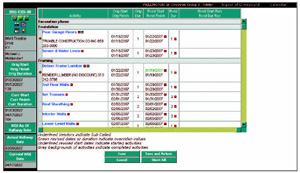
Herbstreit, while no evenflow advocate, is a big believer in establishing consistent methods of executing and monitoring production. He was the architect, back in 1998, of Drees’ first computerized scheduling system, which became the platform for DreesBuild, a Web-based portal that its builders update daily about what’s going on with every stage of their homes’ construction.
Through this portal, Drees can see where bottlenecks occur most quickly (typically at the stages involving poured-wall foundations, framing, and brickwork), and why. For example, one recent job was 23 days behind schedule partly because a delivery of framing lumber had been 10 days late. This portal also puts the strengths, weaknesses, and patterns of its builders and trade partners on full display.
When Drees spots red flags, one of its responses is to centralize its scheduling and reallocate manpower to neighborhoods whose construction is lagging. “The beauty of this is to be able to move [contractors] around from other districts that might have excess capacity,” explains Metz. In that respect, Drees follows evenflow doctrine of viewing its construction sites as a single “factory” whose total capacity—not just that of individual communities—dictates production.