EVERY SUNDAY EVENING AT 8 P.M. Eastern Standard Time, millions of Americans spends an hour being amazed at how a team of a half dozen good-looking designers on ABC's “Extreme Makeover: Home Edition” can take a house from drawing to completion in a week. If they really want to be amazed, they should take a look at the total commitment of hundreds of home building professionals who put in tens of thousands of hours, off-camera and without a make-up artist, to make a dream come true for a deserving family.
BUILDER recently hung out with Beazer Homes USA as its employees, vendors, and a host of other big-hearted pros built a home for the Harper family in the Atlanta suburb of Lake City, Ga.
In answer to the questions that everyone asks, yes, the family really doesn't know they've been selected until the design team shows up with their bus and their bullhorn to give them the news. They know they're one of the finalists, but the excitement on their faces on the show is real. Yes, the house really is built and decorated in a week.

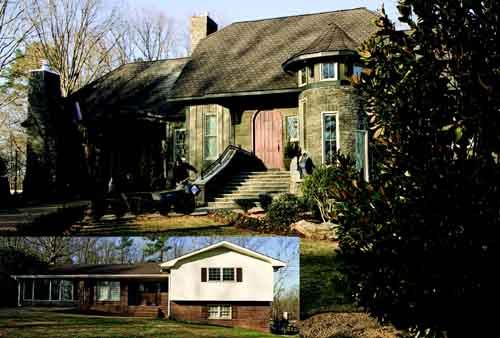
TRANSFORMATION: By all outward appearances, the Harper family's home (left) was fine. But inside, the septic tank backed up into the basement during every hard rain. The damage was so pervasive, renovation was out of the question. Volunteers from Beazer Homes and its trade partners replaced it with this stunning custom home (above)—in four days and four hours.
And yes, the families are amazing people who really need help. In the case of the Beazer house, Milton and Patricia Harper had saved for years to get out of a dangerous housing situation in New York City. They had known the heartbreak of losing a child, who choked to death at dinner one night because paramedics were delayed in reaching him; they were waiting for the police escort required to enter the projects. The Harpers finally found what they thought was their dream home in Atlanta; a 1,400-square-foot ranch with a basement in a neighborhood near an elementary school. By all appearances, it was a lovely home. As life-long renters, they didn't know some of the things they should look for in a home purchase beyond location, price, and bedroom count.
After they moved in, they were horrified to discover that the septic system backed up into the basement every time it rained. At times, the family had 3 feet of raw sewage in their home. It soaked into the walls, destroyed the carpets, permeated their clothes, and created noxious fumes that threatened the health of their three sons. Thousands of dollars in repairs failed to correct the problem; the family literally was forced to sleep in their van when it rained. They couldn't live in their house, but they certainly couldn't sell it either.
Out of money and options, they made an application video and sent it off to “Extreme Makeover: Home Edition.”
Planning Is EverythingWhat they didn't know on the morning of Jan. 16 when the design team and Beazer representatives arrived to give them the good news was that dozens of people already had been working for weeks on their new home. While viewers of the hit show get the impression that the designers think up a plan for the house and then call a builder to make it happen, the reality is a little different. Make that a lot different.

A STRONG START: Demolition of the existing house was swift (left). A chorus of cheers went up when the source of the problem, the septic tank, was removed. By the time the sun rose the following morning, the pre-cast basement walls (right) were in place and framing for the first floor was underway.
For Beazer Homes, whose build started Tuesday, Jan. 18, and officially ended when company president and CEO Ian McCarthy handed team leader Ty Pennington the keys on the afternoon of Saturday, Jan. 22, the frenzy began the first week of December.
Georgia division President Lou Steffens says his wife is partly responsible for the company's participation.
“She's very much into the show,” he says. “She said, ‘You guys have to do this.' I found someone to get a hold of and they said, ‘Funny you should call us. We're coming to Atlanta; we heard about you from HomeAid.'”
In a five-hour meeting with the show's producers, Beazer learned what the Harper family had been through. Their hearts went out to the hard-working family, who was in the process of moving in with a relative because their home was uninhabitable.
“They played us the tape, and we all started bawling,” says Marilyn Gardner, vice president of marketing.
Within days, Steffens and Mike Mansfield, Beazer's vice president of operations, were in California, observing another build and picking the brains of builders who had done previous shows. At the same time, Gonzalo Romero, Beazer's vice president of corporate planning and design, was sketching out the first plan for the house on a napkin.

CONTROLLED CHAOS: The only way to finish the task on time was to overlap the trades. Roofing crews worked overhead as framers, electricians, and plumbers worked simultaneously on the interior. Logistics were key; having the right materials and workers on the site in the right order reduced down time.
While some “Extreme Makeover” builders have used adaptations of existing plans, Beazer opted to start from scratch. Seeing the house as a fairy tale come true for the Harpers, Romero envisioned an English cottage, complete with turret to house its staircase. At 5,307 square feet under roof, it is the biggest house the show had ever attempted. The roof line is complex, the level of detail is extensive, and the scale is massive. If that weren't enough, the Beazer designers needed to consider camera angles.
“It influenced where we placed doors and the widths of openings,” Romero says. Romero's staff worked 16-hour days during the Christmas holidays to finish the plans. A process that normally would take three months was done in less than three weeks.
At the same time, all the materials were being ordered and Beazer staff was working on the build's most critical challenge—obtaining the necessary easements to connect the house to a county sewer system 350 feet away in the next subdivision. Without the success of that behind-the-scenes effort, all the other activity would be fruitless.
In early January, work began to build the frame of the house in a nearby warehouse. Once built, it was taken apart and stacked on trailers to reassemble in the correct order on the site.
One tricky part of the build was the basement, which was a critical part of the design, and normally would take an extended amount of time to install. To meet the constrained schedule, Beazer called on Pennsylvania-based Superior Walls of America to build pre-cast concrete basement walls and truck them to Georgia. Their use was a first for Beazer; it likely won't be the last. The use of pre-cast basement walls cut construction time significantly.

RACING THE CLOCK: An “Extreme Makeover” house is a 24/7 operation. The name of the game is speed, but not at the expense of quality. Beazer attacked the challenge by breaking down the task into small segments and plugging them into a scheduling spreadsheet that tracked progress in five-minute increments.
Setbacks And SlowdownsThe time saver proved crucial. By the time the walls were set, the team already was behind after hitting rock while digging the foundation. That resulted in needing double the gravel they had calculated. The crew leaders convinced a quarry an hour away to open early to help out.
By Thursday night, after 48 hours of round-the-clock work in bitterly cold weather, the team had stalled in their progress. On Friday morning, “Extreme Makeover” senior producer Conrad Ricketts cornered Steffens and Mansfield, telling them that with everything left to do, it would be virtually impossible for them to finish on time.
The pair called a huddle with their crew chiefs and laid out the situation. With a firm resolve that the Harper family would not have to wait even five extra minutes to move into their new home—and that they were not going to have to explain on national television why they had missed the deadline—they rallied the troops and made the jump to light speed. At various times of the day, it was almost impossible to move inside the house because so many people were working at the same time. (By the end of the build, more than 1,800 volunteers had contributed in excess of 180,000 work hours.) On Saturday afternoon, when McCarthy turned over the house to Pennington for interior design, they were two hours ahead of schedule.
But even that achievement paled in comparison to how the team felt when the Harpers saw their new home on Sunday afternoon. Mom Patricia practically collapsed on the spot, and everyone from dad Milton to their 7-year-old son, Mister, was in tears. If you ever want to see a bunch of builders lose it, go watch them give the keys to a family at an “Extreme Makeover” wrap-up.
Once Was EnoughWhile the build was an incredible experience for everyone in the company, it's called “extreme” for a good reason, McCarthy says.
“It's not something you want to do every day of the week,” he says. “It's the logistics, working 24/7, feeding all those workers, having to move them around. It's very demanding.”
Without question, the build took its toll on Beazer Homes. The event monopolized the attention of the Georgia division for the better part of six weeks, and the week of the event, everything else came to a grinding halt because virtually every Beazer Georgia employee and trade contractor was tied up on the “Extreme Makeover” house. Plus, the entire division dealt with exhaustion after the build was over.
“It was a fabulous experience, and we're so glad we did it, but we'll never do it again,” Gardner says. “We teasingly said to the division president, ‘We don't know if we should kiss you or kill you for doing this.' Definitely, once was enough.”
There were valuable construction lessons learned, though. It certainly demonstrated ways to fast-track plans, accelerate trade schedules, and reduce cycle time.
“We not only didn't wait between trades, we were multi-tasking,” McCarthy notes. “We had framers on the roof, plumbing and electrical all at the same time. At the end of the day you get a great home, with no down time and no leaving the home open. We built this in four days and four hours. I don't think we'll use this in production terms but we certainly should be looking to shave time off construction cycles.”
The Pay-OffDespite their determination not to repeat the experience, building an “Extreme Makeover” house was an incredible experience and did a number of things for Beazer, McCarthy says. It firmly established that Beazer can offer home buyers a much wider range of options than the entry-level home builder it's often portrayed as.
“Although we've built homes of this size before, it's great recognition for everyone across the company, of what Beazer can do, the style we can put in, and of having the [necessary] team, from designers to trade partners to our own people,” he says. “It shows everyone we can build to that level. It's an absolutely gorgeous home.”
They also pulled together as a team on a national basis. To involve employees and trade partners outside the Georgia region, Beazer posted a message on its intranet asking for donations for a cash gift to the family. They hoped to raise $100,000 for a scholarship fund for the children; donations came to $250,000. As a result, Beazer also gave the family $100,000 to cover the costs of upkeep of the home and gave the remaining $50,000 to an area homeless shelter in the name of the Harpers' son who died.
“I'm so proud of that achievement,” McCarthy says. “That's a reflection on the compassion of the company. There was no pressure on this. We asked people to donate whatever they wanted.”
As a sales and marketing effort, the decision to do the show was a no-brainer, Gardner says, and it's exceeded the company's expectations in terms of exposure. For weeks before the show aired, Beazer promoted it in its ads and at its sales centers, encouraging people to register to receive an e-mail alert about when the show would air. The show aired on Feb. 20, during sweeps week and drew more than 20 million viewers, plus those who tuned in the next night for the “How'd They Do That?” show, Gardner says. Beazer purchased a 30-second spot during the show and took out full-color ads in the lifestyle sections of daily newspapers in all of its markets.
“The outpouring was phenomenal,” she says. “Employees got such phenomenal feedback [from the public]. People said, ‘We saw you on ‘Extreme Makeover.' I didn't know about you. I'd love to buy a house from you guys.'”
Not surprisingly, many of the contacts were from people who wanted the same house they saw on the TV show. Gardner says they were inundated with messages from people who wanted the floor plans or wanted Beazer to build the house on their own lot. Neither is going to happen; Beazer doesn't sell its blue prints, and it doesn't have a build-on-your-lot division. It also has no plans to put the “Extreme Makeover” house into production.
“It's a very special house,” Gardner says. “I'm so proud of those guys. They built a custom-home prototype in four days and four hours. I saw it, and I still don't know how they did it. I'm in awe.”