IT WAS A CRY FOR HELP IN CYBERSPACE: “Anyone know where I can find a pair of safety glasses that will fit me?! I am so tired of mine slipping down while my hands are too busy to push them back up!”

A volley followed, with tradeswomen throughout the country responding with suggestions for certain brands of protective eyewear, Web sites, and, often, additional questions about where to find small work boots, gloves, and safety harnesses. Women in construction had come together on an Internet message board to find the safety equipment they needed—equipment that wasn't being provided by their employers at their jobsites.

That void led Terri Piasecki to trade in her career as a safety manager for one as an intermediary for tradeswomen, manufacturers, and employers, educating them about the need to provide more than “one size fits all” clothing and equipment and selling the alternatives on her Web site, charmandhammer.com.

“It doesn't matter if you're a man or a woman, you will still be exposed to the same hazards, but the protective side is different,” says Piasecki, who also serves as chair of the National Association of Women in Construction's (NAWIC) health and safety committee.

Recalling an employer who sought her help to find a safety harness to fit his 5-foot, 1-inch female employee—who'd been using a men's large harness—Piasecki says, “That's one employer who would go out of their way. If you have 50 employees and you have one who needs something different, it's very difficult for people to go out of their way.”

One woman out of 50 workers isn't much of an exaggeration. Though it's difficult to pinpoint the share of construction workers women constitute, it's often estimated at less than 10 percent. As described by an OSHA workgroup in 1999, this statistic is part of a circular problem: Safety and health problems for women in construction create barriers to working in the field, but with few women on job-sites, safety and health concerns can persist. In many cases, tradeswomen are on their own to find protective clothing and equipment that fits, keeping manufacturers in the dark as to the demand that could lead to better—and more readily available—solutions.

ON THEIR OWN

“We don't think you can be race, color, or gender blind and able to provide equity for everyone,” says Lauren Sugarman, president of Chicago Women in Trades, an industry workgroup designed to increase the number of women in nontraditional jobs. The industry may fail to uncover dangerous situations if it doesn't consider work-place safety through a gender lens, she says.

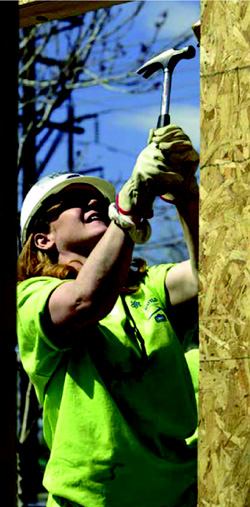
FOR WOMEN, BY WOMEN: Construction crews on Habitat for Humanity Women Build sites go through extensive construction safety training before and during projects.

FOR WOMEN, BY WOMEN: Construction crews on Habitat for Humanity Women Build sites go through extensive construction safety training before and during projects.

Sugarman participated in OSHA's Health and Safety of Women in Construction (HASWIC) workgroup in 1999, which presented the agency with a comprehensive study of the health and safety perils facing women on construction sites. Citing research that included a survey of tradeswomen by Sugarman's organization and two studies by the National Institute for Occupational Safety and Health (NIOSH), protective clothing and equipment in the wrong sizes and poor on-the-job training adversely affected women's ability to do their jobs safely, HASWIC reported.

The group's report included some eye-opening figures. In the second NIOSH study, 46 percent of women responded that they could not easily find work shoes that fit; 41 percent said they could not find work gloves.

Although HASWIC included dozens of recommendations with its report, more-recent reports continue to echo the concerns the group highlighted six years ago. As part of her research for a chapter on women's health and safety for Construction Safety Management and Engineering, a book published by the American Society of Safety Engineers, safety and industrial hygiene manager Carol Schmeidler distributed a survey through NAWIC to almost 200 women working in construction. While 95 percent responded that they were trained to do their jobs safely, 56 percent had become ill or been injured on the job. What's more, 32 percent of respondents were dissatisfied with the fit and function of safety equipment.


Sugarman laments that such valuable research seems not to have made a significant difference on the jobsite. “It's still an individual woman's quest to find what works,” she says. “Whenever you translate something into somebody having to find an individual solution, you're limiting the potential of the best solution. You're not bringing the company's, the industry's, full resources to bear.”

GETTING ON THE AGENDA

That's not to say that individual women aren't making a difference. A small group approached California's state OSHA, requesting that its advisory committee review the rules regarding personal protective equipment. Yet another survey was administered, and though the final results haven't been released, many of the respondents' concerns centered on the adequacy of fall protection harnesses, says Deborah Gold, a senior industrial hygienist at Cal/OSHA.

The traditional design of the harness—a horizontal strap holding two vertical straps together—fails many women. (If the horizontal strap lies above their breasts, the harness isn't secure; if it's below, it may not keep the straps together at the top.) “The universal harness isn't working well for an awful lot of people. You see people dragging the straps because no one's thinking of the size and fit issue,” Gold says.

Cal/OSHA has found, however, that its personal protective equipment rules aren't what need changing; employers' buying habits do. To that end, Gold says her agency intends to use its survey data to push employer education. “If you're going to spend the money for six harnesses, you might as well spend the money for six harnesses that fit. Poorly fitting equipment is going to decrease productivity. There's a high stake in not wasting money on bad-fitting equipment. It's something where both employers and employees have the same interests at heart.”

Nancy Eaton, president of NAWIC, sees promise in both women's numbers in the workforce and the volume of their voices. While fewer than 1 million women currently work in construction, as compared with 10 million men, that ratio will begin to shift as the baby boomers retire. “[Construction companies] are going to have to start drawing from women. There won't be enough men to fill all the jobs,” she says. Companies that can use strong safety records to appeal to women will bolster their ability to attract and retain employees in the future, she adds.

Still, today it's the workers who are pushing for change. “Women are starting to put pressure on manufacturers, not so much the construction companies,” she says. “They're saying, ‘Give us the harnesses that fit our bodies. I'm not doing this any-more. Make something that fits me.'”

Enough women wrote to Ironclad, a manufacturer of work gloves, that it did just that. The company began offering a women's glove in 2001; it redesigned and renamed it, branding it the Evolution, in 2003. The glove features seamless fingertips—where women's nails sometimes get caught—and narrower and longer fingers. “Women's hands have different dimensions [than men's]. Proportionally, they're not the same,” says Eric Jaeger, Ironclad's director of research and development.

The Evolution glove has been well received—so well that the company plans to expand the line to include a wider range of price points and designs—but tends to be sold to individual buyers at hardware and lumber stores, not in bulk at industrial supply stores.

Ironclad also offers extra-small sizes in some of its heavier utility gloves, though the proportions may not be as ideal as the Evolution glove. Enter market realities: “We're in a market that's 90 percent men, so we can't make every single glove also in a women's glove, because we wouldn't sell enough,” Jaeger acknowledges. “We need the demand to generate the products, and we need the products to generate the demand.”

GOOD FOR THE GROUP

Experts agree that the best builders approach safety with a comprehensive plan for a diverse workforce.

Laura Lynch learned a lot about practicing her craft safely as a carpenter through colleagues in the National Association of Women in Construction, but those lessons were ingrained by a monthly safety program conducted by the custom home builder she worked for in North Carolina. “They were smart. Whether you're a young man or a young woman, they don't want you throwing your back out, because their insurance is going to pay for it either way,” she says. “It's proactive thinking and management.”

Many of the experts studying women's work-place safety are quick to point out that while women's bodies are shaped and sized differently from those of their male colleagues, many men also fall outside the “normal” sizes of protective equipment. The best employers, they say, consider a wide range of sizes found in an increasingly diverse workforce and plan for them accordingly.

A recent study of fall protection harnesses found that the traditional design, made for average-sized men as measured by the military in the 1950s, was not working for many of the men on jobsites, says Deborah Gold, a senior industrial hygienist for California's OSHA program. “The bottom line about most of these women's issues on construction sites is that men are impacted as well,” she says.

Safety standards and practices on Habitat for Humanity's Women Build sites, where the construction is led by teams of women, mirror those on traditional Habitat work sites, says Fiona Eastwood, director of Women Build. “The only difference is in the way safety is handled by the different genders,” she says. “We find women are more safety conscious [than men], anyway. They tend to adhere to the letter, if not to the extreme.”

Several companies have introduced tool lines designed for women, but aside from an occasional lighter hammer, Eastwood says most women on her crews use traditional construction tools. “They want the real tools, not the tools labeled ‘for women,' ” she says. “They can use them safely as long as they know the safety precautions.”