YOU CAN LEARN A LOT BY TALKING with OSHA inspectors. First, they're not jack-booted thugs who are out to get you. Second, they do have a mission, and if you get in the way of that mission, you may pay the price.

That's a fact that J.B. Stevens Construction Co. of Gainesville, Ga., can attest to firsthand. When a 14-foot-deep trench collapsed on a worker back in November 2004, emergency crews spent more than eight hours before successfully freeing him from his nightmare experience.

As a result, the builder now faces proposed OSHA fines totaling $84,700. OSHA issued the company a total of four citations, and the violations were published online as part of OSHA's regular practice of pillorying bad actors.

“By failing to follow safe trenching procedures, this employer put the lives of employees and rescue workers at risk,” says Gei Thae Breezley, OSHA's Atlanta-East area director. “Hurrying to finish a job while ignoring safety rules too often ends in workers being injured and killed. In this incident, the worker was trapped for over eight hours.”

VIOLATORS BEWARE

That's an example of OSHA using the stick.

Now here's the carrot. OSHA will actually help you get your safety house in order for free. As a result, you'll have healthier employees, fewer fines, and a new perk to offer subcontractors.

Cindy Laseter heads up one of the busiest and most powerful OSHA regional offices, in Atlanta. She's frank about what OSHA's mission is—and why. She's especially focused on Florida, where 46 construction workers (including residential and commercial sites) have died so far this year.

“What we have done for the past several years is send teams in to do saturation enforcement, conducting a lot of inspections [in problem areas],” Laseter says. “We have found that we see a dramatic decline in safety violations for three months following this effort, then the number starts to creep up again.”

Over the long term, of course, OSHA wants to break that cycle and keep the numbers low. In a nutshell, the agency plans to reduce workplace fatalities by at least 15 percent by 2008 by enforcing fines and assisting in compliance. It also wants to reduce workplace injuries and illnesses by at least 20 percent using the same good cop, bad cop strategy. It takes these sorts of goals seriously because it faces serious scrutiny from the federal government if it doesn't produce results. You can bet that when that deadline draws near, citations and fines will rise apace.

TRUTH OR DARE

Staying out of the OSHA spotlight, it turns out, is more about dumb luck than strategy. OSHA inspectors don't have a rigorous system for choosing which jobs to inspect at any given time. They just drive by.
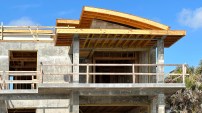

“One of the key things our inspectors look for is fall hazards,” Laseter says. “If the scaffolding is good and everybody is tied off, they're gonna keep going. If not, they're going to stop. They generally focus on key problems: falls, electrical hazards, work trucks, and trenching.

“It really is just that random,” she adds. “We go into an area, and we are aware just from driving around where all the construction is. Typically, the construction is so prevalent that we don't need a complicated scheme.”

In fact, says Laseter, OSHA is really looking at one job, one worker at a time, not targeting a subdivision, for example. That means that even if you have the right gear and guardrails in place, all workers have to be on board with safety protocol, or you could still face a violation.

FULL-COURT PRESS

When a company does get a major safety violation, with a fine of $40,000 or more, Laseter says, OSHA sends out a press release to local media outlets, letting them know about the errant builder.

The agency is also ready to play hard-ball on fines and take the issue to court. Few builders even bother to challenge safety citations.

“We have a contest rate of about 3.2 percent, which is very low,” notes Laseter. “We have a lot of good builders who want to do the right thing, but we also have a lot of mostly smaller contractors that are very hard to reach. They're just playing [Russian] roulette.”

BUILDERS TAKE HEED

Mark Labriola has a new job that was just created in January. He's the national director of safety for Centex Corp. in Dallas.

“We're respectful of what OSHA does, and we try to keep a good relationship with them,” he says. “Speed has to take a back seat to safety. We really focus on efficiency. If you're not being safe, you're not being efficient. One mistake can cost you a lot more time than working safely would have.”

Matt Murphy, a safety consultant with SEE, a consulting firm in Fairfax, Va., says that, as in other regions, builders in his area have also felt growing pressure from OSHA.

“Home builders [here] were ignored for a while,” he says. “They were not on the front burner—but now that commercial is better focused on safety, OSHA's emphasis is shifting toward residential.”

What can builders do to reduce the risk of an OSHA visit? First and foremost, Murphy says, keep a clean and organized jobsite. Also, make scaffoldings safe and secure, and wear hard hats.

“I'd worry more about losing an employee to an accident than a citation,” he adds. “I've heard of builders packing it up over major injuries, not just fatalities. One guy lost his eye, and he sued for a million and won. And workers' compensation rates are going through the roof.”

Labriola says every Centex division now has a safety officer, who is in charge of training and inspections and makes sure that the company's safety culture is passed down all the way to field managers.

He notes that the typical residential jobsite of today is far more safety oriented than it may have been 10 years ago. “For one thing, you'll see a lot of hard hats, and scaffolding that has a lot more sophistication,” he says. “At most of our sites, we now have the contract framer put in tie-off attachments that all of the subs can use when they're working at heights. We try to give everybody the ability to use safety equipment.”

THE FIX

OSHA's Laseter points out that builders have available to them many tools to improve safety. For example, OSHA runs Hispanic safety health fairs several times each year, in different states.

“We don't care whether the workers are documented or not, and we don't ask them,” says Laster. “We hold them on a Saturday, with activities for families, and run safety training seminars all day. We try to bridge the gap with OSHA, to make us feel like an ally.”

In addition, builders can take advantage of “safe” inspections provided by OSHA called “Consultation Programs.” No citations are issued, but builders are required to fix any safety violations pointed out by the inspectors within a certain time frame.

Murphy notes that more builders should take advantage of this offer, but they don't, because they're afraid of getting on the OSHA radar. “Of all the builders who have used this service, I've only heard of two sites where six months after they completed the consultation program they got an inspection—and one was in response to an accident.”

Laseter adds that such safety review programs are effective, because most job-site mishaps happen in predictable ways. “It's the same stuff we've seen for 40 years,” she says. “Nine out of 10 times, workers think they can break safety regulations to beat the weather or meet a contract deadline. Just taking the time to work safely isn't always part of the equation, but it has to be.”

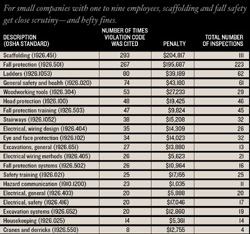
SOURCE: OSHA, NATIONAL DATA, OCTOBER 2003 TO SEPTEMBER 2004, GENERAL CONTRACTORS, SINGLE-FAMILY HOMES

TAKE COVERAGE

A poor safety record can mean no insurance and cost you the ability to do business.

Your ability to get and afford workers' compensation or general liability insurance is dramatically affected by your safety record. In an industry that is already gun-shy about insuring builders (due largely to the prevalence of costly lawsuits), this can be the straw that breaks your company's back.

Tom Williams, an underwriter with the Florida Homebuilders Insurance Agency in Tallahassee, Fla., says that both the availability and costs of insurance can be significantly affected by a record of violations and/or jobsite injuries.

“In most case, we would be looking at the current year, plus the last three years,” notes Williams. “We look at the loss history and how well it has been managed. We're especially interested in the frequency of claims. That's usually a good indicator of whether a company is a good risk.” One thing Williams makes clear: Insurers don't care about the extenuating circumstances that caused you to have safety problems on your jobsite. Ultimately, they're studying the numbers.

“The overall trend in this region has been an increase in the number of [injury] claims, and the value of those claims has gone up,” Williams says. “We've had workers' comp reform put in place in Florida a couple of years ago, but it's too soon to tell what the impact of that will be.

“We look carefully at employee selection and training. We might look at the company's Web site—sometimes we get a five-year loss history.”

Like any underwriter, of course, Williams is especially wary of red flag events like a death on the builder's watch.

“If there's a couple larger losses, we will want to know why that is happening,” Williams says. “In order for us to underwrite that company in the future, we would need to see corrective action taken on those losses.