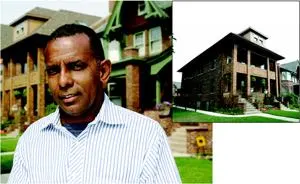
Beyond empty billboards, lonely highway overpasses, and overgrown vacant lots is Ferry Street, a block of renovated historic brick Victorians in the heart of Detroit. Well-kept lawns and shade trees adorn this neighborhood two miles north of the Detroit River, mostly because of the work and dedication of one builder.
Born in Haiti and educated in New York, Julio Bateau came to Detroit in 1978 after grad school. He intended to earn corporate experience but instead turned his attention to transforming part of the broken-down inner city into a dreamscape of gorgeous homes and soaring property values.
“This place was almost like you see Beirut on TV,” says Bateau. “The whole city was absolutely beautiful in terms of architecture, but it was reminiscent of the 1960s riots” that decimated Detroit: burned-out shells of once-beautiful three-story structures, streets so empty they echoed.
After seeing restoration efforts beautify East Coast cities, Bateau sought to do the same for Detroit. He settled on the area known as the Cultural Center, home to the Detroit Institute of Arts, Wayne State University, and Detroit Medical Center buildings. “It begged to be built,” he says.
Developed first in the 1880s as an upper-class residential area, Ferry Street became a fashionable place to live for such esteemed residents as Charles Lang Freer, part-owner of the Peninsular Car Co.; William A. Pungs, vice president of the Michigan Railroad Supply Co.; and architect John Scott, among others. Between 1910 and 1925, the neighborhood became predominantly Jewish, then African American, eventually becoming the residence of Fairview Sanitorium, owned by Dr. Robert Greenidge, Detroit’s first black radiologist.
By the time Bateau arrived, the Queen Anne–style dwellings, with French Renaissance and Colonial Revival detailing, were in ruins. No one saw the stonework, tall-hipped roofs, or classical pilasters, nor the turrets or bowed windows. What they saw were dark, vacant holes, abandoned buildings. No one dared develop the area. They were too afraid of fires, vandals, and thieves and didn’t want to take a chance on building housing so close to where drug dealers and prostitutes plied their trades.
These details hit home for Bateau, who was all too familiar with the plight of under-served populations in his native Haiti. He’d witnessed the plight of refugees first-hand and had seen what it takes to rebuild broken-down neighborhoods, so he began slowly.
First, Bateau bought 421, now his company’s headquarters. The original residence of J.L. Hudson, the head of Detroit’s illustrious former department store, this late-1800s 4,000-square-foot Victorian was boarded up and vandalized. But Bateau saw through the damage to its four fireplaces and other details. He knew it could be “absolutely gorgeous.”
Banks, however, were not as optimistic. Though it only cost $400 to buy the dilapidated property, renovation would cost more and Bateau had no money. (All the remodeled units on this block now go for at least $300,000). “One bank said, ‘The only way we’ll touch it is if you buy the whole neighborhood,’” Bateau laughs. He finally secured a loan when he consented to do the whole block. He agreed to pay less than $150,000 for five houses on big lots on one side of Ferry between Beaubien and Brush streets. Two years later, he bought the other side of the street as well. Acknowledging now that the banks were right, he says, “It was the only way to stabilize the neighborhood.”
THE VISION OF A BUILDER Developing an entire street in a major city usually can only be accomplished by mega-developers. But in a city of ruins it’s a risky proposition even for those companies with very deep pockets. Indeed, during the renovation of three corner brownstones, Bateau endured two major fires, back to back. It was enough, he says, “to break anybody’s will.”
Learn more about markets featured in this article: Detroit, MI.