This month, owners will start moving into the north tower of Glass House, a condominium high-rise that has brought moderately priced urban living to downtown Denver. Situated within the 28-acre Riverfront Park complex in Denver's trendy downtown LoDo District, the $90 million Glass House—whose south tower opened last month—ranks among this market's fastest-selling residential projects.
“I've covered real estate for 23 years, and for a development this size, nothing in Denver has sold out that quickly,” says John Rebchook of the Rocky Mountain News.

Credit: East West Partners and FL2
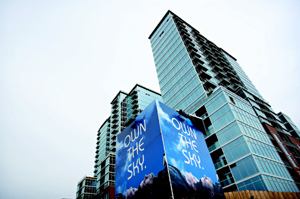
FIRST GLANCE: An imposing billboard, with the tagline "Own the Sky," was the only visible advetising the developers of Glass House used to promote their building. That signage directed people to the project's Web site, where they could register to receive more information.
Within six weeks of its sales office opening in April 2006, most of Glass House's 389 units were gone. “The customer base was pretty deep,” says Chris Frampton, vice president of sales and marketing for Avon, Colo.–based East West Partners, Glass House's co-developer. “A lot of [downtown] renters are paying a 50 percent premium over the rest of the metropolitan area.”
FIT TO A “T”While it's obvious now that Glass House had tapped a pent-up–buyer vein, East West and its development partner, Marietta, Ga.–based Wood Partners, had plenty to be anxious about in a Denver market where construction of for-sale condos in downtown and surrounding neighborhoods had fallen steadily over the previous four years, and where fewer than 500 downtown condos had been sold annually, on average, over the previous decade. Mike Rinner, a vice president with The Genesis Group, a market research firm based in Englewood, Colo., says sales of condos priced higher than $400 per square foot (pretty much everything Glass House competed against) had all but stopped since 2000.

Credit: Wood Partners
CLEAR VIEW: Glass House's window-wall exterior was one of its main selling features. The system was quick to assemble, which helped keep the project on a tight construction schedule.
Glass House's primary targets were young first-time buyers and empty-nesters, and its main attractions were floor-to-ceiling window walls that offer stunning views of Denver's mountains, parks, and skyline, as well as the apartments' comparatively reasonable prices. The developers could market Glass House's condos profitably, within a price range that averaged $375 per square foot, by scaling down the building to what Ryan Dearborn, a Houston-based director for Wood Partners, describes as a “Model T” interior design whose sole option was three colors of wood flooring.
“It's essentially the same apartment, stacked 23 stories,” says Dearborn. That made life easier for the Denver office of JE Dunn Construction, the project's general contractor, which was on a tight, 91-week schedule. But—thanks in part to a mild winter—Dunn controlled construction costs and delivered the towers 34 days ahead of schedule.

Credit: Wood Partners
Dustin Liljehorn, senior project manager for Dunn's Rocky Mountain division, says Glass House's exterior window-wall system can be assembled quickly, which allowed Dunn to use steel-framed “form work tables” to pour concrete for the floors and ceilings. The concrete dries to a tensile strength of 3,000 pounds per square inch within 18 hours, at which point the tables are moved through the side of the building to the next-highest floor. This construction technique is effective, explains Liljehorn, only when workers erecting the building's “skin” can keep up with the concrete pouring.
A subsidiary of Dunn's had worked on Wood Partners' first for-sale projects in Atlanta, which were designed by the same architect responsible for Glass House, The Preston Partnership, based in Atlanta.

MORE CHOICES: Glass House targeted young first-time home buyers and empty-nesters with condos whose average size and selling price—1,067 square feet and $350,000 —made them attractive alternatives to the $1-million-plus apartments typically available in downtown Denver.
“One thing that's fundamental to managing construction costs is the repeat use of a project's team members,” says Rick Mercer, who heads up Wood's design and construction group. He calls Preston's signature window-wall exterior design “aesthetically pleasing” and “practical.” The design attracted the attention of Washington-based Robert Charles Lesser & Co., the consulting firm that advises East West on Riverfront Park.
When Wood wanted to expand its Texas operations (which it opened in 2002), an alliance with East West in Denver seemed the perfect fit. And Wood Partners' successes with this kind of construction in Atlanta contributed to shortening the time it took to get site approval for Glass House to less than six months. “We already had something we could show planners,” says Dearborn.

Credit: The Preston Partnership
SIMPLE APPROACH: Glass House's developers could sell apartments at prices below those of most high-rises in downtown Denver by essentially offering only one option—a choice of three colors of hardwood floors—in every plan, be it an 860-square-foot, one-bedroom flat or a 2,000-square-foot penthouse on the top two floors.
PIQUING BUYER INTERESTRiverfront Park's cachet notwithstanding, the stage for Glass House's appeal to buyers was largely set by a coy, Internet-driven marketing campaign that East West (which handled sales for the project) launched in 2005. A billboard on the construction site showed a rendering of Glass House with the tagline “Own the Sky” and pointed curious passersby to a Web site East West had set up. The site focused—somewhat vaguely, says Frampton—on the residence's lifestyle, with images such as those of people hanging out at Glass House's 200-foot-long pool or its 6,500-square-foot fitness center.
It didn't take long before newspaper articles and real estate blogs were buzzing about the project, and for six months East West leaked more details via monthly e-mail blasts to people who registered on its site. All told, 7,200 people signed up to find out what all the commotion was about.

SUBTLE SEDUCTION: Its developers created buzz about Glass House through a canny Internet marketing campaign that leaked information about the project over a six-month period. The effort drew 7,200 curiosity seekers and 2,000-plus prospects. The heart of the campaign was a jazzy, emotive Web site created by Denver-based FL2.
East West then hired Denver-based Web designer FL2 to create a hipper, “emotive” site, with a different URL that registrants learned of through a separate mailing. The developer also began meeting at a restaurant called Zengo with groups of 10 to 15 registrants (500 in total) who clamored for more information. At the meetings, East West's salespeople answered specific questions.
These prospects were the first to receive an online questionnaire that East West eventually sent to all registrants, who had to fill it out to schedule an appointment at the sales office. More than 2,000 people completed the 25-question survey, and East West scheduled 550 appointments.
Dearborn says Wood Partners thought it might take 18 months after construction was completed to sell out the towers, but five months after the sales office opened, only four units remained unsold. People who already owned homes in Riverfront Park accounted for 20 percent of Glass House's contracts. However, East West limited investors to 10 percent of the apartments sold.
The developers are planning the next phase of their Riverfront Park project, a 375-unit glass building in Commons Park called City House. The building should get started this year and could include some rental units. Wood Partners also has similar projects under way in Los Angeles, Houston, and Dallas, where, Dearborn notes, only one in 24 prospects qualified as a buyer for the W Hotels' plush new hotel/condo high-rise. “Our building will cater to the other 23,” says Dearborn.
LOCATION: DENVER- Building: Two towers, each 23 stories and 286 feet high, with a total of 389 apartments and 400,000 square feet of sellable space. Towers built on one podium with eight levels of parking and 500 slots.
- Developers: Wood Partners, Marietta, Ga.; East West Partners, Avon, Colo.
- Architect:The Preston Partnership, Atlanta
- General contractor: JE Dunn Construction, Kansas City, Mo.
- Owner rep: DAE Construction Services, Denver
- Costs: $90 million, approximately $70 million of which comprised construction