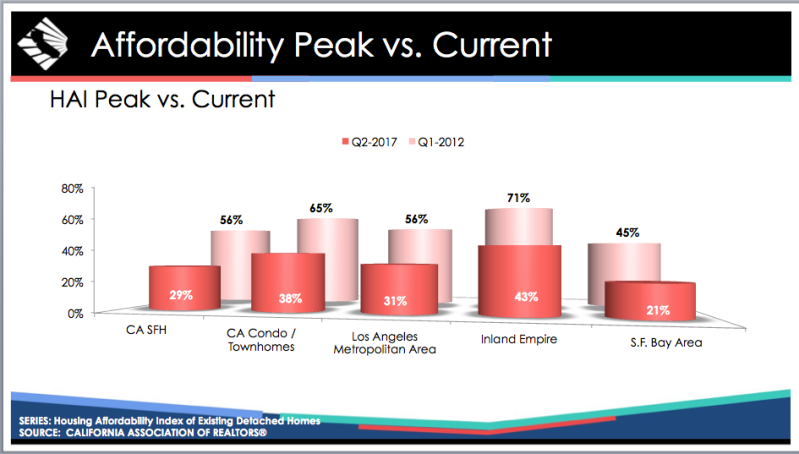
Higher home prices resulting from a severe lack of homes for sale and high demand during the hot home-buying season eroded California’s housing affordability in the second quarter, the CALIFORNIA ASSOCIATION OF REALTORS® (C.A.R.) said Wednesday.
The percentage of home buyers who could afford to purchase a median-priced, existing single-family home in California in second-quarter 2017 fell to 29%, down from 32%in the first quarter of 2017 and down from 31% in the second quarter a year ago, according to C.A.R.’s Traditional Housing Affordability Index (HAI). This is the 17th consecutive quarter that the index has been below 40% and the lowest since third-quarter 2015. California’s housing affordability index hit a peak of 56% in the first quarter of 2012.
C.A.R.’s HAI measures the percentage of all households that can afford to purchase a median-priced, single-family home in California. C.A.R. also reports affordability indices for regions and select counties within the state. The Index is considered the most fundamental measure of housing well-being for home buyers in the state.
A minimum annual income of $110,890 was needed to qualify for the purchase of a $553,260 statewide median-priced, existing single-family home in the second quarter of 2017. The monthly payment, including taxes and insurance on a 30-year, fixed-rate loan, would be $2,770, assuming a 20 percent down payment and an effective composite interest rate of 4.09%. The effective composite interest rate in first-quarter 2017 was 4.36% and 3.85% in the second quarter of 2016.
Home prices have nearly doubled since affordability reached its highest level five years ago, and compared to then, home buyers now need twice the income to purchase a median-priced home. In the first quarter of 2012, buyers statewide needed a minimum annual income of $56,320 to purchase a home that was priced $279,190. And in the San Francisco Bay Area, a home buyer needed a minimum annual income of $90,370 to purchase a $447,970 priced home just five years ago. Compare that to the current minimum income of $179,390 needed to purchase an $895,000 priced home now.
Condominiums and townhomes also were less affordable in second-quarter 2017 compared to the previous quarter. 38% of California households earned the minimum income to qualify for the purchase of a $443,400 median-priced condominium/townhome in the second quarter of 2017, and an annual income of $88,870 was required to make monthly payments of $2,220. 40% of households could afford to purchase the $414,840priced condo or townhome in first-quarter 2017.
Other finding:
- Compared to affordability in first-quarter 2017, only six of 43 counties tracked posted an improvement in housing affordability (Napa, Santa Barbara, San Benito, Mariposa/Tuolumne, Mendocino, and Sutter), 29 experienced a decline (Alameda, Contra Costa, Marin, San Francisco, San Mateo, Santa Clara, Solano, Los Angeles, San Bernardino, San Diego, Ventura, Monterey, Fresno, Kern, Kings, Madera, Merced, Placer, Sacramento, San Joaquin, Stanislaus, Amador, Butte, El Dorado, Lake, Mendocino, Shasta, Yolo, Yuba), and eight were unchanged (Sonoma, Orange, Riverside, San Luis Obispo, Santa Cruz, Tulare, Humboldt, and Sutter).
- During the second quarter of 2017, the most affordable counties in California were Tehama (57%), Kern (54%), Sutter, (53%), Kings and Tulare (both at 52%).
- San Francisco (12%), San Mateo (14%), and Santa Barbara (16%, Santa Clara and Santa Cruz(both at 17%) counties were the least affordable areas in the state.
- Housing affordability figures are now available for the following counties: Amador, Butte, El Dorado, Humboldt, Lake, Mariposa and Tuolumne (combined), Mendocino, San Benito, Shasta, Siskiyou, Sutter, Tehama, Yolo, and Yuba. See accompanying tables.