CHAD AND JAN WILSON HAVE been married for 16 years. They were college sweethearts. He's an electrical engineer; she's a marketing executive. Chad's passion is cooking, and he loves to try out new recipes when their alumni club gets together to cheer for the team on TV. Jan is a history buff and is particularly interested in the Renaissance period.

Their son, Clint, is 13, excels at science and can tell you the names and records of every team that made it to the quarterfinals of the last World Cup. Their daughter, Katie, is 10 and has just gotten the lead role in the local children's theater production of “Annie.” Her idea of a great way to spend the day is writing a play and then designing and creating costumes for all of her characters.

Who are the Wilsons? They're a target demographic of second-time, move-up buyers. Model merchandisers regularly dream up family profiles to create memorable model homes and help buyers connect on a very personal level with the house.

By giving target buyers an identity, builders don't lose sight of their goal during merchandising, says Barbara Decker, principal of Denver-based Captivating Design Service. “The secret is to tug at their emotions and have them say, ‘I love this home!' ” she says.

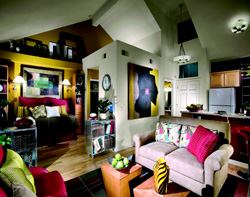
DRAMATIC SCALE: Even the smallest model, such as this 485-square-foot studio at Seabridge Villas in Los Angeles, can feel inviting and spacious with properly scaled furniture and accessories.

DRAMATIC SCALE: Even the smallest model, such as this 485-square-foot studio at Seabridge Villas in Los Angeles, can feel inviting and spacious with properly scaled furniture and accessories.

It's just one of the tools that top merchandisers use to help increase sales of both houses and options and upgrades. Here is a top 10 list of tips from the pros on how to make your models simply irresistible.

1. STAY ON TARGET

Everything needs to work together, says award-winning model merchandiser Mary DeWalt, principal of Dallas-based Mary DeWalt Design Group, because buyers may look at as many as 75 models before they make a purchase decision. The merchandising should show them how a family just like theirs lives in the house.

“A model has to have all the parts in place; it's that subliminal,” DeWalt says. “What makes it so great is everything. I hate to hear builders say, ‘We want to do a Spiderman bedroom to make people remember the house.' You don't want them to remember one really bizarre or trendy thing. It's everything that resonates with how they want to live.”

2. GET THEM AT THE FRONT DOOR

The entrance is extremely important because it sets the tone for the buyer's expectations, says Julie Hilton, director of design for Virginia-based Oakcrest Builders. Make sure the house seems as open as possible and take advantage of natural light. “I liken it to displays you see in a department store to make it appealing,” she says.

3. SPEAK THEIR LANGUAGE

Research the neighborhood and see where your buyers shop. You'll use a different approach if the closest store is a Neiman Marcus than if it's a Target or a Steinmart. Incorporate items from those types of retailers in your models, DeWalt says. “It creates a real strong comfort level,” she says. “It's like greeting an old friend. You're showing them ideas they can recreate.”

What you don't want to do, she says, is become so specific that you cross into the realm of stereotyping and clichés, whether it's with ethnic groups, the architectural style, or the theme of the house. You can convey an equestrian lifestyle, for example, without plastering the house with horse accessories.


4. GET ON THE SCALE

Nothing mucks up a model like furniture and accessories that aren't properly sized for the house, says Joel Armstrong, senior vice president of real estate development for Boca Raton, Fla.–based Levitt and Sons. It drives him nuts, he says, to walk into a model with small bedrooms and see four-poster beds that overwhelm the space. De-Walt has the same beef with accessories and artwork that are undersized for great rooms or volume ceilings.

5. INVOLVE MERCHANDISERS EARLY ON

Builders who use merchandisers regularly say they get the best results when they bring the merchandiser in at the design stage. It helps the architect create floor plans that make the best use of the space to place furniture. “I can't tell you how many times we've moved windows to make room for a king-sized bed in a master bedroom,” DeWalt says, “or moved a door so a dresser will go in a bedroom.”

6. BRIDGE THE GAP BETWEEN ORDINARY AND ATTRACTIVE

If a house is overdecorated, prospective buyers can't imagine their own furniture in the space, says Diane Saatchi, senior vice president with The Corcoran Group, a real estate firm in East Hampton, N.Y. “There should be nothing wacky,” she says. “No room should make them say, ‘What is this room for?' If it's a kitchen, it should look like you can actually cook in it.” Make the spaces practical so people can imagine living in it. “A lot of decorators don't pay attention and [place] the seating in a way so it doesn't face the TV or place the bed in a bedroom so the TV, phone, and fireplace aren't in the right place. ... Be extraordinarily practical.”

7. YOU DON'T HAVE TO SPEND A FORTUNE

If you're merchandising on a tight budget, you'll get the biggest bang for the buck with paint, says Jan Roberts, director of design and merchandising for Chicago-based Town & Country Homes. The current trend is regal tones—purples, golds, greens, and reds—and paint techniques, such as glazing to create an Old World look. “It's warm, inviting, and makes you want to sit there and say, ‘Wow, this feels good,' ” she says. Window treatments can be dramatic without being expensive, and pillows can do wonders for dressing up sofas and beds. Also, you don't have to spend a fortune to get great accessories these days. Roberts says she finds a lot of accessories at Cost Plus World Market and T.J. Maxx and More.

8. LET THERE BE LIGHT

Whether it's making the maximum use of natural sunlight or showing off artwork with track lighting, you need to illuminate your wares. “Lighting in the house is like an exclamation point,” Roberts says. “You have to get it right.” She likes under- and over-cabinet lighting, toe-kick lighting on raised vanities in master baths, downlights in art niches and butler's pantries, and stair lighting.

9. FLAUNT WHAT YOU'VE GOT

One sure way to annoy prospective buyers is to merchandise models with options and upgrades you don't offer. While some items are clearly decorative pieces, other features, such as built-ins, cabinetry, lighting, and molding, could easily be viewed as available upgrades. Make sure your merchandiser specifies items you actually offer for sale.

At the same time, don't hold back on what you can deliver. It is important to let the buyers see the home at its full potential, Decker says. It allows them to visualize all the fun possibilities and keeps them engaged in the sales process by keeping their dream alive. “Many buyers want to customize and make their new homes more unique,” she says.

10. INCLUDE THE KIDS

Whether you're targeting first-time buyers or active adults, you have to include children in your merchandising at some level. It might just be a stuffed animal or a basket of toys or books in a corner of a family room, or it could be a themed bedroom, a game room, or a kitchen bulletin board with the schedule for youth swim league at the clubhouse pool. “If children are going along with their parents to look at models,” Hilton says, “memory points are like a Happy Meal.”

TO LEARN MORE ABOUT THE TRADE SECRETS AND COMPANIES MENTIONED IN THIS STORY, PLEASE VISIT OUR WEB SITE AT WWW.BUILDERONLINE.COM, CLICK ON “THE MAGAZINE” TAB, AND THEN CLICK ON “BUILDER ARTICLE LINKS.”