THE NAHB'S METHODICAL, STATE-by-state approach to solving the general liability insurance crisis by passing notice and opportunity to repair (NOR) laws nationwide is starting to make headway.

As of June, a full 26 states had NOR laws on the books, and an NOR bill was waiting to be signed by the governor of Missouri. At least 12 other states are actively pursuing NOR bills this year.

The NAHB put some real teeth into this effort: It pumped in $12 million over three years to enact and defend NOR laws across the country. Much of the money went to devise model legislation that was endorsed by the American Legislative Exchange Council in late 2003. The goal of the NOR laws is to curb annual double-digit jumps in general liability insurance premiums caused by excessive lawsuits and to offer an alternative method of solving a construction defect case other than going to court.

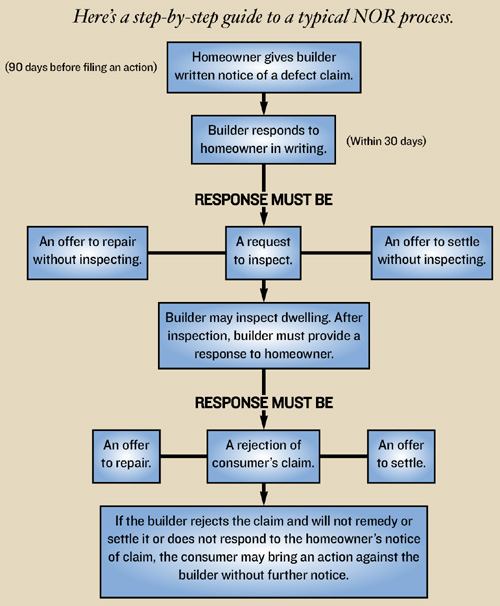
Time frames vary by state, but NOR laws require homeowners to notify builders of a construction defect before filing a lawsuit. The process gives builders the opportunity to inspect the defect and offer to repair the problem or settle the claim with a cash payment (see “The NOR Process,” page 54).

THE NOR PROCESS

“What NOR says is to get in the house, figure out the problem, and fix it,” says Clayton Traylor, the NAHB's senior staff vice president for state and local political operations.

Traylor, who has been managing the NAHB's effort nationally, says that in a recent study, the NAHB found that in litigation-intensive states such as Arizona, California, and Nevada, general liability insurance fees tack on $15,000 to the cost of a house.

High general liability costs just about shut down the condo industry in California a few years ago, which is why the California Building Industry Association (BIA) was able to form a broad coalition of real estate, general business, and affordable-housing groups to get its NOR law passed in 2002. The California law, SB 800, went into effect Jan. 1, 2003.

“It's a much bigger hit when you pass $15,000 on to the cost of a $160,000 house,” says Traylor. “Frankly, the litigation on these matters is very focused on the condo/townhouse market, where trial lawyers can roll up large numbers of plaintiffs.”

BREWING CRISIS

Keep in mind that the general liability insurance crisis had been brewing for 20 years. The issue came to a head in 2003 following the major losses insurance companies took after the Sept. 11 attacks; the investment income loss the industry experienced due to the stock market decline when the Internet bubble popped; and the culmination of more than two decades of million-dollar jury awards in construction defect cases.

“By 2002, the insurance carriers said, ‘I'm done, I can't make any money in this niche business,' ” says Mike Stretch, director of risk management and insurance for the California BIA, who adds that insurance rates are finally starting to stabilize this year in California.

“We truly believe that the fact that the insurance market for builders is becoming a bit more stable this year is a direct corollary to the passage of SB 800,” explains Stretch. “We don't have specific numbers, but we do know that construction defect lawsuits have been mitigated, and prices for renewals are at about 15 percent to 20 percent increase,” he says. “Nobody likes to pay 20 percent more, but compared to previous years, it's really a slight increase.”

Michael Toalson, executive vice president of the Virginia HBA, reports a similar situation in Virginia, which passed an NOR law in 2002.

“For a guy who builds 10 to 30 homes a year, we've seen premium increases of 20 percent to 30 percent,” says Toalson, who adds that while he too does not have specific numbers, construction defect cases have been mitigated in his state. Toalson credits the decline in defect cases to the combination of the NOR law with a licensing law managed by the state-run Virginia Board for Contractors. The licensing law lets homeowners file complaints and includes a uniform statewide building code and a so-called “implied” warranty statute that covers the basic construction of a house for one year and the foundation for five years.

“The board has a contractor's recovery fund that can award a home buyer up to $20,000,” says Toalson, who points out that the recovery fund is paid for by the builders through the fees they pay to be licensed builders. “Our statewide officials understand the importance of a good business climate,” says Toalson. “They don't allow the lawyers to take advantage of it.”

Todd Rowland, senior vice president of insurance carrier Zurich North America's Construction Business Unit, confirms that the business climate for general liability insurance for smaller builders has improved in the Mid-Atlantic states, although Zurich is still insuring only big builders. The builders Zurich insures must demonstrate strong risk management controls, have significantly better than average claims histories, and have the financial wherewithal to shoulder large, self-insured retentions.

Rowland says that Zurich North America has no intention of going back to insuring small builders in states with high rates of construction defect lawsuits—states such as Arizona, California, Florida, Hawaii, Minnesota, Nevada, Texas, and Washington.

“There has been a modicum of improvement, but not enough to get insurers like us back in the game,” says Rowland.

LEAVING LAS VEGAS

One state it's a safe bet Zurich or any other general liability carrier won't return to for small builders for some time is Nevada.

Officials at the Southern Nevada HBA thought they were on the right track earlier this year, but a check of the court records by the HBA in Clark County, Nev., found that defect cases had only decreased slightly since the state's SB 241 law passed in 2003. Cases topped out at 70 in 2003, the year the NOR law went into effect, and only dropped to 64 in 2004. To make matters worse, defect cases spiked unexpectedly to 24 during the first quarter of 2005.

“The simple answer is that the right to repair has been frustrated in Nevada,” says Jim Wadhams, the attorney representing the Southern Nevada HBA. He adds that construction defect cases became so chronic in Las Vegas a few years ago that the county dedicated three judges to handling them.

Although the expansion of the Sun City Summerlin case against Del Webb Communities from nine plaintiffs to more than 1,400 homes made a great deal of press in May (see “Waterlogged,” July, page 48), Wadhams says the real problem is that trial lawyers have kept fighting the NOR law by not releasing a contractor once a repair is finished.

According to Wadhams, the trial lawyers claim that they don't release the contractors because they need to see how each repair affects the rest of the case. Wadhams believes it's simply in the economic interest of the trial attorneys to keep the contractors in the case as long as possible. The longer the contractor is attached to the case, the longer the period of time that the lawyers can bill.

“We need to have language that clearly establishes not only the right to repair, but the right to be free from the lawsuit if you execute that repair,” says Wadhams, who adds that the HBA needs to add language that states clearly that only homeowners who have an actual problem can be added to a lawsuit.

Monica Caruso, director of public affairs for the Southern Nevada HBA, says the home builders will have to regroup and present the new language to the state legislature in the 2007 session. While disappointed by the recent spike in defect cases, Caruso is realistic.

“The uniformity of optimism with the passage of the NOR was terrific,” says Caruso. “We thought we had a great victory, we thought we'd get in touch with our customers and make the repairs that had to be made,” she says. “While in many ways I feel like it's ‘here we go again,' we'll need to develop another marketing campaign geared for the 2007 legislative session.”

ROCKY ROAD

The NAHB's march to pass NOR laws nationwide could hardly have been expected to be executed without a glitch. Like any other attempt to pass legislation, passing these NOR laws—and tweaking them once a track record has been established—has been a very difficult fight often steeped in state politics.

In Missouri, then-Gov. Bob Holden vetoed an NOR bill last year when he was caught in a tough primary. Holden lost the primary, and the state's new governor, Matt Blunt, generally agrees with the NOR concept; at press time, he was set to sign the bill into law.

Another wrinkle for building industry lobbyists is that consumer rights groups such as Homeowners Against Deficient Dwellings (HADD) despise the NOR bills. According to HADD president Nancy Seats, the NOR laws tilt the balance in favor of the builder and put the burden of proof on the homeowner.

“The NOR bills put all the burden on the victim to prove anything,” Seats says. “None of these bills do anything to force the builder to do proper repairs,” she insists.

Suffice it to say, the NAHB and the state HBAs will keep fighting these cases in statehouses across America. For now, the NAHB's Traylor takes heart in an example such as Colorado, where, Traylor says, after the NOR law went into effect on April 27, 2003, the average monthly number of lawsuits filed by the three most active construction defect legal firms dropped 60 percent to about two and a half cases a month.

Traylor also insists that litigation is a very inefficient system, pointing out that the latest NAHB research found that the homeowner typically gets $1 for every $3 spent on a lawsuit.

“Unrealistic promises are made to homeowners, and in about half the cases, after the bills are paid the homeowner doesn't have enough money to make repairs,” Traylor says.

Few people would claim that the NOR laws are perfect. But most everyone in home building would agree that the climate now is preferable to the environment in 2003, when lawsuits were rampant, insurance carriers checked out of most states, and triple-digit premium increases were not uncommon.