With existing-home sales rising for five of the last six months, foreclosure sales seemingly on the decline, new-home sales prices firming, and the economy growing again, it looks like the home building industry may be safely out of the woods. But, as any self-respecting two-handed economist will tell you, there are several lurking economic demons that could pounce on an industry that thinks it has reached a clearing.

It’s hard not to listen to the warnings, because the history of this housing recession is one of dashed hopes. Several times, expectations have risen only to be mercilessly crushed. First it was the subprime fiasco, then the global financial recession of September 2008, and more recently a foreclosure crisis. What’s next?

Try a collapse in the commercial real estate market. If that proves calamitous, the FDIC may need a lot more paper to print its list of bankrupt banks. Other lenders, worried about their exposure, may be unwilling to lend even when builders identify can’t-miss projects. Then there’s the possibility of a sizable increase in foreclosures due to the pending resetting of mortgages taken out by second-home buyers and well-to-do investors, who may not be as well-heeled anymore. And questions persist about the impact of prolonged, high unemployment on home buying decisions.

For all of the above, economists are pretty much of one mind that home building will not snap back as quickly as it did after previous housing recessions, despite November’s 8.9 percent increase in starts. The recovery is likely to be slow, which will make this one unusual. In a study of the five housing recoveries since 1960, housing starts rose 50 percent from the trough during the following year, according Fitch Ratings. Fitch is only looking for a 16 percent starts increase next year, one of the most bearish predictions around.

The NAHB estimates that housing starts will rise 24 percent in 2010 to 695,000. At that paltry level, production would remain 22 percent below 2008’s 900,000 homes. Why such a slow pace? Bernard Markstein, who leads the forecasting group at the NAHB, easily produces a list topped by “excessively high” mortgage approval requirements, non-comparable appraisals, and naggingly high unemployment. The good news, he says, is that some of these negatives should lessen during 2010, setting up 2011 for a big recovery. The NAHB predicts a 50 percent surge in starts that year.

The industry’s prospects would have been much worse had the federal government not extended the $8,000 tax credit for first-time buyers through April. Moreover, the addition of a new $6,500 tax credit for people who have previously owned a home may wake the moribund move-up market.

Homes Are Where the Jobs Go at Night

Even so, the job situation has economists wondering whether the housing market is standing on wobbly legs. “We expect a very modest recovery in home building because underlying demand remains weak,” says Mark Vitner, managing director and senior economist at Wells Fargo Securities in Charlotte, N.C. Vitner projects only an 18 percent increase in home starts this year. He believes last year’s tax credit stimulus provided an unsustainable lift, robbing sales from 2010. “A sustainable recovery will not take hold until employment conditions improve significantly,” he says.

Though he regularly produces the most pessimistic housing forecast, Mark Zandi, chief economist for Moody’s Economy.com, still managed to shake up the NAHB’s fall forecast conference by saying that the market will have another leg down. Zandi’s pessimism stems from persistent unemployment coupled with foreclosure filings, which he believes will rise in the spring and summer, depressing home prices. “Prices have stabilized, but I don’t think price declines are over,” he said.

A more bullish forecast comes from IHS Global Insight, which projects 850,000 housing starts, a whopping 49 percent increase. Inventory is so low, IHS believes, that builders will need to go vertical to meet rising demand. “In 2010, job growth, low inventory levels of new homes (currently at their lowest point since 1983), and household formation will result in sustained increases in housing starts,” says Patrick Newport, the firm’s U.S. economist.

The consensus forecast, however, is for something in between. The National Association for Business Economics (NABE), which produces an average forecast based on submittals from 48 professional forecasters, is calling for 790,000 starts this year, a 36 percent increase. “2010 will be the first year since 2005 that the housing sector will contribute to overall growth,” the group reported in November.

Painting an Employment Picture

Even if starts rise by a third, it will take the economy a long time to fully recover from staggering unemployment. Though monthly job loss totals slowed dramatically in late 2009, and unemployment actually declined to 10 percent in November, total employment has fallen to levels last seen in 2004. All the job gains of the last five years essentially were wiped out.

“The employment situation still looks incredibly dire,” says Vitner. “We are on a pace to lose 9 million jobs in this recession, and it will likely take until the middle of the next decade to replace those jobs.” NABE’s consensus forecast calls for 9.6 percent unemployment this year.

Vitner points out that even as jobs are replaced, many recently employed won’t be in a position to buy homes. Roughly one-third of the unemployed, he notes, have been out of work for six months or longer. They have likely exhausted their savings. “If they get a job tomorrow, they’re not going to be able to go out and make big purchases. They’ve got a heck of a hole to fill.”

If unemployment holds back housing, economic growth should provide a propellant. The consensus forecast for economic growth in 2010, according to the NABE, is 3.2 percent. Coupled with the economy’s performance in the second half of last year, “real GDP growth should also be enough to recover losses from the recession and return output to an all-time high by the end of 2010,” the forecasters say.

Neutralizing the Negatives

The economy’s health is one of several reasons why home building stands on firmer ground than it did a year ago. A second would be home values, which have increased the last several months, according to S&P’s Case-Shiller Index, although many analysts are calling for another comparatively small decline this year. And median existing-home prices, as measured by the National Association of Realtors (NAR), rose throughout last year, even though 30 percent of sales were distressed properties.

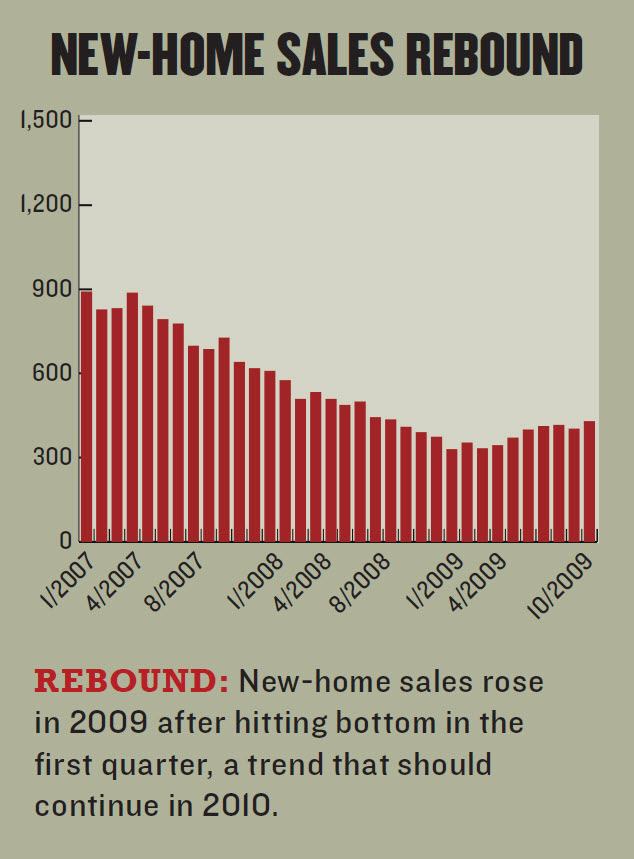
But the real good news is on the new-home sales front. After reaching a nadir of 354,000 in January 2009, new-home sales established some strong forward momentum through October, rising 21 percent to 430,000. New-home prices firmed up during that period as well, though they remained slightly below year-ago levels. Economists took the appreciation as a sign of stabilization, even though the gap between the median price of existing ($173,100) and new homes ($212,200) widened to $39,100.

The industry has done so well working down its inventory that analysts worry builders won’t be able to take advantage of the tax credit extension. The Census Bureau estimates that 239,000 new homes were left for sale in October, compared to 380,000 during the same month the year before, a 37 percent decline.

Markstein isn’t worried. “Given how weak demand is, and that only a portion of the demand created out of the home buyer tax credit will be directed at new homes, builders should be able to meet the demand in time for home buyers to qualify for the tax credit. Further, some of that increased demand will come from repeat buyers” who will have an ample inventory of trade-up homes from which to choose.

Double-Dip Ahead?

Markstein is more worried about foreclosures, which he calls a “major risk” to the recovery. It’s very difficult to accurately forecast the foreclosure situation, given the many organizations reporting varying statistics. Nevertheless, he believes that foreclosures should peak during the first part of the year. “It looks like we are near the end of the worst of the crisis,” he says.

Data from RealtyTrac supports that view. It shows that foreclosure filings fell nearly 3 percent in October over the previous month. Though filings are still up nearly 19 percent over the previous year, they have fallen for three consecutive months. RealtyTrac defines a foreclosure filing as a default notice, a scheduled foreclosure auction, or a bank repossession.

“Three consecutive monthly declines is unprecedented for our report, and on first blush an indication that the foreclosure tide may be turning,” says James Sacaccio, CEO of RealtyTrac. “However, the fundamental forces driving foreclosure activity in this housing downturn—high-risk mortgages, negative equity, and unemployment—continue to loom over any nascent recovery.”

Data gathered by the Mortgage Bankers Association (MBA) provides plenty of reason to worry. In its latest survey, MBA identified about 4 million homeowners either in foreclosure or three months or more behind on their payments. “There’s a lot of potential inventory coming on the market in the next year,” says Jay Brinkmann, the organization’s chief economist.

Or maybe not. The $64,000 question is whether banks or the government can step in before people actually lose their homes, which seems to be happening in many metro areas. Home building has benefited recently from foreclosures that don’t make it to the market and depress prices. Some economists, though, question whether banks are holding back properties that they will eventually have to sell. “We’ll see foreclosure sales pick up in the spring and summer,” Zandi said at NAHB’s conference.

No doubt worried about a housing recovery being nipped in the bud, the Obama administration stepped up efforts last year to put pressure on the mortgage industry to move quicker to modify loans in danger of foreclosure. The administration began a voluntary program last February to encourage lenders to rework loans. Borrowers could have their mortgage rates reduced to as low as 2 percent over five years.

But they have to fill out paperwork first, lots of complicated paperwork, and that has proved to be a stumbling block. Nearly 60 percent of the 375,000 borrowers who qualify for the program have either sent in incomplete forms, or they haven’t filled them out at all. By early September the government had rescued only 1,700 borrowers.

The situation is a ticking political time bomb. If it takes a dramatic turn for the worse, it could undo the recent strength in home prices, setting off an unwelcome chain of events. The NAR reports that existing-home prices have increased since January, even though distressed properties now make up 30 percent of overall sales. Rising prices, of course, create stability in the market and make people more likely to buy.

Other Problems

Several other big question marks cloud any industry outlook. One of the most prominent is what happens to mortgage interest rates once the Federal Reserve stops buying mortgage-backed securities in the spring, as it plans to do. The Fed has, in effect, become the mortgage industry in the last year, gobbling up Fannie Mae and Freddie Mac paper to bring liquidity to the market. Once the agencies have to rely on private investors again to buy mortgage-backed securities, what kind of yields will those investors demand? Analysts at JP Morgan predict that mortgage rates will only increase 20 to 40 basis points.

The March timing of the Fed’s pullout, though, isn’t good. That’s close to when the latest round of home buyer tax credits will expire. Unemployment is likely to remain high. And the foreclosure situation may still be a big question mark.

Even so, most housing economists believe that these challenges won’t be enough to derail a housing recovery, benefiting from low pricing and several years of pent-up demand. Like a movie superhero, the market has established enough forward momentum that it should be able to sustain a few body blows. And by this time next year, foreclosures may be in retreat, employers should be adding jobs, and mortgage rates may still be low. 2011 could be a very good year.