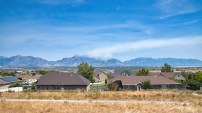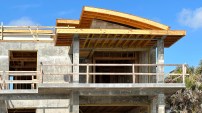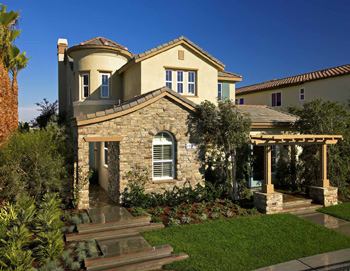
PARDEE HOMES: Built under the company's Living Smart program, the homes at Pacific Highlands Ranch in San Diego are capable of producing 50 percent or more of the energy they consume. In addition to optional solar panels and other sustainable features, the homes have R-19 roofs and R-13 walls, sealed framing, water-conserving fixtures and fittings, recycled content materials, on-demand water heaters, low-odor paints, and porous driveway pavers that allow water drainage into the soil.
Imagine Homes doesn't build houses like they once were built.
But this doesn't mean the company is forsaking the traditional home construction ideals of care and craftsmanship. It just means Imagine is building homes with an eye toward site sensitivity, energy and water efficiency, and indoor air quality.
“We saw a need in [our] marketplace,” says John Friesenhahn, president of the recently launched San Antonio–based builder. “[Customers] were asking for homes that they could afford but that didn't have a cookie-cutter feel and also that wouldn't ruin our area's beautiful natural habitat. We thought, ‘Well, if we don't start building architecturally classic homes that have less impact on the environment, then what is San Antonio going to look like when our kids are grown?'”
INTO ITS OWNBy any standard of measurement, green building is hot. As oil hovers around $70 a barrel, interest in conservation and energy efficiency has come to dominate the consciousness of the average American consumer. The subject even has its own exhibit at the National Building Museum in Washington, “The Green House: New Directions in Sustainable Architecture and Design,” which will close in June 2007 and then travel to other cities.
For years the purview of the sandal-wearing hippie fringe that built homes with straw bale, rammed earth, and recycled building products, green building has become an integral part of commercial, public, and civic construction as businesses, governments, and educational institutions seek to create buildings that use less energy and are healthier for human habitation.
Green building has now spilled over into the residential world as well. According to the NAHB, 14,600 green homes were built in 2004, up from 2,500 in 2000. In addition to using state and local green building programs that have cropped up over the years, builders can certify their homes through voluntary national programs such as the U.S. Green Building Council's Leadership in Energy and Environmental Design or Masco Contractor Services' Environments for Living program. They can also build green using the NAHB's Green Home Building Guidelines or the EPA's Energy Star program. These programs offer guidelines on how builders can improve their homes' site development, energy efficiency, and overall sustainability.
Despite its increasing popularity, however, green building remains a complicated topic that often leaves builders scratching their heads. What exactly is green building? What does building a green house entail? What does it cost to build green? And what are the minimum features a house must have before it can be considered green?
A FLEXIBLE RECIPEAccording to the California Integrated Waste Management Board, a green (or sustainable) building is a structure that is designed, built, renovated, operated, or reused in an ecological and resource-efficient manner. Such a building saves water and energy, conserves natural resources, uses salvaged materials or products made with a high recycled content, and reduces its overall impact on the environment, among other things.
“Everyone has their individual opinions about what are the necessary and essential ingredients to make a house green,” says Margo Thompson, research associate at the NAHB Research Center, in Upper Marlboro, Md. “There are a lot of different ways to slice it.”
Indeed. For example: Is it better to use wood from sustainably harvested and renewable trees or a longer-lasting, man-made product that requires a fair amount of energy to manufacture? Wood siding lasts 25 years or more but requires more maintenance; the synthetic product requires less maintenance and can last 40 years.
Or how about this: Say a builder uses bamboo flooring instead of oak. Bamboo is a rapidly renewable grass, which saves old-growth trees, but it is primarily manufactured in Asia and thus has to be shipped halfway around the world to reach U.S. builders, using fossil fuels in the process.
“All-or-nothing green is good, but it's just not practical,” says Jennifer L. Languell, president of Fort Myers, Fla.–based Trifecta Construction Solutions, a company that helps builders realize the benefits of green building and sustainability. “You have to define what green means to you.”
Languell says she usually informs her builder clients about the components of green construction and advises them to set benchmarks they want to achieve. “I ask them what they're interested in and what message they want to send [about their homes],” she says. “Is it health, high performance, energy efficiency?” She then tells builders their options and looks at strategies for achieving their goals.
Ideal Homes in Norman, Okla., approached green building by examining its homesites. “We changed our neighborhood design to start evaluating the natural topography and grading, and as a result we've reduced our drainage cost,” says president Vernon McKown. “If a builder starts studying green community design, it will save money on grading and drainage.”
DEVISING AN ENERGY STRATEGYAnother good way to begin green building is to adopt a strong energy strategy. “For almost all climate zones, energy efficiency is probably the place to start,” says Thompson. “It's one of the easiest areas to understand.”
Imagine Homes understands the concept well, having devised an energy plan that aims to minimize callbacks while maximizing conservation.
“We're using 100 percent blown-in cellulose insulation, and we're doing blower-door testing and duct-blaster testing on every home, to check for leakage,” Friesenhahn says. Though it might seem excessive (and expensive) to do a blower-door test on every house, the company feels it's important. “If I know we're testing the duct systems, I may not get that call down the road that there's a heating or cooling problem in the house,” Friesenhahn explains. “If I can eliminate the service call, it will save me money on the back end.”
In addition, Imagine's homes feature low-VOC (volatile organic compound) carpet, padding, and paint to improve indoor air quality; low-flow plumbing fixtures; and tankless water heaters. The result: The builder estimates that its homes are 20 percent to 30 percent more efficient than required by San Antonio's energy codes.
But an energy-efficiency strategy can also be as simple as how you orient the house, says architect Peter Pfeiffer, principal of Barley & Pfeiffer Architects in Austin, Texas: “The city of Austin did a study 15 years ago that showed that if production builders simply altered the exterior elevations of their plans to reflect the way the house is facing, they could cut the energy consumption in half.”
For example, a house with a west-facing front would have fewer windows and a shading porch to deal with the harsh sunlight, whereas a house with a north-facing front could have more windows. As Pfeiffer notes, a single-pane window in the shade is more efficient than an insulated window in the sun.
A tight building envelope is also extremely important, Pfeiffer says, because a leaky house is responsible for a large amount of wasted energy. “Air infiltration is probably the second major source of energy consumption or cause of excess energy consumption [after poor site orientation],” he says. It's essential that builders use housewrap, Pfeiffer cautions.
One builder that has spent a fair amount of time improving the tightness of its building envelopes is McStain Neighborhoods, in Louisville, Colo., one of the early pioneers in building and marketing green homes. In addition to DuPont Tyvek housewrap, McStain is big on properly installed window, door, and roof flashing, says Jeff Mednick, the company's special projects manager.

BEAZER HOMES: In order to obtain a Gold rating under Masco's Environments for Living program, the homes of Verano at Bartram Park, in Jacksonville, Fla., will exceed model energy codes by 30 percent. The homes feature a fresh-air system, sealed combustion appliances, sealed framing to eliminate drafts, R-30 attic insulation, and 13-SEER cooling units. The program's comfort guarantee promises that the temperature at the location of the home's thermostat will not vary more than 3 degrees from the center of any conditioned room within the thermostat's zone.
McStain builds primarily with engineered framing lumber and finger-jointed studs (to reduce landfill waste), tankless water heaters, low-E windows, and 2x6 exterior walls with blown-in cellulose insulation. Under the Energy Star program, the builder tests all of its homes for tightness, and it recently started experimenting with sprayed foam insulation—an excellent product for creating a tight building envelope. “It is superior to fiberglass because it stops airflow and stops humidity,” Pfeiffer explains.
Foam insulation is just one of the options that Naples, Fla.–based Gulfstream Homes offers as part of its effort to make energy efficiency an important feature of its houses. “We wanted to incorporate basic green techniques, so we approached it in a more practical manner,” says vice president Steve Peel. “Most of [our strategy] involved air quality and energy efficiency.” Standard offerings include formaldehyde-free fiberglass insulation and 15-SEER HVAC units with variable-speed fans and high-grade air filters. Upgrade options include air cleaners and fresh-air returns. The builder also created a special logo so that buyers can easily identify green products in its design center.
Gulfstream Homes builds about 70 homes a year. One could argue that it is easier for the company to implement a green building program than it would be for a larger builder. But size doesn't matter. For example, Los Angeles–based Pardee Homes, which builds about 3,000 homes a year, made a commitment in 2001 to build all Energy Star homes, and it took the company less than a year to phase in the program. “We now use some form of green principles in all our houses, but Living Smart is our sustainable brand,” says marketing vice president Joyce Mason.
Pardee's homes feature sealed duct systems to eliminate air leaks into nonliving spaces, highly efficient glazing, fluorescent lighting, and photovoltaic cells for solar electric power, among other items. The homes exceed federal codes by 30 percent, Mason says.
Pfeiffer and Languell contend that it's even more important for high-volume builders to use sustainable techniques, because these builders are responsible for up to 95 percent of the new homes in the country. “We could build custom homes one at a time to be totally efficient or off the [electrical] grid, but baby steps with large builders have a much more cumulative effect on the problem,” Languell says.
A perfect example of sustainability on a grand scale is taking shape in the western section of Seattle, where the Seattle Housing Authority is transforming a 129-acre urban neighborhood from an old public housing project into a new, 1,600-unit, mixed-income community called High Point. “It was a former site of temporary military housing that was built in 1942, and then it was turned over to the Seattle Housing Authority in 1953,” says Tom Phillips, the agency's redevelopment manager. “It was basically a public housing site until 2003, when we started to develop it.”
High Point's developers started with the site, preserving more than 100 mature trees and planting 2,600 more, setting aside more than 20 acres of land for parks and open spaces, and designing a natural drainage system that retains 98 percent of the stormwater on the site. “It has a regular-looking sidewalk, but [the sidewalk is] made of porous pavement,”
Phillips says. “The water goes through amended [composted] soil and is absorbed by the earth rather than immediately going to a pipe. Most of the water is diverted into the earth, part of that goes into a swale, and some of that water makes its way into a retention pond and is slowly released into [a] creek. It gets cleaned by the soil before it goes into the pond and doesn't overwhelm the creek.” Phillips says that had the developers built a traditional drainage system, High Point's pond would have needed to be three times larger than it is. “This was a way for us to get more land to develop on,” he notes.
Seattle-based Mithun Architects, which created High Point's site plan, also designed the project's 600 Energy Star–qualified rental units. “These [multifamily] houses will feature high-efficiency closed-loop boilers that allow us to eliminate hot-water tanks,” says Brian Sullivan, a former project manager and lead architect with Mithun who now works for the Seattle Housing Authority. “The combined system is for hot water and radiant baseboard heat, so we use less equipment, and it's more efficient.” In addition, the units feature airtight drywall construction, fresh-air vents in each living space, and low-VOC materials.
High Point's developers are selling the land to production builders one block at a time. Each builder has to be invited and must achieve at least three stars in the King County Master Builders Association's Build Smart program. The builders with projects thus far are Devland, Lyle Homes, Saltaire, Polygon Northwest, The Dwelling Co., and Habitat for Humanity of Seattle and South King County. For-sale units include flats starting at $200,000 and single-family houses at $600,000.
COST CONCERNSMost builders agree that sustainable homes provide energy and health benefits, but many believe cost is a problem, which is why production builders have been slower to incorporate sustainability features than architects and custom builders with wealthy clients who can afford to pay more for such items.
“Some builders feel that it impacts [up-front] cost and that there may not be a pay-back,” says Robert Rivinius, president and CEO of the California Building Industry Association, in Sacramento. A builder might look at the upfront costs, he says, and feel that buyers may not want to pay the extra money.
“We believe [green building] needs to be voluntary, and it needs to be cost-effective,” says Rivinius, arguing that California's already strict energy codes play a role in the state's lagging homeownership numbers. “You have to have people who are willing to pay the cost,” he continues. “Part of the builder's business will be to determine if there are enough people who are willing to pay to have a green home.”
Some builders have done exactly that. Peel estimates that green building features increase the price of the average Gulfstream Homes house by $4,500 to $6,500, but he believes the features have helped propel sales nonetheless, although he can't quantify exactly how much because the Naples market has been so hot.
Similarly, the sustainable features that Ideal Homes uses add about $3,500 more to the cost of its houses, but McKown says making strategic changes such as reducing duct leakage by 20 percent has been cheap and has had dramatic energy-saving benefits. “We like to look at things that have a five-year return on investment,” McKown explains. “If the cost [of the feature] is $500 or less or has a significant saving, our buyers tend to like it.”
Either way, Ideal's approach hasn't hurt sales. “What we've found is that on the high end it's harder to sell, but it's easier on the lower end of the market,” McKown says. “We're saving our customers $50 per month on their utilities. But high-end buyers don't give a damn about saving money on their utilities.”
The California Integrated Waste Management Board agrees that a green building may cost more up front, but the board says the end result is lower operating costs over the life of the building. “We generally say green building adds a 2 percent to 5 percent increase in hard costs,” says McStain's Mednick. “But what's the [real] cost if you factor in energy savings?”
Architect Pfeiffer argues that sometimes the benefits of a green home are immediate, because some sustainable products—a metal roof, for example—enable home buyers to lower their insurance premiums. Other items, such as tankless water heaters, can bring tax benefits.
“Just imagine you have a house with a $1,500 mortgage payment, a $300-a-month utility bill, and a $100-a-month insurance bill—it's really costing you $1,900 a month to own that house,” Pfeiffer says. “What if the house had a $1,550 mortgage payment, a $100-a-month utility bill, and a $50 insurance bill? Which house is more affordable?
“The problem is that too many builders and bureaucrats aren't looking at the big picture,” Pfeiffer continues. “It's not payback we're talking about; it's immediately cheaper to own the better-designed home. Immediately, from the day you move in, it's cheaper to own because somebody thought about it just a little bit more.”
In Languell's view, fear of the unknown is one of the predominant reasons more builders don't incorporate green principles in their homes. They just don't know how to do so, or they're unsure whether it will cost too much. Also, Languell says, hesitant builders may not know how to sell it and may be unconvinced that people will buy it.
“In eastern Iowa and northern Illinois, where we work, building green adds about $5 to $10 per square foot,” says architect and builder Jason C. Gideon, CEO of Advanced Designs in Anamosa, Iowa. “But over the last couple of years, we've been focusing more on green building, and more and more homeowners are asking about it to reduce their month-to-month operating costs.”
Advanced Designs' houses include geothermal heat pumps, expanded foam insulation, air exchangers, and radiant reflective roofing. “Such houses do cost more, but they're reducing [the homeowners'] energy cost in the end,” Gideon says.
Some builders are finding that a green product will often pay for itself. Foam insulation, for example, makes ridge vents unnecessary and allows builders to reduce the size of the roof rafters, Mednick says.
DON'T FORGET MARKETINGMarketing is one of the most overlooked issues in the green building debate. What good is a green home if the buyer doesn't see the value in it? Strangely enough, builders are abandoning the term “green” in favor of more-effective words. “There's a movement toward high performance, efficiency, and health,” Languell says. “The word ‘green' doesn't tell consumers what the features will do for them.” Languell says the terms “health” and “energy efficiency” are more effective with buyers.
No matter what course of action, or word, you choose, it's still important that you explain to your buyers and your sales team how your houses are different. “A lot of the equation is with the salesperson knowing what the buyer is interested in and explaining the benefits,” Friesenhahn says. Buyers are motivated by money—or at least saving it—so explaining the benefits in financial terms is a good idea.
Ideal Homes' McKown puts it this way: If you tell customers they can spend $5 and save $10, that's a no-brainer. “Once your sales guys have figured out a way to communicate it to their customers, it sells itself,” McKown says.
It's hard to see the benefits of green building if you're unfamiliar with the principles, but as the age of cheap oil ends, do you really want to be the builder whose houses suck money out of buyers' pockets? Are you willing to wager that this is all a passing fancy? Would you stake your reputation on it?
Making the decision to go green—or sustainable or healthy or high performance or whatever—may seem like it requires a leap of faith on the builder's part, and it's even harder to go forward with such a program in a soft market. “It's our hope that [green features] will differentiate us in the marketplace from the next builder,” says Gulfstream's Peel. “I think in a market where people get choosy, anything you can do to differentiate [yourself] is good.”
Pardee, for one, has proved that going green pays off. “We built our first Energy Star home in Las Vegas in 1998,” Joyce Mason says. “It was a very tough, competitive market, but the Energy Star homes sold faster than our other homes. So it was a nice way for us to differentiate [ourselves] from the other builders.”
STARTING OUTThese tips can help you start the process of siting, building, and selling a sustainable home:
- Pick just a couple of green strategies and focus on them. Experts say energy efficiency is your best bet.
- Look for features that have a five-year return on investment. Evaluate the payback of features carefully.
- Maximize your site's natural topography to reduce drainage and grading costs.
- Design with passive solar gain in mind.
- Modify your exterior elevations to reflect the lots' orientation and maximize energy efficiency.
- Use radiant reflective roofing materials to keep houses cool and energy costs down.
- Use housewrap to create a tight envelope.
- Reduce duct leakage.
- Perform blower-door tests to save money later.
- An energy audit can tell you whether your techniques are working.
- Forget the word “green.” Instead, sell “high performance,” “energy efficiency,” or “health.” These terms resonate more clearly with buyers.
- Showcase the benefits of green houses to help you differentiate yourself from the competition.
- Tell buyers why your houses are different.
- Give buyers a logical reason to pay a little more for sustainable features, such as the money and the natural resources they'll save.
- Create a logo to help buyers identify your green products.
- Train your sales staff to explain green benefits to buyers.
- Join a voluntary green building program. A group's identifying label is good for recognition and marketing.