Click here to read the Online Extra portion of this article.
This is the third installment of a three-part series (click here for the first and here for the second installments) on how the breakdown in lending standards has forestalled the home building industry's economic recovery. The stories focus on how we got to where we are today, how foreclosures and plummeting property values affect a new community in Indiana, and the analysts' best guesses on when the downturn will end.
The housing downturn will run its course, and sales and pricing power will pick back up eventually. Just do not expect a recovery in 2007 or 2008. It's not happening.
Despite a move in mid-September by the Federal Reserve Board to lower its Federal Funds Target Rate from 5.25 percent to 4.75 percent in an attempt to force interest rates down and home buying activity up, it is now clear that the housing correction still has a long way to go before it peters out. So says former Fed Chairman Alan Greenspan, NAHB Chief Economist Dave Seiders, and Center for American Progress Senior Fellow Christian Weller, as well as a host of other economists and interested observers who sounded off on the housing market's health in the national press during the lead up to the Fed's big Sept. 18 rate-cut announcement.
Though the odds that the economy will fall into recession increased this summer, the most hopeful of the new-home prognosticators still predict that new-home sales will rebound in the middle to later parts of 2008. Others take a darker view, envisioning the market bottoming out in 2008, with at least a year of dragging along the bottom before gradual recovery begins in 2009. And the most pessimistic see no way that the bottom will happen before 2009, with recovery stretching beyond the opening decade of the new millennium. Yes, you read that correctly: no improvement on a sustained basis until 2010 at the earliest.
Oh, and if there's a recession, which looks more and more likely all the time? Push everything back at least two to three more years.
With so many cons and so few pros lining up against housing on our checklist of issues—historically high inventory oversupply, tight money, an affordability crunch, flagging demand, declining home values, foreclosures—it does seem likely that once the market lands with a thud, it will drag itself along the bottom licking its wounds, before a gradual recovery begins.

SOURCE: FIRST AMERICAN CORELOGIC
The one great exception to this dire scenario is that some markets never tanked in the first place, so have no real rebounding to do. So far, that includes the Pacific Northwest, Seattle, Portland, Ore.; Austin, Houston, and San Antonio, Texas; and inland parts of North Carolina, Charlotte and Raleigh. Slow and steady growth, while not as exciting during the boom, means no massive inventory problem (as there is in Miami, for example, with more than three years' worth of condos and still growing) and no, or at least less, pain during the bust. But overbuilding may yet hit these markets, as national home builders are on the move, seeking the few large markets that have not been slammed by the housing recession.
Christopher Cagan, director of research analytics for First American CoreLogic, suggests that the rest of the country is unlikely to see recovery for three or four years. Inventory must be burned through, consumer confidence in housing needs to rebound, and the fallout from exotic mortgage products and loose lending standards needs to be sorted out—meaning more foreclosures to come and more inventory to work off, Cagan says.
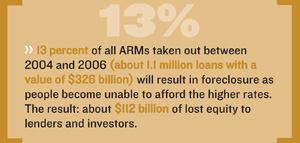
Cagan, who published a study on mortgage payment resets this spring, projects that 13 percent of all ARMs taken out between 2004 and 2006 (about 1.1 million loans with a value of $326 billion) will result in foreclosure. The result: about $112 billion of lost equity to lenders and investors.
But eventually, demand will return and the market will come back. It always has and always will, Cagan says. Before that happens, though, markets that saw home values double or more in recent years will see values decline—he expects routine price declines of 5 percent a year for the next three to four years. But that's not the end of the world, he adds.
“This is not a once-in-a-million-years event; this is not Pearl Harbor or 9/11 or the extinction of the dinosaurs. This is the business cycle, and this is the kind of thing that happens,” he says. “The residential real estate business cycle lasts eight to 15 years, depending on the situation. We had our last peak around 1990.”
In other words, we were due for this downturn.

THE BOTTOM IS COMING, THE BOTTOM IS COMINGBefore coming to a definitive answer on when the national housing market will bottom out (for regional breakdowns go to www.builderonline.com to see what your local market will look like), we first need to figure out just what a bottom is. Builder interviewed 12 leading industry experts, and while there were some similarities in when each of them saw the market hitting bottom and beginning to crawl up again, each expert was looking at the idea of a bottom through a different prism, and watching different indicators.
Hitting bottom means that the statistical indicator being measured must stop declining and reach stability. For most observers, that indicator is sales.
Projections for the bottom in new-home sales vary from 800,000 to 900,000. But Margaret Whelan, JP Morgan Securities' managing director of investment banking for home building, (and former UBS analyst), says these numbers can be deceiving. The recorded level of new-home sales may be around 900,000, Whelan says, but factor in the current rate of cancellations and the actual number could be more like 600,000.
Those experts not focused on sales are watching for inventory levels to come down, starts to bottom out, or sustained home price growth. Sales prices of new homes are a relatively volatile indicator and may go up or down month-to-month, depending on the homes sold. Only sustained growth of home prices over a period of several months would demonstrate a growing market.

SOURCE: MARGARET WHELAN
And prices are unlikely to go up anytime soon. Builders are not just in competition with each other now; they also are vying with homeowners looking to sell their current homes, investors who are stuck with homes they thought they'd be able to flip by now, foreclosed homes, and homes on their way to foreclosure. It's a jungle out there.
WAY TOO MUCH OF A GOOD THINGIn a typical housing market, 1 percent of the U.S. housing stock (about 1.1 million units) is vacant and for sale at any given time, says Whelan.
“Today it's closer to 2.5 million,” Whelan says. “The spread is 1.4 million vacant homes, most of which have never been lived in, and those homes need to be absorbed.”
Whelan believes the misreading of demographic trends was a large part of how overbuilding became such a problem. While the industry thought population growth and new household formation created the surge in demand, it turns out it was caused by speculators and people reaching beyond their means, thanks to easy credit, Whelan says.
But there is disagreement among our experts on whether or not the foreclosure situation will get worse. On one side, Wachovia senior economist Mark Vitner and Hanley Wood Market Intelligence senior director Lance Ramella feel that foreclosures won't significantly add to excess inventory. They see homes headed for foreclosure already on the existing-home market as part of the large inventory run-up over the last year. Vitner does believe that the threat of foreclosure will force sales, and that will drive prices lower.
But virtually all other experts agree that foreclosures will add to the ongoing inventory glut. John Burns, president of John Burns Real Estate Consulting, says the peak in default notices, the precursor to foreclosures, will appear in 2008, with foreclosures peaking in 2009 or 2010.
“There's almost no doubt that it's going to get worse and that it's going to last at least two years,” Burns says. “If you look at past cycles, foreclosures have peaked a good four to five years after the housing market softens.”
SHARING THE BLAMEBut homeowners who can no longer afford their mortgages are not the only ones adding to oversupply.
Total housing starts hit a two-month cumulative peak in January (2,292 million) and February (2,125 million) 2006, according to the U.S. Census Bureau—after the market began cooling.
The investors who bought many of those homes are now trying to sell them, and are not buying other homes. They are selling never-lived-in properties on the existing-home market, competing directly with the builders in their own subdivisions, some of which aren't even built out yet.
Would-be new-home buyers who can't sell their current homes, or don't want to sell them at current prices, are cancelling purchase contracts, sticking the builders with inventory beyond what they already have and can't sell.

SOURCE: U.S. CENSUS BUREAU
Because of weak sales and builders getting stuck with more cancellations than anticipated, Eric Belsky, executive director of Harvard's Joint Center for Housing Studies, predicts fewer housing starts in the second half of 2007, with starts likely to stay at a low level in 2008. Other projections vary for when the level of total and single-family housing starts will pick up, ranging from starts picking up in 2008, to starts not picking up until 2010.
Bernard Markstein, staff vice president for the NAHB, says that single-family starts will bottom out in mid-2008 at one million units. Fannie Mae Chief Economist David Berson is slightly more pessimistic, projecting total starts to hit a trough of 960,000 units in mid-2008. Both see signs of improvement in the later stages of 2008.
David Shulman, senior economist at the University of California, Los Angeles Anderson Forecast, says builders big and small, though mostly big, have cut way back on starts and will continue to cut back. He predicts total housing starts to fall to a low of 1.0 to 1.1 million in the first quarter of 2008. But Shulman does not see activity picking up quickly, with starts rising to just 1.4 million units in 2009.
“In a housing down cycle, you typically go down 50 percent from peak to trough, and we're almost there, in terms of starts,” Shulman says.
But both Whelan and Thomas Lawler, a Vienna, Va.–based economic and housing consultant, say that starts need to be lower still. Lawler says that builders must get single-family starts below 1 million units in the second half of 2007 before any dent is made in the inventory overhang, which he and other experts say has yet to erode at all. Single-family starts will need to be held under 1 million through 2008, he adds.
THE PRICE IS WRONGIt is clear to all industry experts that prices have gone down. Home builders are slashing costs to buyers at closing, offering free options, cars, boats, paying down a buyers' mortgage and closing costs, or anything else they can do without cutting the sticker price.
But those measures do not appear in the data. From the National Association of Realtors data of existing home sales (though NAR senior economist Lawrence Yun admits brokers in the field are cutting prices) to the Office of Federal Housing Enterprise Oversight index, to the Census' new-home sales price data, price reductions have yet to appear, but experts say they will in late 2007 and 2008. The S&P/Case-Shiller U.S. National Home Price Index, which tracks resales, has already shown price cuts and projects further cuts to come. In its August report, the S&P/Case-Shiller index shows home sales prices declining 3.2 percent from the second quarter of 2006 to the second quarter of 2007.
“Affordability has to definitively improve; prices are still too high,” says Moody's Economy.com chief economist Mark Zandi, noting that with lending standards tightening and fixed and adjustable mortgage rates moving up, affordability has not improved, despite price adjustments.
But that is changing, and this fall will see the beginning of a new wave of price cuts, with home builders leading the way, says Zandi. Expect prices to decline 10 percent on average from their highs during the market's boom, with the formerly hottest markets seeing 15 percent to 25 percent declines, he says. Those areas include Florida, Arizona, Nevada, Southern California along with the Central Valley, outlying areas of Washington, D.C., the coastal Carolinas, and Boston.
“[Home builders] are now slashing prices more aggressively,” Zandi says. “And that will force sellers of existing homes to start cutting prices more aggressively.”
RECOVERY, THE MOMENT OF TRUTHThis is no ordinary housing cycle—that much should be clear by now. Typically, weak economic conditions coincide with a housing downturn. And while job and economic growth has slowed, the economy is not (yet) in recession.
Though the stock market continues to boom, our experts see housing's problems spilling over into the larger economy. While housing may yet drag the rest of the economy down with it—some mortgage-backed securities and hedge funds are already going belly-up—our analysts peg the chances of a recession between 25 percent and 40 percent. Analysts outside the industry say the odds for recession are on the rise. A Wall Street Journal poll of 52 economists conducted in September projected the likelihood of a recession at 36 percent, up from 28 percent in August.
Inventory is so far outside historical norms, several experts say there is no comparing it to past cycles, that we are in uncharted territory. You can thank the now-burst credit bubble for that. When the Federal Reserve kept lowering the Fed Funds target rate, and lenders started loosening lending standards, they pulled years of demand forward.
“We did five years of demand in three years,” says Shulman.
Americans who might be thinking about buying homes as prices fall and they see relatively good bargains already bought homes at market-topping prices and are stuck with homes declining in value and mortgages they can't afford. The buyers that usually pull housing out of its funk are simply not there, despite Yun's claim that “there is clearly a pent-up demand.”
So get your spoons out, pour that medicine, and swallow hard. There is too much inventory to burn through and starts have been too high, continuing into 2007. Beyond that, the credit situation is far from worked out—though regulators proposed tougher guidelines for lending and both states and the federal government plan to act against predatory lenders—and Federal Reserve Chairman Ben Bernanke promised Congress in July that the Fed would be reviewing “a wide range” of mortgage lending practices and hoped to propose new rules by the end of 2007.

SOURCE: THE WALL STREET JOURNAL
In the short-run, tougher lending standards will hurt housing demand further, but in the long-run, it works in housing's best interest. Less demand now means more demand later.
There is so much lining up against a quick housing recovery that the earliest Builder can see it happening is 2009, and more likely not until 2010. If the housing market's problems with credit spill over to the overall economy to a greater degree, dragging down job growth (as construction continues to slow, so will job growth), consumer spending (therefore weakening economic growth), and this housing recession turns into an economic recession before housing has rebounded, it will be many years before home sales pick up and pricing power returns to the hands of builders.
It was a seller's market for so long, now it is the buyer's turn. And right now, there are too few of them, and those that are there are waiting for the bottom in home prices to hit. Why buy now when you can wait a bit and pay $100,000 less?
But the bottom is coming and will hit in late 2008 or early 2009, followed by a period of dragging along the floor. No recovery until 2009 or 2010. And after all we heard, that still may be optimistic.
“If you were walking along at night, and you fell into a hole, and you hit the dirt, that's when you're at the bottom,” Vitner says. “Then you have to find a way to get out of the hole. Well, housing still hasn't hit the dirt. When it hits the bottom, then we still have to climb out of the hole. We're not going to feel a whole lot better until we're out of that hole.”
Click here to read the Online Extra portion of this article.