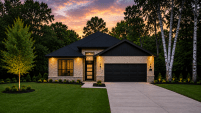
OUR STRAIGHTFORWARD DIRECTIONS to the architects were not unlike the ones that builders hand out every day. Give us a 2,300-square-foot home—the size of the average new home built in this country—that fits on a 45-foot-wide lot and include the requisite three bedrooms and two baths (you can’t get too wild and crazy on these projects because the builder, after all, has to sell the homes).
Oh, and design the homes according to the pattern book for Baldwin Park, Orlando, Fla.’s award-winning, neo-traditional neighborhood, where they will be located. And just to increase the pressure, don’t forget that thousands of builders will see these homes in person in January at the 2005 International Builders’ Show in Orlando and in print in BUILDER’s January issue.
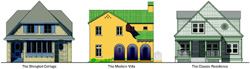
That, in a nutshell, was the challenge that BUILDER and David Weekley Homes issued to Don Rattner of the Studio for Civil Architecture in New York, Bill Kreager of Mithun in Seattle, and Geoffrey Mouen of Geoffrey Mouen Architects in Orlando. The architects were more than up to it. In testimony to the depth of their creativity, and the limitless possibilities in residential design today, each architect designed a completely different home in a different architectural style, with a novel floor plan and innumerable touches worthy of imitation. The three homes meet our objective: to showcase all that production homes can be.
Moreover, each home targets a different buyer demographic, reflecting how broad the pool of new-home buyers is today. Rattner’s home, with its carefully wrought entertainment spaces, was designed for a DINK (double-income no kids) household. Kreager addressed the needs of empty-nesters. And Mouen designed his home, with its open kitchen/family room, for a hardworking family of four.
Each home pushed the pattern book to the max, which is just what the developer, David Pace, wanted. Pace, who was instrumental in the development of Disney’s Celebration, was hired by the Pritzger family of Chicago to guide the creation of Baldwin Park, one of the most original traditional neighborhood developments (TND) in the country. Baldwin Park recently won an award from ULI for the top community in America.
“The pattern book actually provides our builders with quite a bit of liberty,” Pace says. “While I’m proud of the architectural diversity in Baldwin Park, some of our builders haven’t pushed their designs as much as they could have. These show homes demonstrate just how fresh architecture within a TND can be,” he notes.
Adding to the uniqueness of this project, our show homes will be built around a mews, a grassy park setting. They will share the mews with five other homes from David Weekley’s collection at Baldwin Park. The common area makes these homes among the most desirable in the community.
The Shingled Cottage Kreager decided to up the degree of difficulty by including a first-floor master suite in his home. “We chose the most challenging product for a small lot site,” he says. “The design of this home concentrates all outdoor activity in one space by wrapping the home around a private courtyard, making possible a much more generous outdoor living space without the violating privacy of either neighbor.”
Kreager, who spent days walking Orlando neighborhoods for inspiration, designed his shingled cottage, with its Dutch Colonial form, according to the Southern predilection for “discrete rooms.” He finds that buyers in the South prefer defined rooms with individual character. They want a separate and defined family room instead of a great room, for instance.
The Modern Villa Rattner, a renowned practitioner of historical styles, drew upon a Mediterranean vocabulary for his modern villa aimed at a couple without kids. The style evolved out of the influence of Hispanic and Italo-European culture in Florida’s historic past.
Learn more about markets featured in this article: Orlando, FL.