PRIVATE, GATED COMMUNITIES HAVE LONG regulated house color, roof pitch, and the placement of the driveway. Their developers detail rigorously to attract buyers who are concerned with preserving property values and who can pay for a community with cachet. But in recent years, strict design regulations began to filter down to multiphase subdivisions from Tucson, Ariz., to Tallahassee, Fla. Now, hot housing markets and more sophisticated and diverse buyers are raising the bar on design irrevocably in many parts of the country, even on entry-level homes. In a backlash against certain suburban features that prevailed during the past two decades—formulaic elevations and boxy houses dominated by big garages—city planners and developers are going to new frontiers of design dictate. They demand streetscapes that fit in with a well-developed civic ethic and elevations that vary pleasingly from house to house and block to block.

Some builders fight such prescriptions tooth and nail. After all, so-called monotony laws can undercut the economies gained by building houses that share similar features, and rules governing the repetition of elevations complicate the sales process. Others simply take such mandates as a challenge to do better work. They realize that good community design is no longer the purview of exclusive enclaves. And, with more builders crowding the lucrative markets, they understand it's their best bet for beating the competition. In response to those trends more builders are back at the drawing board, coming up with more compelling streetscapes and figuring out how to make them pay.

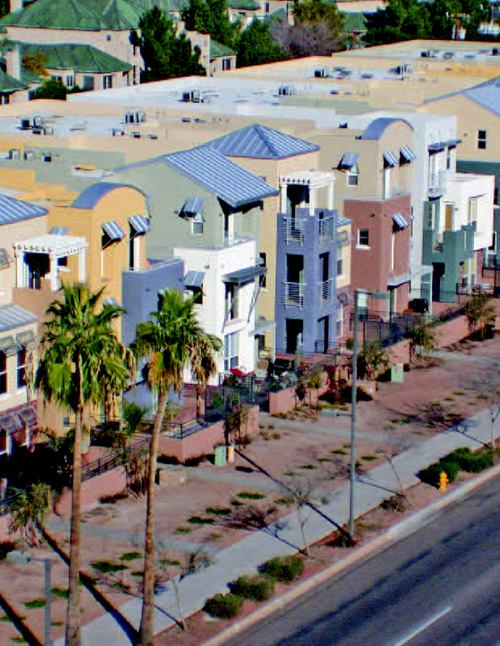
MIX AND MATCH: Artisan Homes used a medley of soft colors, roof forms, and shade elements, from awnings to pergolas, to create a lively Phoenix streetscape.

Eric Brown, president of Artisan Homes in Phoenix, is one entrepreneur who's created a niche for himself building in restrictive planned communities. Phoenix resisted stringent design requirements in the past, he says, but now it's on a perpetual self-improvement binge. “We had a major battle trying to up the standards, and a lot of builders were quite angry about it,” says Brown, who sits on the city's design review standards committee. “Three years later, no one has felt ill effects by having better design. Buyers are starved for it. And doing those things the planners want has made it easier for us to get projects through both neighborhoods and city governments.”

Strategic Thinking

There's no doubt that good design is good business. But at the heart of the issue is how to create architectural diversity without sacrificing profits. And that requires a fundamental shift in thinking from the days when a simple tweak like a pop-out window qualified as a change in elevation. One of Brown's profit strategies starts at the lot-planning stage. He pre-plots Artisan's homes, spending more money on the elevations of homes that sit on high-profile lots. In one 38-plot subdivision, for example, Brown specified a striking elevation with a lot of stone. It cost more than he felt buyers would be willing to pay, though, so he reduced the price by 25 percent, distributing the balance among all the other homes. “The other people are getting just as much benefit,” Brown says, “because those elevations make the whole community look better.”

OUTSIDE THE BOX: Simple geometric forms unify these multifamily dwellings by Artisan Homes, while pop-out bays break down the buildings' scale and animate the elevations.

Charter Homes, of Lancaster, Pa., also budgets what it calls “postcard” opportunities into the cost of shaking up the street scene. The builder scrutinizes the community plan, looking for places to create architecture that stands out, a landmark telling people where they are. “We offer one or two elevations that are only available to those sites—community entrances, corner lots, and any place the eye rests on a series of homes,” says president Rob Bowman. “When the street turns a corner, making sure there's something on the elevation you don't see anywhere else does amazing things to break up the sameness of the street.” On those homes, the builder might wrap a front porch to the side, put a turret on the second floor, or add a nicely detailed sunroom or grouping of windows.

“If those extras bring space and light into a home, the value is created and it's not a cost the builder has to bear,” Bowman says. “In other cases there are things we do that are included in overall development costs.” One of them is designing for the areas between homes—what landscape architects call negative space—using fences, hedges, and trees to mitigate the march of architecture and delineate public and private space. In the scheme of things, those elements don't cost much money; they simply take a little more thought.

“It's hard to get away from looking at two-dimensional elevations to the third dimension—how people are going to relate to the street,” Bowman says. A gesture as simple as creating two steps from the street to the front yard costs about $100 and adds interest to the landscape. His company also plays with variations on ordinances for street trees, arranging them in groups rather than, say, planting one every 50 feet, and purchasing trees that vary in size.

PRE-PLOTTING FOR PIZZAZZ: Charter Homes adds extra features to homes on high-profile lots, such as this corner house, above, with a beautifully detailed porch. Left: Landscaping mitigates the march of architecture.

Developers constantly ratchet up landscaping requirements, says Daryl Spradley of Maitland, Fla., a design consultant for master planners across the country. “Builders traditionally haven't recognized the value of a landscape package,” he says, citing a client who got 25 percent more for his homes than the competition and attributed it to the manicured setting. “Some builders have figured it out; others just don't want to do it,” he says. “But it has a big impact.”

Style And Substance

Baywood Development Group, in Newport Beach, Calif., has no problem with municipalities and master plan developers who insist on exceptional streetscapes. “We have a difficult time competing when we have a generic project,” says president Bill Watt. “We like a level playing field, as long as people are realistic about the costs.”

The architectural styles prescribed for a community, and the mix of styles ultimately built, figure prominently into those dollars. Some of the most beautiful historical houses—such as folk Victorians with their lap siding and clean, elegant detailing—are relatively inexpensive to build, Watt says, compared with Craftsman-style homes, which have a lot of elements to include. “You go through the allowed styles and say, ‘Let's do a lot of these, not very many of those,' ” Watt says. “You need an architect who's creative.”

Any architect will tell you that the best way to mix styles successfully within a neighborhood is to use materials, proportions, and details that are true to those precedents. Historically evocative homes continue to appeal to a broad range of buyers over time, says architect Adele Chang, a principal at Lim Chang Rohling & Associates, in Pasadena, Calif., and they offer the opportunity for countless design permutations. Within the same floor plan, a significant massing element such as a front porch would be an appropriate option on a Craftsman or colonial elevation, as opposed to, say, Georgian or French country.

The firm takes its cues from Pasadena's rich architectural traditions. “The old houses were very simple; I think we've forced a degree of complexity on homes in recent years that may not be necessary,” Chang says. “Within that simplicity it really comes down to sensitivity to proportions and fenestration and detail. None of that has to be costly.” She notes that the details on colonial-style homes were traditionally very delicate and not as overworked as more recent iterations have been. “The size of the fascia board is not this chunky, 1-foot-thick piece that you have to apply moldings to in order to break down the scale,” she says.

BREAKING UP: At the Chapala Lofts in downtown Santa Barbara, Calif., B3 Architects broke the predominant building form with a change of massing and color, while respecting the rhythm of the street.

Architect Barry Berkus, president of B3 Architects, in Santa Barbara, Calif., says California's vernacular Revival styles of the 1900s to the 1940s also lend themselves to multiple combinations of material and form. Spanish Revival, for example, lets builders mix wood, ornamental tiles, and wrought iron with traditional stucco. Familiar forms include gateways, porches, and thick walls. “Here, windows are set far back for shade,” Berkus says. “The more you do that in architecture, the stronger the elevations in this vocabulary.”

In order to satisfy design restrictions, builders may be tempted to tweak classic styles in ways that compromise their design integrity. Architect Michael Woodley, of Woodley Architectural Group, in Denver, says that some community guidelines will dictate three different roof styles, allowing builders to clip or project part of the roof to create a different profile, regardless of whether it matches the architecture. “An old trick was to offer a roof pop-out in a hip or a gable. Some builders want to create diversity by just changing the roof on the projection,” Woodley says. “But the roofs need to fit the style of the architecture, even if you have to change the floor plan significantly. If you have a Craftsman elevation, lower the roof pitch and steepen it up for a cottage elevation. Doing that, and changing the roof direction, can make it look like a completely different house.”

CLUSTER CONCEPTS: Distinctive elevations belie the matching floor plans on these cluster homes, designed by Woodley Architectural Group. Varied entryways and roof lines and details such as inviting window boxes embellish the houses' basic shape.

Mass Appeal

Thanks to computer technology, a change in roof direction costs far less than it did 15 years ago, and it's a classic way to break up repetitive roof forms throughout a neighborhood. One elevation may have a gable that faces the street. Another elevation with the same floor plan may feature a gable that turns to the side, or perhaps a hip roof. Because massing makes such an impact on the street, builders in hot markets are often willing to spend more money to shift the framing on a roof, says Berkus. “When there's more latitude with pricing, they'll go to a different roof structure on the front of the house, whether it's adding a gable or hip or parapet walls,” he says, adding that many houses being built today offer buyers structural options such as bonus rooms and three-bay garages, which also change the massing considerably.

Garages present constraints and opportunities of their own. Spradley says the placement of garages has been regulated much more closely in recent years. A front-loaded, three-car garage takes up 50 percent or more of an elevation and can obscure the entrance. Planned communities frequently deem them unfriendly and even unsafe, since they turn eyes away from the street.

COLOR CONTEXT: Colors can evoke a sense of history and give the impression that these homes have evolved over time. “Proper color balance can make a community feel more mature,” says Eric Mandil, this palette's designer.

Part of the problem is that ceiling heights have risen in homes. “Plate heights have increased from 8 feet to 10 or 12 in the last decade,” Spradley says, “so if you have a reverse gable, a massive amount of garage is staring out at you.” That factor is compounded by another reality: As baby boomers' kids grow up and begin to drive, the demand for multiple-car garages increases. To minimize the impact of a large, flat area, many planned communities now require courtyard loads. Spradley also suggests recessing the third bay by 2 feet, which forces the roof line to change. A more elegant and costly solution, he says, would be to create a 4- to 6-foot overhang with columns underneath, making a covered walkway along the face of the bays. Distinctive doors are another way to downplay a domineering garage while integrating it with a home's architecture. “I'm seeing more developers requiring historic kinds of garage doors,” Spradley says, “but that runs the cost up.”

Fine-Tuning Design

Indeed, attention to details, even simple ones, can create an exterior ambience that says a community has been smartly developed. Well-chosen elements such as nice light fixtures and house numbers can make a modest community look like a million bucks. “It's like the black dress with the great accessory pin,” says Eric Mandil, a Denver architect and interior designer who consults for builders. “Using something better than paste-on house numbers lends more character and individuality. Maybe you'll spend more money, but as a percentage of the whole, you're spending a lot less.”

So much depends on choosing details that fit in with the natural and cultural environment. When Rob Mossberg, president of Cottage Co., based in Harbor Springs, Mich., decided to build Bay Street Cottages—18 two-bedroom homes on one and a quarter acres in a tony part of town—he and his architect walked the old resort communities nearby for inspiration. They mixed cottages painted in historical colors—green, red, and yellow—with units clad in honey-toned cedar shingles and installed more than 100 flower boxes that are automatically irrigated. “The magic is in how you mix and accessorize, and it's not only what you use, but how it comes together and is installed,” Mossberg says.

MIX MAGIC: Over 100 flower boxes and the colors of old Northern Michigan resort architecture perk up the Bay Street Cottages, which includes 18 units and two floor plans.

Finding the right anti-monotony formula for each project is the challenge, of course. Builders have to dig deep into the local market to understand who's buying the homes and what those buyers can afford. The bottom line, though, is that consumers, not just cities and developers, appreciate the difference between a cookie-cutter community and a well-designed one. And builders who aren't being innovative in their homes today will be competing with their resale products tomorrow. “You can make a lot of changes with $2 a square foot,” Brown says. “The first ones who come up with a better mousetrap will get the sale.”

Cheryl Weber is a freelance writer based in Severna Park, Md.


Customizing With Color

Color is one of the cheapest ways to create diversity on a streetscape, yet it may be the toughest design tool to master. Part art, part science, it takes a professional to convey just the right message with color. “A proper color balance in a streetscape can make it look more classic and mature,” says Eric Mandil, an environmental colorist, architect, and interior designer in Denver. To design a palette, Mandil looks to a community's natural environment, playing to the quality of light. Fresh greens and yellows look good against Florida's lush vegetation, he says, whereas Colorado, with its bright white light, can take saturated colors that absorb the light. California has a soft light, so subtle tones like sage green read well. Mandil often works with paint manufacturers to create just the right hue for a community. “In a Las Vegas project, we color matched the mountains,” he says. “That's also a marketing tool. The developer owns that color, and you can start to customize.”

Mandil specs paint colors that complement the masonry, which makes the materials feel structural when they're often just a veneer. And he carefully balances the tones throughout a community. “You can add a little staccato with deeper saturation, like adding pepper into the mixture,” he says. “But yellows on the south side can vibrate too much, and don't put a moody, broody color on a north-facing façade. If you keep colors in similar values, you can have a lot of different colors and create great diversity with subtlety.”

Paint colors should convey the feeling that a community has evolved over time, and part of the process involves devising a formula for how many permutations there should be. In a neighborhood of 200 homes, for example, Mandil would try not to repeat a color scheme more than 10 times. The body color may repeat more, but the trim or an accent color will change. To check the overall effect, he arranges tiny paint chips on the site plan, squints his eyes, and looks down the street. “You pre-plot it so the buyer isn't making color choices,” Mandil says. “You calculate it out so you know the community will be handsome.”