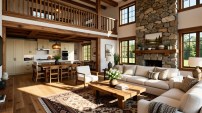
HOW DO AMERICAN FAMILIES REALLY live in their houses? That was the question our Reality House 2006 endeavors to answer.

To find out, BUILDER commissioned San Diego–based Marketscape Research and Consulting to investigate. Researchers Barbara Nagle and Doris Payne spent hours in family homes, not only asking questions but also observing how the families actually lived in their houses (see “The Real Deal,” November, page 63).

They quickly learned that today's households increasingly are multigenerational. The families they interviewed, located in Las Vegas, Orlando, Fla., and Southern California, range in size from three to six people. Ages ranged from 85 years to 6 months.

While three families fit the conventional notion of a son or daughter taking in an aging parent or grandparent in declining health, several others highlighted the diverse reasons that lead to the creation of multigenerational households, such as the need for affordable child care or the need to combine incomes to afford a home.

Combining parents, children, and grandchildren—and sometimes other far-flung family members—means rethinking everything from privacy to the number of stair steps from the front door to the lawn.

BUILDER selected Memphis, Tenn., architectural firm Looney Ricks Kiss to design its Reality House 2006 to accommodate several generations. Issa Homes is the builder of the 5,394-square-foot house in Celebration, Fla., which will debut to builders at the 2006 International Builders' Show Jan. 11–14 in nearby Orlando.

DIFFERENT DESIGN

Among the housing issues the families face are safety and accessibility for older members. One of the homeowners mentioned that even a single step without a handrail kept his mother from going outside when she was at home by herself. Plus, the older family members want to feel that they are contributing something to the household, often by providing child care or cooking and cleaning. One homeowner's 85-year-old grandfather helps out by walking his great-granddaughter to school every day.

Not surprisingly, privacy is a major concern. While the families spend a lot of time together in the kitchen and living areas, each member feels a significant need for a place he or she can be alone. As one grandmother who has her own suite put it, “I've been living alone for four years. I wanted privacy; they're here when and if I need it. That part was very important.”

The partners on the project took that to heart. The Reality House pays careful attention to the unique dynamics of a multi-generational household that wants to spend time together yet needs quiet spaces for all of its members.

The Reality House features both indoor and outdoor retreats, including a “Second Generation Suite” that comprises sleeping, dressing, and sitting areas. With a coffee and snack bar, it allows for a great deal of privacy and flexibility without shutting the person off from the daily socialization of preparing and eating meals together as a family. That space adjoins a ground-level lawn terrace that provides older parents with a private, outdoors getaway.


Teens and parents have their own retreats, too. Both secondary bedrooms have sitting/study areas and a semiprivate hangout space, while the “Ultimate Master Suite” has an indoor sitting area and an outdoor master porch.

There's also a first-floor den/study separated from the bustle of the main house by a gallery that offers a flexible space for any family member—or guest—in need of some solitude. And if that's not enough, the backyard holds the treasure of a workshop, a great place for a hobbyist to work on a new creation or the next great American band to rock out without rattling the dishes in the kitchen cabinets.

AN EMERGING MARKET

If building for multigenerational families seems to have slipped by you, you're not alone. The existence of multigenerational households didn't even warrant the attention of the U.S. Census Bureau—which measures virtually everything—until 2000, when it analyzed them for the first time. It reported 3.9 million multigenerational households, nearly 4 percent of all households.

About two-thirds of the households were made up of the householders, their children, and their grandchildren. The final third consisted of the householders, their children, and their parents or in-laws. A scant 2 percent of the households consisted of four generations.

Census demographers reported that multigenerational households were more likely to exist in:

  • areas of recent immigration,
  • places with housing shortages or high housing costs, and
  • areas with high rates of children born to single mothers, who live in their parents' homes.
  • Until now, the home building industry's idea of multigenerational housing has largely been age-restricted enclaves within master planned communities. Grandma and Grandpa get to see the grandkids whenever they want and then retreat behind a guarded gate, where they are “safe” in their own house and among their peers.

    Is this beginning to change? Leading architects seem to think so. At the “Reinvention 2004: The Next American House” conference sponsored by residential architect (one of BUILDER'S sister magazines), a brainstorming session focused on housing's near future. Topping the list of 15 emerging trends in home design: Housing should accommodate more activities, types of people, and living arrangements, and it should be multigenerational.

    TAKE-AWAYS

    Builders who would like to target buyers with multigenerational households can get their attention—and win their thanks—by considering several issues. Grand front porches may contribute to a great front elevation, but our researchers found that side and back porches such as those near the family room, den, and the second-generation suite in The Reality House, are used much more. They're especially valued by grandparents who may not be able to leave home as often as they like. The side porch becomes their trip to the park, Nagle says.

    There's also more company as extended family members come to visit when an older relative moves in. That leads to a need for guest accommodations—The Reality House's den/study can easily double as a guest bedroom, and the nearby pool bath gives those guests a convenient bathroom. Plus, these buyers have a tendency to work at home at least part of the time as they try to mesh a career with caring for an older relative and children. A home office—or space for a computer work station and ample wiring—is an attractive feature.

    All eight of the families interviewed had tile floors, purchased either when the house was new or installed later as a replacement for carpet. They cited the wear and tear that larger families put on flooring, cleanliness, and the ease of navigation for older family members. So give them plenty of hard-surface flooring options.

    Finally, take a hard look at those high ceilings that are so popular in great rooms. These families hate them because they contribute to high noise levels. That's especially problematic if an older family member has a hearing loss that requires turning up the volume on the TV.

    FOR MORE INFORMATION ON MULTIGENERATIONAL HOUSEHOLDS, VISIT OUR WEB SITE AT WWW.BUILDERONLINE.COM, CLICK ON “THE MAGAZINE” TAB, AND THEN CLICK ON “BUILDER ARTICLE LINKS.”