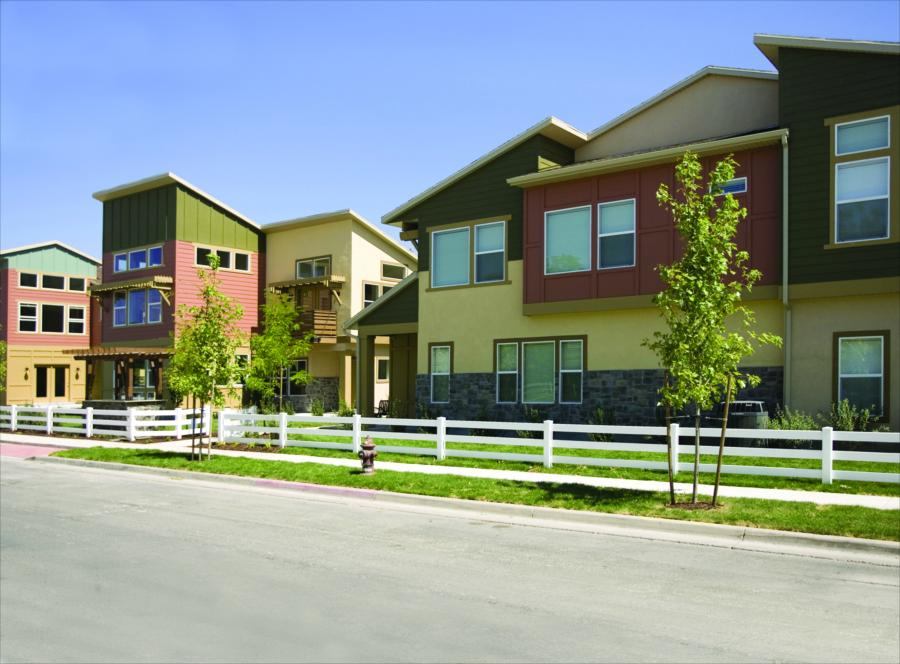
City Wise: Higher density townhomes and condos in the suburbs outside Salt Lake City have allowed Garbett Homes to convert young renters into first time buyers.
Credit: James Holmes
True, much of the news about the housing landscape these days is gloomy. But not all of it. People still need houses to live in, and there are those who still want to buy new. It’s just that they aren’t part of the McMansion crowd, and they don’t look like the new-home buyers builders came to know so well during the boom times. Today’s home buying households are generally smaller, more frugal, and more energy-aware. Many are first-time buyers who don’t have the contingency burden of unloading existing homes. Those who work are less inclined to tolerate a commute that takes them through an entire radio news cycle or newspaper before they reach their desks. And by the looks of the projects on the following pages, the old “bigger is better” mentality has, in many instances, given way to an affinity for more intimate living quarters. Builder visited 10 strong-selling neighborhoods to determine what it was that got buyers off the fence and into their new homes.

Here’s the Deal: Permits for BackRiver Townhomes were contingent on $3 million worth of public land improvements in an adjacent park, and the designation of five townhomes as affordable units (cost to builder: about $2 million).
Credit: Michael Rixon
Big Picture
Townhomes disguised as coastal estates strike the right balance.
When developer Tom Hastings broke ground on BackRiver Townhomes, a collection of 45 upscale attached residences in the Boston suburb of Hingham, Mass., his competition wasn’t the other builder across town. It was the comfy single-family homes his target buyers, aged 55 to 65, were nicely settled into and reluctant to leave. Resale gridlock wasn’t holding them back (property demand in Hingham and nearby Wellesley had been unfazed by the downturn), and neither were the $1 million-plus price tags on some of the townhomes (after all, these folks were plenty wealthy). Rather, it was a simple matter of convincing discerning empty-nesters that a low-maintenance community of shared walls could feel even better than what they already had.
At six units to the acre, the townhomes are a close lot, but they breathe well and actually feel rather grand. With their crisp blend of Newport- and Nantucket-style architecture, residences arranged in clusters of three look like big old houses on the outside, not unlike the shingle-style beachfront retreats that dot the New England coastline. Cupolas with flared light wells flood interiors with natural light, and each home enjoys either a walk-out garden or river view.

Credit: Michael Rixon
Giving the property an air of permanence was essential. (The town of Hingham was founded in 1633, not long after the first pilgrims landed at Plymouth Rock, so many surrounding properties are historic.) Hastings says a $25,000 investment in landscaping, including hand-hewn stone walls and mature tree plantings, was well worth it. “We always try to create an environment that looks like it’s been there a long time,” he says, noting that trees provide the added benefits of erosion control, shading, and coastal wind buffering.
Ten units were presold before construction began, and half of the entire project was sold—all to empty-nesters—before the model opened.—J. Sullivan

Credit: Michael Rixon
Location: Hingham, Mass.
Community: BackRiver Townhomes
Total acreage: 7.4
Date opened for sale: Spring 2007
Product: Townhomes from 2,200 to 3,800 square feet
Price range: $875,000 to $1 million+ (five affordable units reserved for low-income buyers are priced at $198,000)
Sales to date: 22 (of 29 released)
Total number of units at build-out: 45
Builder/Developer: The Hastings Cos., Hingham
Architect: Steffian Bradley Architects, Boston

Cottage Industry: Buyers have responded so well to the Rose cCollage, the smallest of the Cafe Collection plans, that Neal Communities is planning an entire new line of homes based on it.
Credit: Perry Johnson
Small and Smart
Neal Communities captures buyers with a value-priced Café Collection.
Forest Creek, a master planned community launched by Lakewood Ranch, Fla.–based Neal Communities, struggled for pretty much every sale from the time it opened in May 2006. The developer could have done something big and bold to get buyers’ attention, but instead did the opposite.
In February, Neal Communities unveiled the Café Collection, a group of eight compact plans, including three small and sassy Key West–style cottages along with tried-and-true Florida standards.
Prices started at $122,900, a value that practically caused whiplash from so much head-turning. Buyers knew a once-in-a-lifetime deal when they saw one. The first weekend the models were open, 1,100 people toured and eight contracts were signed. Within three weeks, 25 cottages were sold.
The local media also knew a story when it saw one. The price and style of the homes, coupled with their energy-efficient design and the amenities at Forest Creek, snagged headlines by the fistful.

Credit: Perry Johnson
“We had 42 articles written about it—43, with this one,” says sales director Miranda Oswald. “We just ran our first Forest Creek ad two weeks ago.”
Patrick Neal, owner of Neal Communities, says he decided to offer the value-priced line of homes for the most pragmatic of reasons. He had houses “that weren’t going to be bought by anyone as long as there were 11,500 houses on the MLS.”
Neal Communities achieved the pricing on the Café Collection through a favorable land purchase, efficient design—there are only three windows in the houses—and aggressive pricing with trade partners. “For the first time in 40 years, we’re naming the price we’ll pay,” Neal says.—P. Curry
Location: Parrish, Fla.
Community: Forest Creek
Total acreage: 135
Date opened for sale: May 2006
Product: Cottages from 1,200 square feet to 1,648 square feet; townhomes from 1,434 square feet to 1,684 square feet; single-family homes from 1,768 square feet to 2,504 square feet
Price range: $122,900 to $239,900
Sales to date: 102
Total number of units at build-out: 338
Builder/Developer: Neal Communities, Lakewood Ranch, Fla.
Architect: BSB Design, Des Moines, Iowa; Davis Bews Design Group, Oldsmar, Fla.
Interior designers: Charlene Neal, Lakewood Ranch Fla.; Masterpiece Interiors, Winter Park, Fla.; Marc-Michaels Interior Design, Winter Park

Sales Driver: The renovation of an underground parking structure allowed the builder to offer slightly more than one parking space per unit, with elevator access to each floor. Big bonus.
Credit: Courtesy Cushman Wakefield
Surprise Inside
An adaptive-reuse building in the heart of L.A. serves up the anti-loft.
Commit yourself to an adaptive-reuse deal and you never quite know what you’re going to find behind those walls. Developer Walter Eeds wasn’t exactly shocked when Library Court, a 90-unit condo building in downtown Los Angeles, took 2½ years to get approvals and another year to build. But in the end came a sweet reward: All 10,000 square feet of its retail space was leased by the time construction wrapped up, and every last unit sold and closed out in 13 months.
In an earlier life, the 1960s building had housed offices and a health club. By the time it was acquired by The Greystone Group, of which Eeds is CEO, its primary inhabitants were vagrants and rodents, but they were the least of the developer’s problems.

Credit: Courtesy Cushman Wakefield
“The building actually was two different buildings ... that essentially had been zipped together,” Eeds explains. Design-wise, the first challenge was to sew up those seams for seismic purposes and figure out what to do with a hole in the roof structure left by the fitness club’s former rooftop pool. Architects at Levin & Associates added a sixth story (more density, more profit) and cut a light well in the center of the building where the pool had been. Interior corridor access to residences now stems from this light well, which overlooks a courtyard.
Other pragmatic moves, such as the decision to drywall over retrofitted framing and mechanicals, proved equally fortuitous. “Our strongest selling point was the fact that we were not a loft,” says community sales manager Rebecca Travell. Buyers liked the defined walls and finished ceilings and floors. Proof, perhaps, that even hipsters in the 28 to 45 demographic had grown tired of exposed ducts and raw concrete.—J.S.
Location: Los Angeles
Community: Library Court
Total acreage: .54
Date opened for sale: June 2006
Product: Studio, one- and two-bedroom condos from 590 square feet to 1,185 square feet; townhomes of 1,179 square feet
Price range: $475,000 to $750,000

Credit: Courtesy Cushman Wakefield
Sales to date: 90
Total number of units at build-out: 90
Builder/Developer: The Greystone Group, Newport Beach, Calif.
Architect/Land planner: Levin & Associates, Los Angeles

Wide Open Spaces: Front yards may look traditional but the backyards are prairie grasses that provide natural storm water management, which is crucial in flood-prone Iowa.
Credit: John Johnson
Show and Sell
An Iowa builder grows success with green education.
Rick Tollakson, president and CEO of West Des Moines, Iowa–based Hubbell Homes says he thought a conservation community was “about the dumbest idea I’d ever heard of.” He changed his mind when members of a local green building organization told him that area governments would expedite permits if a developer proposed one.
Hubbell Homes actually proposed—and got approval for—three conservation developments. Of them, Glynn Village in Waukee is the largest at 300 acres. Every house in the community abuts 100 feet of prairie grass and wildflowers.
The rationale for native prairie grass is one subject that requires a bit of “show me” education, Tollakson says. It’s just not the same as looking out the kitchen window onto a big yard of turf grass.” We still have people saying it looks like weeds,” he says.
The builder also has had to explain the environmental benefits of small yards and a site plan that places houses close together. And how the standard geothermal heating systems work.

Credit: John Johnson
As a result, much of the marketing about Glynn Village is educational. Hubbell Communities, a magazine published twice a year, is mailed to target ZIP codes and put out in area grocery stores. The builder’s Web site provides additional information, and a PR push has yielded several articles. The builder also speaks regularly to community groups. “People know we’re excited about doing this,” he says. “We think this is the direction development is going.”—P.C.
Location: Waukee, Iowa
Community: Glynn Village
Total acreage: 280, half devoted to open space
Date opened for sale: July 2006
Product: Brownstones of 1,627 to 1,832 square feet; single-family homes of 1,656 to 2,255 square feet
Price range: Brownstones, $157,900 to $171,900; single-family, $199,900 to $360,000
Sales to date: 58 (Hubbell Homes sales, it builds about half of the homes sold at Glynn Village)
Total number of units at build-out: About 700
Builder/Developer/Architect: Hubbell Homes, West Des Moines, Iowa
Interior designer: Right Touch Interiors, West Des Moines

Credit: James Holmes
Tried and True
A Utah builder’s success boils down to a simple maxim: Stick with what you know.
Every week, thousands of moviego-ers flock to the Megaplex 20 theater in South Jordan, Utah. When the lights dim, one of the first things they see, along with the previews, is an ad for Garbett Homes—a local builder that just happens to be releasing some nifty little homes across the street in the mixed-use neighborhood of Summerlane at The District.
Garbett’s unorthodox direct-to-consumer strategy—one that marketing director Rene Oehlerking says is not so different from “selling an iPod or a shoe”—is a little quirky and has generated model traffic. But the builder’s business strategy is conservative, and that’s what’s kept Garbett on solid ground, even in a downturn.
In a nutshell, owner Bryson Garbett specialized in small affordable when small affordable wasn’t cool. During the boom, when other builders were gobbling up land to build starter castles, Garbett stuck with what he knew best—small, urban-style homes in the ’burbs—and focused on fine-tuning his pro forma. “The two areas where you can make buildings affordable is in the size of the home and the density,” he says. The average density of a Garbett community is eight to 15 units per acre.

Family Friendly: Townhomes and stacked courtyard flats with garages hidden from the street have appealed to young couples, young families, single women and single moms.
Credit: Rene Oehlerking
In The District, 64 units (about a quarter of phase one) were presold before the first homes were even framed. “We don’t ever start a building until it is 50 percent sold. Usually, by the time a building is completed, it’s sold out,” says Garbett. “Right now, we’ve sold about 75 percent of what we’ve started building.”—J.S.
Location: South Jordan, Utah
Community: Summerlane at The District
Total acreage: 22
Date opened for sale: Summer 2006

Family Friendly: Townhomes and stacked courtyard flats with garages hidden from the street have appealed to young couples, young families, single women and single moms.
Credit: James Holmes
Product: 276 townhomes and 182 stacked flat condos (30 of which are live/work) from 899 square feet to 1,775 square feet
Price range: $149,900 to $215,000
Sales to date: 76
Total number of units at build-out: 800
Builder/Developer: Garbett Homes, Salt Lake City
Architect: JSA Architects, Salt Lake City

Memory Lane: The 16 plans at James Hill were inspired by kit homes that were popular nearly a century ago in Birmingham. The main street into the community will have one of each plan, highlighting the wide range of diversity.
Credit: Randall Crow
Bridging the Gap
Signature Homes in Alabama provides an entry point into an upscale development.
On the morning of April 11, the staff for James Hill at Ross Bridge arrived at the sales office to find people waiting in line to make reservations for the release of the first 37 homesites.
“People arrived as early as 6 a.m. to post their names at the door,” says Barry DeLozier, senior vice president of Hoover, Ala.–based Signature Homes, the builder of James Hill. “We wound up with 45 reservations for a 37-lot phase.”
That would be a success story for any release, but especially for one that didn’t do any traditional advertising.
“There were a lot of strategic pieces to the puzzle,” DeLozier says, noting that marketing for the community was done on site and online. “We did a lot of e-mailing. “There were probably thousands of e-mails leading up to the date of the event.”

Credit: Courtesy Signature Homes
E-mails went out to the referral database and the builder’s network of co-op brokers. The community’s release was promoted on Signature’s Web site, which draws about 500 unique visitors a day, and with on-site signage.
What really got buyers excited about James Hill, he says, was the triple-threat combination of location, price, and product. Ross Bridge has been the fastest-selling master plan development in the history of Birmingham.
The price point at James Hill—$230,000 to $320,000—opened the development to an enthusiastic, underserved segment of the market. The neighborhood is surrounded by much more expensive homes.
Signature Homes designs new product for each neighborhood, which creates a sense of urgency for buyers. The James Hill designs were inspired by the early 20th century boom years in Birmingham, when kit houses were popular.

Credit: Courtesy Signature Homes
“We call them antique reproductions,” DeLozier says. “The exteriors look virtually identical to the houses built in the 1920s.”—P.C.
Location: Hoover, Ala.
Community: James Hill at Ross Bridge
Total acreage: 80
Date opened for sale: April 2008
Product: Single-family homes from 1,600 square feet to 2,800 square feet
Price range: $230,000 to $320,000
Sales to date: 30
Total number of units at build-out: 213
Builder: Signature Homes, Hoover
Developer: USS Steel, Hoover; Daniel Corp., Hoover
Architect: Dungan Nequette Architects, Birmingham, Ala
Interior designer: Brandi Belcher, Signature Homes, Hoover

Tasty Proposition: A series of exclusive sales events at local restaurants made qualified move-up buyers fall in love with the neighborhood.
Credit: Courtesy John Laing Homes
Vested Interest
It’s not the number of prospects that matters. It’s how you treat them.
When it comes to first dates, there are certain rules: Meet in neutral territory, don’t get too personal, and take it slow. John Laing Homes honored this code in the launch of its Heirloom collection of single-family homes in the acclaimed New Urbanist community of Stapleton in Denver. Not wanting to presume, the builder didn’t even have the neighborhood blocks platted when it invited a handful of prospects to a local Mexican restaurant for a sneak preview. Some 22 move-up buyer groups—all culled from a word-of-mouth interest list—showed up to peruse product renderings, floor plans, and homesites over quesadillas and margaritas. Prices were not discussed.
On the second date (at an Asian restaurant), the builder asked for more of a commitment. Buyers wanting to know more about pricing and premiums had to come with financing pre-approval, and they had to have already met with the John Laing sales team to pick their favorite floor plans and homesites (feedback that was ultimately used to plat the neighborhood). This time an interesting dynamic emerged.

Credit: Courtesy John Laing Homes
“Prospects started introducing themselves and co-mingling,” says Julie James, regional director of sales and marketing. “They would ask each other what home and homesite they were interested in. This created additional urgency, but also started creating a sense of community. The event was scheduled from 5:00 p.m. to 7:00 p.m. but ended up lasting until 8:30.” It created such a buzz, in fact, that two serendipitous restaurant patrons ended up joining the interest list that night.
The first official sales release took place during a third sales event, over Italian. This time, the 16 prospects in attendance were invited to come up one at a time to lay claim to their lot of choice and receive a bottle of champagne. “We sold 12 houses in two hours, and the remaining four still wanted to buy,” says new-home counselor Jesse Hamilton. “We actually had to cut it off because originally we had only planned to release eight lots.”
The builder’s good manners and good taste paid off. The RSVP rate was 100 percent. Total sales to date: 26, all with non-contingent contracts.—J.S.

Credit: Courtesy John Laing Homes
Location: Denver
Community: The Heirloom Collection at Stapleton
Date opened for sale: April 2008
Product: Single-family homes from 2,205 square feet to 2,625 square feet
Price range: $430,000 to $500,000
Sales to date: 26
Total number of units at build-out: 56
Builder/Developer: John Laing Homes, Denver
Architect: Woodley Architectural Group, Denver
Interior designer: Hillary Reed Interiors, Denver

Fab Prefab: Timberhawk has walls, stair systems, and porches prefabricated at a factory in Mt. Pleasant, Utah, which allows the builder to achieve better efficiency.
Credit: Megan Bradley
Efficiency Rules
Cost controls allow one builder to offer three-bedroom townhomes for the same price as the competition’s two-bedroom units.
About four years ago, Chris Jaussi figured out that he could make more money building affordable townhomes than high-end custom houses. “I could build a four-plex of row homes for the same cost as one custom home,” says Jaussi, CEO of Timberhawk in Mount Pleasant, Utah.
Affordable didn’t have to mean shoddy, either. “Just because someone can’t afford a half-million-dollar home, they should still get good quality,” Jaussi says.
His product is a three-bedroom townhome that he sells for $129,900. The product itself is widely available in Rexburg, Idaho, but most other townhomes at his price point are two bedrooms. “This is the best deal in town,” he says.
Jaussi achieved his combination of quality and price by focusing on efficiency. He only builds two floor plans to control pricing on supplies and labor. And his trade contractors give him discounts because he pays them every week. “They give us better deals because they know they don’t have to chase money. … It allows us to keep building where many other people are not.”

Credit: Megan Bradley
Jaussi also invested in a wall panel component factory, which resolved a critical issue with framing costs and quality that had been vexing Timberhawk. “If you don’t have your framing quality up, it messes up all your other subs,” he says. “It’s had a huge impact on our business.”
It’s also helped him cut material costs, both by reducing waste and by keeping track of supplies, which can be tough on a winter jobsite.
“We had to order 60 extra sheets of plywood once,” Jaussi recalls. “We couldn’t figure out where it had gone. We found it in the spring when the snow melted.”—P.C.
Location: Rexburg, Idaho
Community: Rexburg Meadows
Total acreage: 10.5
Date opened for sale: November 2006
Product: Townhomes of 1,400 square feet
Price range: $129,900 to $145,000
Sales to date: 90
Total number of units at build-out: 128
Builder: Timberhawk, Mt. Pleasant, Utah
Architect: Jessop Design Group, Salt Lake City
Interior designers: Joelle Einerson and Jamie Jaussi, Rexburg, Idaho

Credit: Courtesy Tim O'Brien Homes
Suburban Import
City homes with suburban DNA offer the best of both worlds.
There are plenty of languishing single-family subdivisions these days that builders wish they’d never built in the first place. Oak Hill isn’t one of them. At first glance, it’s got all the trappings of suburbia—traditional five-over-four-and-a-door elevations, roomy garages, island kitchens, and walk-in closets—except that it’s not in the ’burbs. Rather, the neighborhood’s location inside Milwaukee proper has made it a hot property among municipal employees with residency requirements who still want the big house and yard.

Inside Edge: Tim O’Brien Homes offers a $5,000 discount to city employees on top of any other promotion it’s got going. That’s allowed the builder to post flyers on City Hall bulletin boards and in other municipal workplaces.
Credit: Courtesy Tim O'Brien Homes
“In Milwaukee, all public sector employees are required to live within city limits,” says builder Tim O’Brien, who bought 15 of the project’s 34 homesites (lot prices: $80,000 to $130,000) and has already sold five homes since breaking ground on seven earlier this year. “That includes the department of public works, police, fire, the public school system, and anyone in City Hall.”
O’Brien’s offerings might seem run of the mill in locations farther afield, but inside city lines, they are a rare find. “We offer about eight ranch plans and eight two-story plans, allowing people to move the footprint around,” he says. “Most buyers are couples in their 30s and 40s who either have kids or are planning to have kids.”
The neighborhood’s proximity to downtown jobs and public transit means buyers don’t have the commuting and parking expenses of their suburban brethren. Plus, all O’Brien homes are Energy Star and NAHB Green Building certified, with guaranteed utility savings of 25 percent or more.

Credit: Courtesy Tim O'Brien Homes
That’s the kind of stuff happy home buyers chat about at work—a phenomenon that’s been easy to leverage, O’Brien says. “When we get a homeowner who is a member of the police force, fire department, or school system and we earn their trust, we tap them for referrals and sometimes even get them to do a presentation to their department. ”—J.S.
Location: Milwaukee
Community: Oak Hill
Total acreage: 16
Date opened for sale: Spring 2007
Product: Single-family homes from 1,600 square feet to 2,200 square feet
Price range: $225,000 to $350,000
Sales to date: 19
Total number of units at build-out: 34
Builders: Tim O’Brien Homes, Milwaukee; Miracle Homes, Milwaukee
Developer: General Capital Group, Milwaukee

Every Inch Counts: The elimination of wasted space, as well as ample use of natural light, makes the relatively small units at Naomi Place feel more spacious.
Credit: Robert Frazier
In The Niche Of Time
Customizing homes to tap an unserved market pays off in Texas.
In the early 2000s, Lanterra Homes was doing what most other Texas builders were doing—building McMansions. Then, its president, Carlos Bazbaz, identified a large, unserved niche—the 70,000-plus employees of the largest medical center in the world, the Texas Medical Center. He learned that 60 percent of the employees earned at or below the area’s median income of $59,000, but that homes around the medical center started at $200,000. “ A lot of these people were stuck in apartments because they couldn’t afford a house,” Bazbaz says.
Economy of scale was critical in making Naomi Place both affordable and livable for renters who were ready to become homeowners, Bazbaz says. Units average a modest 1,300 square feet with plans that “really focus on the use of space. We had to make sure we had minimal wasted space on the site and in the house itself. ”
Each unit includes a one-car garage and an adjacent parking pad. That configuration allowed the builder to offer a fenced backyard and 11 feet between the units.

Credit: Robert Frazier
“That’s like in the suburbs,” he says. “Most people shopping in the inner city don’t find that.”
Floor plans were equally smart, trading unnecessary corridors and walls for extra square footage in bedrooms, bathrooms, and storage areas. The first floor is essentially two big rooms—a living room and an eat-in kitchen.
Bazbaz says his biggest battle was convincing buyers that they could live comfortably in such a small footprint. Model merchandising played “a huge part” in helping customers visualize how spaces could be designed to live large.
“We had people who told us that when they saw the square footage, they weren’t even going to visit,” he says. “Once they saw it, they couldn’t believe how big it was.”—P.C.

Credit: Robert Frazier
Location: Houston
Community: Naomi Place
Total acreage: 3
Date opened for sale: January 2005
Product: Patio homes of 1,300 square feet
Price range: Low $160,000s to high $180,000s
Sales to date: 59
Total number of units at build-out: 60
Builder/Developer: Lanterra Homes, Houston
Building designer: Innovation Design Consulting Group, Houston
Interior designer: Kathy Andrews Interiors, Houston