IS THERE SUCH THING AS A COMPLETELY original, undiscovered niche in today's housing market? Robert Luntz, a partner with Resolution: 4 Architecture, a New York–based architectural firm, believes he has discovered just such a prize.

“We think there's a segment of the population that's underserved,” Luntz says. “Where are all these people who live in cool lofts and spaces in the city supposed to go when they move to the country? They certainly don't want to go live in a colonial-style house.”

But the obstacle to more people moving into hip, modernistic homes isn't a matter of not enough demand, he insists. It's a matter of cost.

“Basically, in our area, a modern house is $350 to $500 a foot,” Luntz explains. “We've been practicing for 15 years and have tried to come up with a method to do modern work for a relatively affordable price. That led us to modular.”

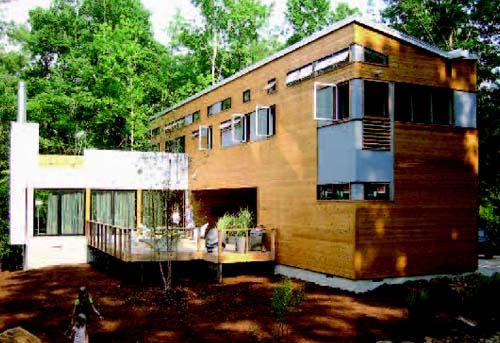
CLEAN LINES: The natural exterior materials used on many prefab modernistic projects like this “Camp Smull” house by Resolution: 4 Architecture of New York lends a warmer feel to the minimalist forms.

Assembling A Workforce

The utility of modular construction had always appealed to Luntz, he says, just not the traditional floor plans. “There's a whole industry that builds modular homes,” he notes. “They build on time, in a controlled atmosphere, and create a quality product.

“Our work in Manhattan required us to work in a lot of lofts 15 feet wide by 50 feet long, so we began to put together a ‘typology' of designs,” he adds. This library of geometric “modules” makes it possible for the architects to communicate their designs to established modular manufacturers such as Apex Homes of Pennsylvania. As a result, they have been able to build their prefab modern designs for about one-fourth the cost of a site-built equivalent home.

Where do builders and tradespeople fit into the picture? At this point, Luntz says, the architects have been selling the idea to promising contractors.

ON THE MOVE: Modernist prefabs come together just like more conventional modular buildings. Homes like this one can have a highly custom look because they're made up of interlocking geometric shapes similar in proportion to those in urban buildings.

“We've identified several prototypical types of builders, [and we're] telling them about us,” Luntz says. “First, we're calling modular builders. Then, we're talking to custom builders who focus on renovations and additions. They understand the fact that once the home arrives, it has to all be put together and the trim work has to be done. Then there's the standard one-off custom builder. Maybe he's having trouble with labor and weather and taking a year to finish one project, and he'd like to do more work in the same time.”

Who Will Buy?

But is the demand for these stylish boxes real? Do the math, says Luntz. His firm's Web site gets 15,000 to 20,000 hits a day, with about 15 phone call inquiries interested in modernist modulars.

In their December 2004 issue, Fortune magazine described prefab modernist homes as one of its top 25 products of 2004. And Resolution: 4 isn't the only firm getting into the modular modernism arena. Royal Homes, a large Canadian modular builder based near Toronto, now offers a special Q Series of prefab modern homes that retail for about $100,000 (land not included). And The New York Times recently reported on how an Austrian architect, Oscar Lee Kaufman, built a 39-foot-by-24-foot modernist home using what he calls OA.SYS (Open Architecture System) at his factory in Dornbirn, Austria. He then shipped the home to a New York couple, and five workers assembled it in about as many days. Total cost to the buyer (including landscaping and excavation): about $300,000.

“We're aiming at between $125 and $150 per square foot for a modernist home in rural mid-America,” Luntz says. “If you're closer to urban areas, the cost is more like $150 to 175, and if you're around the New York City area—say, in the Hamptons—you will probably pay $200 a foot.”

Hidden Values And Costs

Of course, these new modernist marvels have drawbacks. Because they are built in modular sections, they require electrical and plumbing contractors to finish the job. Even more challenging is the lack of any central heating or air-conditioning system—a problem that Luntz is working toward solving. These “urban bunkers” are also smaller than traditional homes, although living large seems to be less important than living well to the clients interested in this aesthetic.

On the up side, the smaller footprint and factory construction of these homes give them a solid green pedigree: They have less wasted material, have firm, tight, well-insulated envelopes, and can be sited to take advantage of passive solar heating. In fact, says Luntz, clients drawn to these designs tend to be environmental early adopters.

“We're putting geothermal heat into a home in upstate New York right now,” notes Luntz. “These are people who are also interested in using green products in an environmentally correct response.”

Breaking Through

If these prefab homes are so popular, why aren't U.S. modular home builders adding them to their mix?

“The modular industry is regulated at the state level,” Luntz explains. “They have a systems approval that allows them to do things within their system only. These homes don't fall within that system, so each time we go to a different state or build a different house, that requires a different system approval.”

In other words, so far, the architects have been steering the bus through the precipitous terrain of certifying these prefab homes, one by one.

That doesn't mean, however, that Luntz has a problem with the idea of mass-producing modular prefab homes to create a whole community, for example. On the contrary. He says his firm is already talking to large builders and developers about that very thing.

“Would we be interested in producing something large scale as a product? Absolutely,” Luntz says. “We fully subscribe to mass customization, and we think when that happens, we will be able to get some economies of scale—to bring prices down.