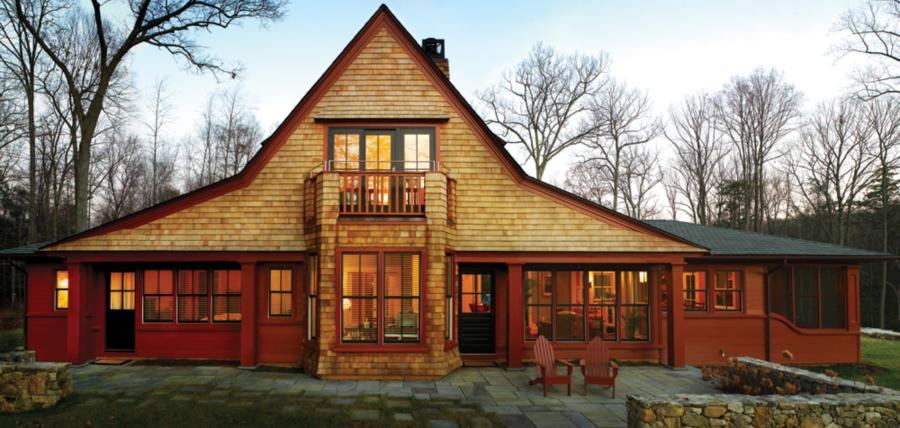
Pretty Face: The lake side of this upstate New York house paints a charming picture for boaters. A strong horizontal band of windows and doors is capped by a dramatic roof gable with wing extensions. “That peak is the toothpick through the club sandwich,” says architect Donald Powers.
Credit: Jeff Herbert
Custom home buyers may not be driven by the same financial constraints that are prompting everyday Americans to downsize, but they are nevertheless asking for smaller houses. Some want to minimize their carbon footprints; others are looking to simplify their chaotic lives, prepare for retirement, promote family togetherness, or be prudent in uncertain times. Coziness begets comfort, and there is a certain satisfaction in occupying a house that feels good and functions well without being over the top.
And as architect Donald Powers notes, ostentation has become unfashionable. “Everything now is swinging around to compact. The economy is demanding it, and the environment is demanding it. If the ’90s were defined by the McMansion, I’d love to think the first part of the 21st century could be defined by a return to small and high quality.”
How much house is just enough? We looked at three custom homes whose owners probably could have asked for more, but decided that smaller was better.
Lake Effect
This lakeside cottage has sucha casual, homespun air about it, you’d hardly suspect the intense discipline that was necessary to pull it off. The hitch was that several of its aesthetic priorities were at odds with each other.
For starters, it was unclear which side of the house was meant to be the front in this summer community east of the Hudson River, about an hour and a half outside New York City. The southeast arrival sequence from the main road and driveway had to be striking, explains architect Donald Powers, but then again so did the west elevation facing the water. “The lake is very public, so it couldn’t just look like the casual back of a house,” he says. The compromise? A residence with two faces that are complementary and yet distinct from each other.
Engineering the perfect plan (one that would celebrate the two-acre site’s best features) also required a balancing act between daylight and scenery. To make the most of pristine lake views, Powers strung most of the rooms together in an enfilade pattern facing west, with large picture windows overlooking the water. But the massing and window placement made necessary because of this decision came with a trade-off: a comparatively small south elevation with minimal solar exposure.
Channeling natural light inside thus required some ingenuity to keep the home’s interiors from feeling too dark. One clever remedy is a light box that captures midday sun from a bank of south-facing shed dormer windows and then redirects those rays into the living room through a clerestory valance above the fireplace. Dramatic millwork in the ceiling, painted a gloss white, amplifies the ethereal effect of that diffused light.
Equally inspired is a small gallery space at the intersection of the home’s two main axes. Slightly wider than a hallway (and therefore big enough to hold a sideboard and painting) this area forgoes natural light and instead is brightened up with pinhole halogens and picture lighting. It’s a point of discovery in its own right, but also one that functions like the narrow end of a telescope in that the window and door openings of all the rooms stemming off it are aligned to frame views of the outdoors. “We made this circulation point a room of its own that wouldn’t necessarily want a lot of natural light,” Powers explains. “It’s a little event at the deepest point of the plan where you can turn left or right, front or back and see outside in any direction.”
For all its artistry, the house is also supremely functional. Designed for empty-nesters as a family retreat that will eventually become a primary retirement residence, the space is amply appointed for single-story living, with a master bedroom and studio on the ground floor and guest bedrooms up top for kids and grandkids. Low-maintenance cladding materials include paintable PVC siding (on the lower portions of the house, closest to the water table), fiber-cement board, and cedar shingles with a 50-year lifetime.
Off Tract
The setting is a familiar slice of Americana: one of the last remaining cul-de-sac lots in a subdivision that first broke ground in the 1970s. And yet, the contemporary dwelling now occupying that space isn’t your typical house in the ’burbs.
Nor is it your typical Texas custom home. Eschewing the local tradition of limestone and brick in favor of stucco and concrete block masonry, it’s not extravagant. And, measuring just a few steps shy of 2,500 square feet, it’s only a wee bit bigger than the owners’ prior residence. Their mission wasn’t to build something larger and fancier, but rather something smarter, cleaner, and more efficient.
With all due respect to the neighbors, builder Byron Bottoms and the architects at McKinney York took cues from nearby tract homes for examples of what not to do. Thick massing, for example (a recipe for poor indoor air quality and one-sided window glare), was replaced with narrower building forms to promote balanced natural light and cross-ventilation. Cantilevered overhangs and a transplanted 30-foot tree (salvaged from a nearby school library renovation) protect the house from the hot sun.
And whereas other homes on the block sit smack in the middle of their lots (thus creating useless slivers of side yard), this one scoots up to its southern lot line, freeing up space around the side and back for a large play area for the owners’ young children. Pivoting the garage 90 degrees added a layer of privacy to that yard, and a ground source geothermal system underneath its grassy expanse feeds into the home’s HVAC and hot water systems.
Interiors are equally efficient and multipurpose. A study off the living room can be closed off with sliding walls or left open to keep an eye on the kids. A laundry room outfitted with reinforced concrete walls, a steel door, and multi-point latching mechanisms doubles as an above-ground tornado shelter. And to save space, formal and informal entries to the home (front, garage, and back door) all spill into the same foyer.
“We discovered quickly that we couldn’t provide an independent and isolated space for every possible activity, and we couldn’t afford to spend a lot of money on circulation space, so the plan is very tightly organized,” says architect Al York. “The corridor space is about a tenth of what you’d find in a standard tract home.”
This satisfied the clients’ craving for an environment that was cohesive, not cavernous, he adds. “They didn’t want the kids off in a separate wing. They wanted to live together as a family. They wanted a quality house, but they were very smart about not building more house than they needed.”
Through The Woods
Good architecture makes nice with the neighbors, and in this case, the trees were there first. The owners envisioned a modest house that would blend quietly with nature, causing minimal disruption to the forest. Honoring this wish, architects Brian Johnsen and Sebastian Schmaling allowed
The main body of the house is a one-story bar that sits parallel to a bluff overlooking Lake Michigan. “We wanted to take advantage of the views, but also the predominant breezes that came up off the lake and accelerated at the top of the bluff,” explains Johnsen. To that end, the bar volume is punctured by two 16-foot-wide apertures (at the main entry and the dining room) that can be opened wide—front to back—via massive pivoting and sliding mahogany doors.
A small, second-story observatory above the entry foyer (accessible via spiral staircase) further aids in venting warm air, at the same time providing a bird’s eye view of the property. Shading from the site’s deciduous tree canopy reduces the home’s A/C load in summer, while a large commercial skylight on the west side of the roof structure promotes heat gain in winter.
Simple in shape, the long volume of the house is counterbalanced by two perpendicular structures, which, in combination, form an intimate forecourt.
Stemming from the south end of the home is a garage whose shed roof appears to float above a clerestory band of windows. The north end is marked by a trellised ipe colonnade leading up to the front entry. An inspired integrating device, the colonnade passes through mature trees, wraps the house in the form of an elevated patio, and eventually extends inside to create the exposed structure of the living room ceiling.
This blurring of boundaries between indoors and outdoors—a concept the architects refer to as “extended surface”—is also notable in the 4x4x16–inch concrete block masonry that forms a fireplace inside as well as the base of the home’s exterior skin. Outside, the block complements fiber-cement siding with deep cedar battens and a standing-seam metal roof to offer up an organic reinterpretation of the region’s agrarian buildings.
“We looked for ways in which we could elevate common building products to a new level of elegance,” Johnsen says, “not only to stay within budget, but also to redefine the vernacular of what would otherwise be considered a basic ranch home.”