It’s a small world after all.

Or at least that’s the present mindset. The era of super-sizing apparently over, America is starting to build smaller houses. Last year, for the first time in more than a decade, the size of single-family homes under construction started to trend backward, falling from an average square footage of 2,629 in the second quarter of 2008 to an average of 2,343 by year’s end, according to Census data. That’s after doubling in size from 1960 to 2007.

Moreover, in a recent NAHB survey of home builders nationwide, 90% reported that they were building smaller.

That downshift is expected to continue even once the economy picks back up, for compound reasons. Tighter lending standards mean buyers can’t qualify for quite as much. Land in highly desirable areas (particularly close-in suburbs within walking distance to transit) is in short supply. Neighbors in said areas are waging all-out anti-mansionization wars with renewed vigor. Smaller homes have the capacity for greater energy efficiency.

And then there’s the fact that buyers, on average, don’t need as much because households are smaller. Of the 28 million households that are expected to be added to the American landscape between 2010 and 2030, fewer than 5 million (about 17%) will be families with kids, while 10 million are projected to be single person households.

Attached homes are claiming an ever-increasing share of the housing pie, but many citizens aren’t quite ready to give up the dream of four exterior walls and a yard. For them, small cottage-style houses are a popular choice--and perhaps a bridge to the future.

Here are a few of our faves, both new and old.

 
Pontiac, Mich.
What can you do with $100,000? Dominick Tringali Architects and Brooklynn Homes parlayed that meager budget into an all-American residence that’s not only easy to build, but primed for LEED certification. Intended as a prototype for a new collection of Habitat for Humanity homes, the handsome little house was built for just $54 per square foot. The pro forma relies on stacked framing and prefab walls and ceilings to reduce construction waste, with room dimensions dictated by plywood dimensions and stud spacing.

It’s also energy-efficient. Strategic site orientation, window placement, canopies, and porches maximize daylighting and cross-ventilation, while preventing unwanted solar gain in summer and heat loss in winter. The tight structure is built with rigid insulation on the exterior walls and crawl spaces walls below grade. Add to that a tankless water heater, dual flush toilets, low-flow faucets and shower heads, a high-efficiency furnace, rainwater collection barrels, and Energy Star windows and appliances. Yes, it can be done.


Flint Hill, Va.
Ok, technically this is an accessory dwelling to a custom home. But the judges of the 2006 Builder’s Choice Awards--in which this sleek little structure garnered a grand award--were quick to note that its plan could serve as a fine model for production housing.

Designed by architect Todd Walker as a pool house to complement a larger estate home in the bucolic Virginia countryside, this 1,100-square-foot outbuilding sits on a slope and has four levels: a lower-level garage; a main floor entertaining space with a kitchen and pool deck; a second-floor living area with another kitchen and full bath; and a loft.

The simple architecture references local barns and other agrarian structures in the area, albeit with a fresh twist. Instead of installing its fiber cement siding shiplap style, builder Levick Construction turned the 4-inch boards vertically and butted them together for a fresh look that extends the lines of the standing seam roof. Durable ipe decking and reclaimed wood floors provide rustic complements the crisp façade.

 
Olympia, Wash.
Builder Scott Bergford claimed top honors as the 2009 Energy Value Housing Awards “Builder of the Year” with these nifty little numbers that have done well with buyers in the Pacific Northwest. And it’s not hard to see why.

Built with SIPs, low-E double pane windows, and radiant flooring--a combo Bergford says has reduced callbacks by 90%--the super-efficient homes boast average energy costs of just $200 per year. That’s about 60% less than comparably sized older homes in the area, according to independent tests conducted by the Washington State University Cooperative Extension Energy Program.

All houses by Scott Homes are Energy Star-certified, as well as Five Star-certified under the Olympia Master Builders’ Built Green program. Craftsman-style details and other character-rich features such as reclaimed wood floors have made these homes winners with both home buyers and the environment.

 
Little Rock, Ark.
The Arbors at Stagecoach Village is a fairly atypical housing model for areas in and around Little Rock. Created with singles and downsizing empty-nesters in mind, the intimate pocket neighborhood places 21 Craftsman-style cottages on five acres. Homes ranging from 1,650 square feet to 1,800 square feet on 45-foot-by-110-foot lots coexist comfortably with mature hardwood trees and orient toward a common green space with walking paths. Fiber cement siding makes them low maintenance.

And here’s the really good part: built for just $85 per square foot, these cute little alley-loaded gems were affordable, even at the height of the housing boom. With prices ranging from $185,000 to $200,000, the entire neighborhood sold out in 2007.

“When the built environment is used to help create community you broaden the traditional definition of architectural sustainability…into the realm of human relations that can prolong, elevate and enhance the living experience in a given space,” says architect/builder/developer Randy Ripley, who before this venture had only done commercial work. “While architecture alone can’t force this type of relational experience, it can provide the fertile ground to nurture and increase that opportunity.”

 
Nantucket, Mass.
Vacation homes often grow larger when renovated, but this remodel of a humble New England cottage stayed within guidelines set by the local Historic District Commission, thereby respecting the scale of its neighbors. Exterior design elements were largely unchanged by MF Builders, save a set of new windows, but the entire house was raised above the flood plain and its structural and mechanical components were replaced. It’s a wee house measuring just 570 square feet that accommodates four people comfortably and can sleep up to seven.

Because the client had spent her childhood years in the house and felt pretty nostalgic about it, she wanted everything in its original location, notes architect Stephen Dadagian, who won a Builder’s Choice Award for this project in 2007. New cedar paneling and salvaged wide-plank flooring match the original, giving the interiors a warm, familiar feel, while new cabinets, light fixtures, and plumbing fixtures provide a tasteful facelift.


Amelia Island, Fla.
Cottages can be quaint in and of themselves, but their charm factor increases tenfold when they are artfully grouped together. “The Trio,” an intimate enclave of coastal-style residences in Amelia Park, a traditional neighborhood development of 420 homes outside of Jacksonville, Fla., proves this equation. Tucked into a grove of mature trees, the three homes--designed by Moser Design Group and local architect Julie Sanford, and built by Gregory R. Lane General Contractors--face inward toward a central garden walk. The arrival sequence from the street is through a brick garden gate flanked by hedgerows.

The effect, says developer Joel Embry, is a “neighborhood within a neighborhood … that is secluded but still connected to the rest of the community.”

Ranging in size from 1,700 square feet to 2,500 square feet, the homes feature wide front porches, metal roofs, and light exterior colors. The largest, at 2,480 square feet, was inspired by “The Wayback,” a rental cottage in Seaside that makes similar use of a lot off the beaten path.

 
Reunion, Fla.
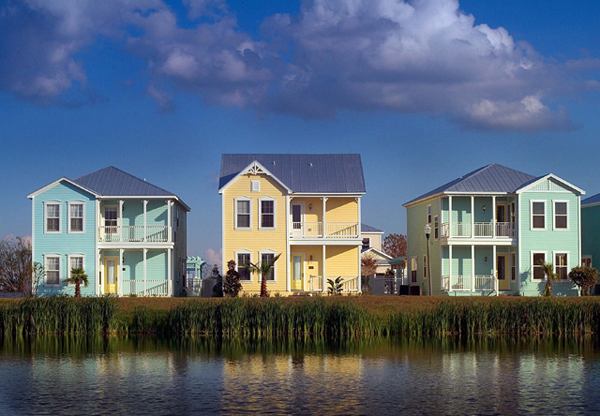
When the setting is a tropical resort community featuring three signature golf courses and a water park, it’s only appropriate for the houses to go downright whimsical--particularly when Walt Disney World is right next door. The jellybean colors, two-story balconies, and Victorian gable-end detailing in these Key West-style cottages at Reunion in Orlando, Fla., don’t disappoint.

With plans ranging from 1,886 square feet to 2,678 square feet, the 187 homes of Patriot’s Landing are sited on narrow lots with alley-loaded garages in back, with side-yard spaces for small pools or courtyards. Perimeter lots in the site plan feature conservation views, and the neighborhood is loaded with activities for all ages.

 
Tehachapi, Calif.
The Mill Street Cottages don’t necessarily look like active adult housing. Situated on the site of a former junkyard, these 11 age-qualified bungalows, designed and developed by architect Alex Kosich, orient around a central green, featuring broad front porches and a symphony of textures and nice details. And did we mention this prime infill spot is located within walking distance of restaurants, shops, a hospital, and other key community amenities?

The 1,400-square-foot homes are clad in maintenance-free fiber cement siding and come standard with accessible design features such as wide hallways, roll-in showers, and electrical outlets that are located lightly higher on the wall for easy reach. Secondary bedrooms feature direct access doors to the outside, making them ideal for home-based businesses or live-in caretakers.

 
Jamestown, R.I.
Ospreys are known to nest on high perches near water, and the birds themselves are marked by dark brown back feathers with white underbellies. Hence this aptly named coastal residence in the Ocean State, which won a Builder’s Choice Award of Merit in 2007.

A contemporary take on the classic fishing shack, the custom, 1,400-square-foot waterfront house by Estes/Twombly Architects was actually designed in response to coastal zoning requirements, which placed it close to the street and lifted it 6 feet above the ground. The upside-down plan places two bedrooms on the first floor, with shared living spaces up top to take advantage of the view.

Unlike the original flimsy fishing hut on the property, which blew across the road several times during hurricanes, this one sports smart, practical materials such as a metal roof, cellular PVC trim, and prefabricated galvanized structural ties, brackets, and rail supports, courtesy of local builder Joseph Scotti.

 
Portsmouth,Va.
Most infill master plans today include a mix of housing types for households of different sizes, life stages, and financial means. That includes modestly-sized single-family homes for young families, such as those now lining the streets of New Port at Victory, a 500-acre mixed-use development formerly occupied by military housing.

A public-private partnership involving developer LM Sandler & Sons, urban planners at Lessard Group, builder Chesapeake Homes, and the City of Portsmouth, New Port follows the principles of New Urbanism with a traditional street grid, friendly porches, vernacular house styles, and garages off the street. The neat cottages in Phase I will set the stage for a wider variety attached housing options in subsequent phases of development.

Seven models designed by architect James Wentling were closely reviewed by the city for conformance to an established set of design guidelines. The houses range from 1,678 square feet to 3,014 square feet (each with three to four bedrooms and two-and-a-half to three baths) on 38-foot-by-86-foot lots. Prices start at the mid-$200s.

Related Articles:

Cottage Industry - Small, modestly priced new homes are gaining popularity points, and it’s easy to understand why.

Manifest Density - Flexible Condos fill the holes in a master plan.

Little Gems - SThree custom homes find their sweet spot under 3,000 square feet.

Slideshow: Small Kitchens - A small kitchen, designed well, can do it all with less.

Jenny Sullivan is senior editor, design, at BUILDER magazine.