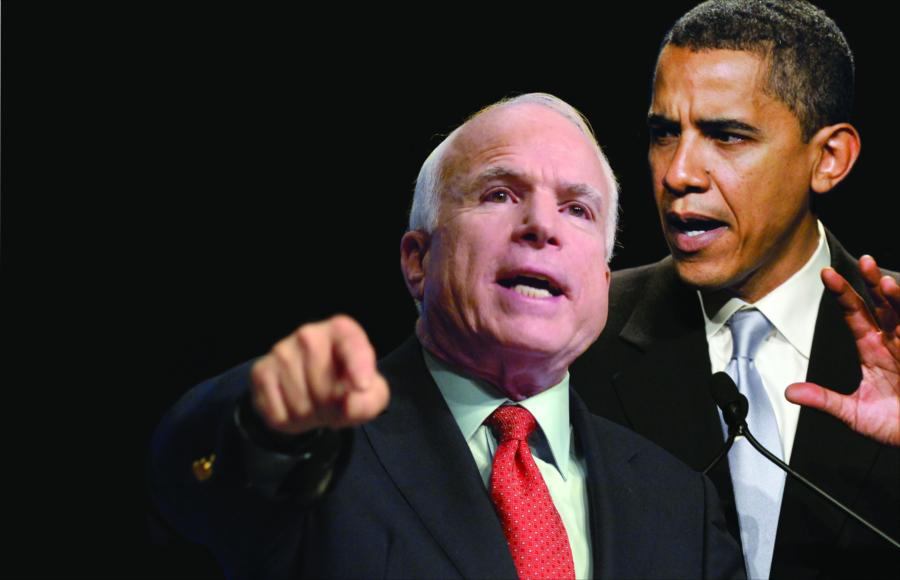
Credit: AP photos

With no end to the housing downturn in sight, with banks and investment firms hemorrhaging billions of dollars, then failing, and the federal government offering more than $1 trillion and counting to try and stem the tide of the credit crisis, the next president of the United States may hold the future of the country in his hands. Many businesses and individuals are hurting, but the home building industry has more at stake than most.

To say that this election is important to builders would be an understatement of the greatest magnitude; the economy is in a full-fledged nose dive, and builders need a president to restore the American people’s confidence, create new jobs, and right the capsized economy before people will start buying homes in large numbers again.

Although some national polls find Sen. John McCain, R-Ariz., and Sen. Barack Obama, D-Ill., in a dead-heat for the Oval Office, builders, traditionally conservative, lean heavily toward the Arizona Republican with his long history of fighting regulatory restrictions for business in the Senate. But even McCain is now backing business and banking regulations.

It’s a confusing time for any American, but especially for a builder fighting a tidal wave of negative sentiment about housing.

Finding real answers in the candidates’ whistle-stop promises and scripted answers to softball questions is difficult at best. To provide clarity on the candidates’ positions, Builder first asked readers to rank their top concerns on a 1 to 10 scale with 1 being the highest priority and 10 being the lowest. Then we distilled the candidates’ positions on some of those issues. Our survey revealed that many of you rate the energy and credit crises most important, with immigration, infrastructure development, affordable housing, and green building rounding out the list of your chief domestic concerns.

Read on to find out where McCain and Obama stand on several of your top issues.

Credit Bailout

Even with the presidential campaigns in full swing, the country’s economic problems took precedence in the news in September. As financial companies large and small collapsed or teetered on the brink, the federal government initiated bailouts of Fannie Mae and Freddie Mac, investment banks, insurance companies, and some smaller banks that purchased mortgage-backed securities. The bailout tally has passed $1 trillion and continues to grow.

Both candidates are adamant that as president they would vigorously go after the predatory lenders perceived to be behind most of the financial mess, and both offer a series of new regulations and penalties to deal with mortgage fraud. Each candidate also favors creating a new, shorter mortgage application that uses plain and simple language.

McCain, who told the Wall Street Journal that he is “always for less regulation,” has changed his approach somewhat in light of the recent financial system shocks. On Sept. 19, he announced a new reform-heavy business plan.

Blaming Wall Street for the mess, McCain proposes creating a Mortgage and Financial Institutions trust to seek out troubled companies before they become insolvent and for the Treasury to work with regulators to head off bankruptcies. McCain calls for more transparency on Wall Street, reforms to the nation’s regulatory agencies, and consumer protections.

McCain also would like to give American homeowners the opportunity to trade untenable loans for more manageable FHA-guaranteed mortgages.

“Many are waiting for their first homes, their first big break, their first shot at financial security,” McCain said on April 15 in Arlington, Va. “And helping them will be my first priority in setting the economic policies of this nation.”

Obama also wants to put troubled mortgage holders into FHA-insured loans and would create a $10 billion fund to help victims of predatory loans refinance them. Another part of Obama’s housing plan includes offering homeowners who do not itemize on their tax returns a 10 percent mortgage credit, giving roughly 10 million homeowners an average of $500.

The Illinois senator is not new to the war on mortgage fraud. In April 2007, he sponsored legislation to define mortgage fraud and create criminal penalties for it. He also called for increased funding for federal and state law enforcement to investigate and prosecute mortgage fraud.

“If the government can bail out investment banks on Wall Street, we can extend a hand to folks who are struggling on Main Street,” Obama said on June 9, in Raleigh, N.C.

Immigration Reform

Builders have strong feelings about immigration, but as our survey results indicate, they do not always come down on the same side of the fence.

Open-ended responses range from, “As much as we hate to admit it, we need them almost as much as they need us,” to “Why is the fine only $275 for employers of illegal immigrants, when $10,000 per illegal immigrant plus jail time for employers would be more effective in reducing income for illegal immigrants?”

And, in fact, both candidates call for ramping up the prosecution of companies found employing illegal immigrants.

With the number of aliens in the country growing—The Pew Hispanic Center’s research shows that there were an estimated 11.1 million illegal immigrants in the U.S. in 2005 and an estimated 11.5 to 12 million as of March 2006—the immigration issue will be key to the agenda of whoever wins the election in November. Immigration reform was a hot topic in Washington in early 2007, and both candidates worked on a Senate bill before it died a political hardball death on the floors of Congress.

Obama, who wants to add people, technology, and infrastructure to help secure America’s borders and ports, favors increasing the number of legal immigrants allowed into the country every year. He has proposed legislation to improve the speed and accuracy of immigrant background checks and would also seek out and punish those found hiring illegal ­immigrants.

Obama’s plan includes working with Mexico with the hope of improving economic development there in order to lessen the desire to cross the border to find work in the U.S.

McCain’s top immigration priority is to secure the borders and would require border-state ­governors to certify that their state is secure. McCain then proposes to implement an electronic worker eligibility verification system in conjunction with the Homeland Security Department, a system that would also screen for what he calls “bad actor” employers, who would be aggressively prosecuted. The program also would identify criminal illegals for prosecution and deportation.

McCain’s goal would be to force aliens to leave or legally become U.S. residents. While his stance is tough on illegal immigrants, he offers a softer tone toward migrant workers, saying of them, “We have economic and humanitarian responsibilities as well, and they require no less dedication from us in meeting them.”

Green Legislation

Hitting closest to home, perhaps, is readers’ concern over green building and energy-efficiency legislation. Increasingly, green building standards are being mandated by local governments. Some companies have outpaced the mandates and are reporting better-than-average sales with cost-saving and earth-friendly marketing pitches. But many builders resent government involvement in the conduct of their business.

In their responses, readers urge the candidates to reduce smart-growth programs and impact fees, and call for less regulation of the building and banking industries. Others propose the use of incentives for buyers, suggesting tax breaks for homeowners who use alternative sources of energy in their homes.

True to his anti-regulation stance, McCain’s proposal is to call for the federal government to adopt higher-efficiency standards for its own buildings. McCain says he will demand that all federal buildings be retrofitted to meet this new standard, and all buildings built, purchased, or leased by the government must meet the standard as well.

“We can save taxpayers money in energy costs and move the construction market in the direction of green technology,” McCain says on his Web site.

McCain recommends that homeowners buy more energy-efficient light bulbs and appliances and opt for better windows and insulation when remodeling. In addition to the energy benefits, McCain suggests the retrofitting will create a boom in new jobs in the construction and manufacturing sectors.

Obama, on the other hand, feels government intervention is needed. He would incentivize state and local governments to implement new building codes that prioritize efficiency by creating a grant awards program, and he would require the Energy Department to regularly update efficiency standards. He also plans to offer matching federal money for states that retrofit existing buildings and would put federal money behind smart-growth planning.

Obama also lays out an energy-efficiency roadmap for local governments, utilities, builders, and consumers. He has established a goal of making all new buildings carbon neutral, or producing zero emissions, by 2030, with shorter-term goals of improving new building efficiency by 50 percent and existing-building efficiency by 25 percent over the next decade.

Energy Crisis

At the time of our survey, which concluded in September, the most important issue to our respondents was the gas crisis. Since Builder posted the survey, the price of oil has fallen from more than $147 a barrel to less than $95. But gas prices still remain near $4 per gallon, energy prices in general remain high, and building product costs are on the rise. In nearly all aspects of their business, builders rely on oil—from the petroleum required for the manufacture of building products to the cost of gas for commuters to the center city from the suburbs, builder profits are inexorably tied to the cost of crude.

A major part of both candidates’ plans for dealing with the gas and larger energy crises lies in developing our own infrastructure to produce more fossil and alternative fuels, and create new energy and infrastructure jobs. But that’s a long-term strategy. In the near-term, both candidates want to increase America’s domestic oil supply and force prices down at the pump.

Sen. Barack Obama’s plan includes first releasing oil from the Strategic Petroleum Reserves to cut gas prices at the pump immediately. He agrees on the need for more domestic oil and gas production but does not advocate opening up protected areas to drilling. Instead, he proposes that oil companies develop the 68 million acres of land where they hold existing leases but are not currently drilling.

His major focus has been on developing other types of fuel. “It’s time to create a new American energy economy by investing in alternative energy, creating millions of new jobs, increasing fuel efficiency standards, and ending the tyranny of oil once and for all,” Obama told a crowd in Chicago on July 31.

As part of  an annual pledge of $1 billion intended to create a new wave of green jobs and green manufacturing, Obama would create educational programs to train workers to weatherize homes for one million low-income families a year.

McCain’s plan in the short-term is to increase the supply of domestically produced oil and reduce our dependence on foreign oil. The Arizona Senator proposes to lift the moratorium on drilling along the Outer Continental Shelf to increase oil and natural gas production. He would expand use of natural gas as transportation fuel and use it to produce electricity, and suggests building the infrastructure necessary to transport domestically captured natural gas around the country for such uses.

“Our nation is sending $700 billion over-seas every year to countries that don’t like us very much,” McCain said on Aug. 19. “When I’m president, that’s going to stop. We’re going to achieve energy independence, and we’re going to do it by using every resource at our disposal to get the job done, including new off-shore drilling.”

And to help business owners and spur spending on new products, McCain would offer business tax reform that would permit first-year expensing of new technology and equipment purchases, which could reduce taxable income and interest payments.

RESPONDENTS’ TOP CONCERNS

1. Gas Crisis

2. Lending Standards

3. Immigration

4. Infrastructure Development

5. Health Care

6. Affordable Housing

7. Energy-Efficiency Mandates

8. Foreclosure Relief

9. Mass Transit

10. Green Building