Credit: Marc Burkhart
Three years into the worst housing downturn since the Great Depression, three dozen major builders have declared bankruptcy. Yet for every builder that has gone under, hundreds more are on life support, hanging on only because their lenders choose to look the other way.
“I know many cases where builders imploded a year and a half ago, and they are still working out their problems with banks,” Doug Yearly, a regional president of Toll Brothers, said at an investment conference in September. “Lots of builders are hanging on by their fingernails,” adds Joel Shine, the former president of CityView, which works with builders to provide workforce housing, “and banks are letting them hang on by their fingernails. That’s not going to end well.”
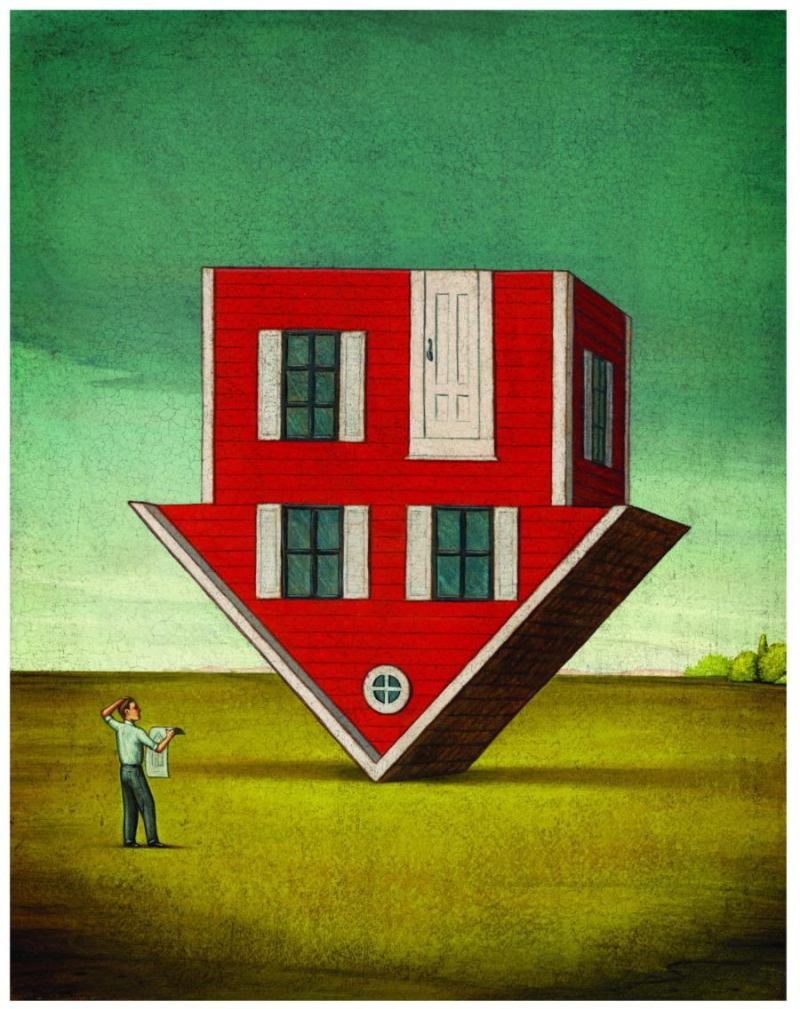
Nearly everyone in the industry knows someone who remains in business, struggling mightily to generate enough cash to pay off debt and fund operations, only out of the good graces of a lender. From a financial perspective, these companies are upside down, without the assets to pay off their debts. As we move into the winter months, with builders and lenders both starved for cash, the pace of builder liquidations and bankruptcies is likely to markedly increase.
Apocalyptic forecasts, made early in the downturn, that industry ranks could be trimmed by at least 50 percent may well come true. Housing analyst Ivy Zelman of Zelman & Associates believes that the current debt crisis may push that figure as high as 75 percent. “As more and more banks are forced by regulators to clean up their balance sheets,” she says, “private builder failures will accelerate. Even well-performing builders will struggle to obtain financing to move forward with projects.”
Many builders have quietly wound down their operations to avoid bankruptcy, selling off land and unfinished homes to investors. Some, such as Houston’s Royce Homes and Taylor-Morley of St. Louis, attracted considerable attention in the process. Others remain in pitched battles with bank workout departments.
The banks, of course, would like an immediate repayment in full of loans they’ve made. But most builders don’t have the money, or the inclination, to do this, especially if they have gone to outside equity for funds, and those equity sources are looking for a 20 percent to 25 percent return.
“That leaves the banks with only three choices,” says one builder who has been negotiating with his banks for more than a year. “They can foreclose and pursue any guarantees, which is likely to put the builder out of business. They can continue funding the build-out of the neighborhood with the hope of maybe getting full repayment or minimizing their losses. Or they can accept a discounted repayment of the debt.”
Most builders faced with this situation would prefer to build their way out of the mess. They would like to get the financing to build another project, or complete the ones they started. But throughout the country, banks have virtually shut off the AD&C spigot. “There’s no debt available,” confirms Jack Haynes, executive vice president of builder loans for Countrywide Home Loans. “The only way to finance deals is with equity through institutional sources, and that’s a very expensive option.”

“Many builders are just hanging on,” says Bob Rivinius, president and CEO of the California Building Industry Association in Sacramento. “Most builders have had staff reductions of 50 percent to 80 percent. I’ve been through four home building recessions in my career, and this is by far the worst. This year will see the lowest level of housing production in California since World War II.”
Debt Crisis May Tip the Scales
The current banking liquidity crisis may be the event that finally forces lenders to call loans that they’ve forgiven for years. In the early part of the housing recession, bankers say they wanted to foreclose on nonperforming loans, but they couldn’t find buyers for them. So they decided instead to be accommodating and work out loans, hoping that builders would have a successful 2008 spring selling season. When that didn’t materialize, some banks began to aggressively foreclose, trying to cut their losses.
Unless government attempts to free credit prevail, banks may shift their foreclosure efforts into overdrive. “We can no longer afford to ignore credit defaults,” says one prominent banker to builders. “A year ago, we may have looked the other way and ignored a default, and we lost a lot of money as a result. Now, we’re asking ourselves, ‘If we continue to do that, are we going to lose everything?’”
Adding to the difficulty facing builders, roughly three-quarters of the big banks want to get out of the real estate business, says John Burns of John Burns Real Estate Consulting, who has worked with more than two dozen banks this year on workouts with builders. Burns notes that one major bank recently announced that it lost more money on real estate loans in the past year than it made in the previous seven years. “When they ask the builder for their debt back, the builder says, ‘If you give me another $2 million to finish the project, I’ll give you $4 million at the end.’ The bank says, ‘No, you don’t understand. We want to get out of real estate lending.’”
A big part of Burns’ job is to modify lender expectations. “After examining their portfolio of bad loans, banking executives may start with bravado, saying, let’s blow this out and take a 10 percent haircut.’ Their attitude changes when I tell them it’s really a 70 percent haircut. Then the question becomes whether the bank wants to work with the builder. If they force the builder into bankruptcy, they may get back only 50 percent. If they work with the builder, they may get back 70 percent.”
Builders can expect a long winter of workouts and banks pushing to improve terms. If banks don’t remargin loans, they will ask builders to pay a little more, agree to a wider spread, or tighten a loan covenant. But if the asset is severely impaired, and the builder won’t work with them, lenders have few options except to call the loan. Some, though, may not insist on new underwriting, because they don’t have the manpower or the capital to take back too many loans.
The builders most likely to persevere are the ones who have been transparent with their banks, says Shine. “The bucket of borrowers that are good operators and have been up front and honest with the bank will continue to get extensions as long as the regulators let the bank keep in the deal, and as long as the builder’s business plan is reducing the bank’s exposure. The bucket of borrowers that the bank perceives as being either less than 100 percent up front with them or less than 100 percent qualified to deal with the problems are going to get loans called.”
Long-standing private builders with plenty of equity, or “dry powder,” in their operation, and nonrecourse revolvers, are also likely to survive. They are in a great bargaining position when their bank wants to reduce their loans and asks for an equity contribution, says Haynes. “Those are the builders who may just hand the property back to the bank,” he says. “They may work through some other projects and come out of it OK with plenty of dry powder for the next campaign.”

Credit: Marc Burkhart
Moody’s Economy.com, the ratings firm, believes that builder fatalities are likely to increase going into next year. The problem, as Moody’s says in a recent report, is that even if the Treasury’s plan to buy bad assets bolsters the banks, home builders must write down landholdings to distressed market values, pay down debt, and build their equity and cash positions. “Absent these steps—or despite them—we believe that some home builders will not survive,” Moody’s said, adding that “we don’t expect the overall housing market to show any significant improvement until at least 2010.”
Private builder landholdings, of course, are the ticking time bomb. In several recent sales to investors, public builders have unloaded land for 20 to 25 cents on the dollar, compared with peak-market prices. Many builders are convinced that raw land has no value in many markets today, when you consider what it would cost to develop, and what you could ultimately get for homes. Yet many banks still haven’t forced private builders to write down their land assets to current values and cough up equity to make up the difference.
“There is no way to stave off the builder crisis,” adds Shine. “The combination of losing money, shrinking demand, and the evaporation of the debt market has already taken its toll and will continue to do so for a while. There will be a lot less builders at the end of this cycle, and, sadly, I do not see anything that Washington can do to completely solve this.”
Pressure on the Banks
The situation for builders could have been even worse had the government not acted to shore up the banks and court buyers for struggling institutions. But it’s too early to tell what will happen to builder loans in the wake of J.P. Morgan’s purchase of Washington Mutual and Wachovia’s takeover by Wells Fargo. Likewise, it will take months, maybe even years, for the $700 billion the Treasury plans to spend to buy up bad mortgage-related and other assets to work its way through the financial system. “It will be injected and absorbed slowly,” says Countrywide’s Haynes.
Meanwhile, bad builder loans are popping up with alarming frequency on the economic radar. Bank of America Corp., the biggest U.S. consumer bank, told investors in New York last month that more than half of its $13.4 billion in builder loans are considered troubled, though builder loans account for less than 4 percent of its total portfolio. Brian Moynihan, head of the global corporate and investment banking unit, said that 19 percent are not paying interest, adding that losses are likely to mount. “It’s not pretty” is how Moynihan described the situation.
Second-quarter data from the FDIC, which tracks real estate and development loans held by banks, show that 8.1 percent of construction and development loans were delinquent, triple the rate from a year ago. “While troubled loans are increasing across all types of loans, residential mortgage loans account for the largest share of the increase, and construction loans are the fastest-growing category,” said Sheila Blair, FDIC chair. FDIC-insured commercial banks currently hold $3.6 trillion overall in real estate loans, and $559 billion specifically in construction and development loans.
Many banks that traditionally lent money to builders now find themselves on a government watch list. The FDIC’s list of problem banks numbers 117, up from 90 the previous quarter. The majority of the new problem institutions have a concentration in construction and development loans, say FDIC officials. Many of them are regional banks, which on a percentage basis have a bigger exposure to real estate. Banks socked by delinquencies must typically hoard money against losses and curtail new lending.
Analysts say that mid-size community banks are the most likely to fail during major economic downturns. Though the scenario hasn’t materialized yet in many places, if it does, these banks will do whatever they can to collect, even call loans that they know will cause builders to fail.
Measuring the Fallout
Some markets have been more hard-hit than others. When the housing industry first began to turn in Atlanta in mid-2006, there were roughly 2,400 builders in the market. By the end of this year, estimated one local banker at a recent investment conference, half of them will be left standing. Already, local powerhouses such as Robert Harris Homes and The Macauley Cos. have gone out.
Phoenix is another market with a high casualty rate. Industry veteran George Casey believes that many of these firms started in the ’90s without a proper understanding of the kind of capital structure they needed. “Home building and land businesses need to be capitalized differently,” says Casey, who works for DMB Associates. “You need a source of long-term debt to operate as a land developer. It’s the poorly capitalized builders that are going out of business.”
Burns believes that overhead expenses will do in a lot of builders. Many public builders are reporting SG&A (selling, general, and administrative expense) running from 15 percent to 20 percent, when 10 percent used to be closer to the norm. Some of the private companies he’s worked with have overhead expenses that are closer to 40 percent. It’s hard to make those numbers work with two sales per month, he says. “That will kill you. It’s overhead that will bring these builders down.”
When Tim Eller, chairman and CEO of Dallas-based Centex, surveys the private builder landscape in the markets in which Centex operates, he sees a lot of carnage and more on the way. “The potential for consolidation is huge,” says Eller, adding that Centex is reconsidering its decision to leave some markets, because very few large competitors are left. “The potential loss of private builders is beyond my wildest imagination.”