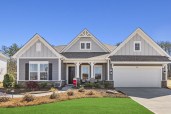
McVaugh Custom Homes, Houston
32 Units
THE IRONY OF BEING NAMED as one of America’s Best Builders in 2005 isn’t lost on Jim McVaugh—after all, as the president of Houston-based McVaugh Custom Homes, he has been building in one form or another his whole life. “I don’t know if I can remember a time in my early childhood that I wasn’t planning or building a fort or a clubhouse,” he recalls. Even into his teenage years, Mc-Vaugh was highly regarded for his elaborate tree house designs. “I must have at least 15 of those under my belt,” he laughs.
Despite that early passion for construction, when it came time to determine his career, McVaugh chose another vocation. Experience in accounting ran in his family, and with a CPA father, and a mother in banking, accounting seemed like an ideal career choice to McVaugh as well. But he couldn’t evade the lure of real estate completely. It wasn’t long before McVaugh found himself coming full circle—discovering a way to apply the accounting skills he had honed with the creativity in construction that he craved. “It’s almost like I was destined to do it,” he admits. “I just don’t have the personality for accounting.”
After crunching numbers in a general accounting environment, McVaugh found himself working for a Houston-based, multi-family real estate developer, O&D Developments, in the late 1980s. The joint-venture Canadian company bought and rehabbed about $10 million worth of projects a year, including apartment complexes, shopping centers, and high-rises. It was then that Mc-Vaugh decided to build his own home. While searching for a lot, he found three. “I just planned to build three homes, sell two, and keep one,” recalls McVaugh. “I ended up selling all three—and the rest is history.”
From 1991 to 1994, McVaugh completed nearly 30 homes in Houston, all the while maintaining his day job as an accountant and collaborating on the side with his boss at O&D Developments as a joint venture partner in home building. His product line focused on semi-custom patio homes starting near $175,000. But in 1994, he decided the time was right to make a leap. With a desire to move into higher-end products, he broke away to dedicate himself full time to the growth of McVaugh Custom Homes.
Driving Forward
Although the business has been in operation for 13 years, the McVaugh story really started to gel in 2000. Since that time, the company has tripled in size—growing from 11 units in 2000 to 32 in 2003, and an estimated 45 units in 2004.
By balancing the diversity of its product mix—expanding its offerings from sheer high-end custom to include semi-custom products—the company has blossomed in Houston’s demanding market. By maximizing the advantages of technology, the firm has successfully scrutinized its efficiencies and integrated operational enhancements. And with a continuing dedication to cutting-edge design and unique features, Mc-Vaugh continues to stay a step ahead of its competition.
After committing himself to home building, McVaugh’s products gradually crept up in price until he found himself working in the truly custom market, building 10 to 12 homes a year at an average sale price of $900,000 with spec homes up to $1.8 million. His banking relations were solid, and he found that a track record of funding for projects of four- or five-unit townhomes easily qualified him for the higher-end specs. “Financially, it wasn’t much different.”
But when the Houston high-end environment got tough in 2001, he made the decision to apply his custom touches to patio homes and zero lot-line products, a diversification move that now accounts for 40 percent of the company’s sales. “High-end custom pretty much dried up when the stock market took a nose-dive—and, of course, there was 9/11. I had to transition back to where the majority of buyers were,” McVaugh recalls.
Dubbing these $400,000 to $550,000 products as The Villa Series, he decked them out with outdoor living spaces, tile roofs, and a Mediterranean style that evokes the feel of a resort. “Buyers want to feel like the king of their castle in any price range,” he says, reflecting on the product line’s success. “They want the things they see in the more expensive houses.” And so he delivered them: Each patio home features cedar garage doors, travertine flooring, granite countertops, and furniture-style cabinets.
By keeping the Custom Series homes priced from $550,000 to $1.2 million at about 30 percent of his product mix and doing another 30 percent of business in Estate Homes from $1.2 million to $3 million, McVaugh has been able to create a successful balance. “I’ll tell you the villa homes have become our bread and butter,” he says. “The profitability is just better. And for us, the custom and estate home product is the gravy.”
Unlike many builders, McVaugh has no anxiety about building spec homes where he sees that the market demands it. In fact, he is just breaking ground on his most expensive spec to date—a $3.2 million home in The Woodlands’ Carlton Woods section. “I’ve had good luck with specs. I build the products that people want to buy. They don’t scare me because I know that, worst-case scenario, I have the margins built in so that I can sell the house for what I owe the bank.”
While focusing on a successful business model is critical, it’s the company’s flair for creativity that evokes the most pride in Mc-Vaugh, who personally strives for a unique feel in his design, finish-out, and architectural styles. “Jim has always been on the cutting edge—bringing product or ideas that we see across the United States to the Houston area,” says Jennifer Arriaga, director of sales, marketing, and operations. “We will typically introduce something, and then in the next year or so several builders around us are doing the same thing.”
Five years ago, when the market was presenting a lot of trim and crown molding—all painted high-gloss white—Jim defied the trend and opted for tone-on-tone trim and walls and stained interior doors, wire-brushed alder exterior doors, and stained garage doors. “I like a big bang,” says McVaugh. “When people walk in the house, I want them to say ‘Wow!’ And these are some of the things that made them do that.”
While many competitive builders in his price range focus on square footage, Mc-Vaugh has built his reputation with a different philosophy: “Even if it is 6,000 square feet, a lot of these houses just look like a big box, with the finish-outs no different than a production home,” he says. “We thought buyers would be willing to trade that square footage for unique features and finishes. So we would build those houses—and they always sold.” The company now applies this thinking to every price point, and McVaugh credits this approach with the success of its patio home projects.
In the early days, McVaugh personally did all the selections with each customer. He now employs two, full-time licensed interior designers to meet those needs. But his dedication to creativity continues to set him apart from the competition. Recognizing that these features are always evolving, he scours design magazines and visits other markets, especially California, looking for inspiration. His next bold move: “I think the market now is moving to more stone,” he muses. Recalling Houston’s look, McVaugh notes that houses changed from brick to stucco with a more Floridian look and then to a more European look. Then they started adding stone. “Now, I would love to do a house in all stone with one little kick-out in stucco,” he says. “Sure, it’s been done before, but it’s not common at all.”
Introducing It
And
it’s not just his designs that make Mc-Vaugh stand apart. Unlike many
builders his size, McVaugh displays a unique commitment to technology—a
differentiator that is supported by three full-time information
technology (IT) staffers. The company boasts an elaborate internal,
Web-based application developed in-house that integrates both
back-office and jobsite functions. “I believe it has enabled us to build
more homes and be more competitive with less staff,” he says. Today,
his operation is run with a staff of 23 full-time employees.
“We continue to add functions to it that are streamlining our employees’ workload,” says McVaugh. Case in point: change orders. Today, all customers log on and approve their change orders online. The information is written online, and after customers approve and submit their order, it goes directly to the inbox of the superintendent along with the inboxes of the director of construction, the interior designer, and the accounting person who immediately enters it into the books as a receivable. “In one click of a button, five people are notified instead of relying on a superintendent to carry around a piece of paper, get it signed, and hope that the order and check don’t get lost in his truck,” McVaugh says.
Not only has this system allowed the company to streamline current operations, it has permitted it to expand outside its traditional boundaries. Armed with a computer, McVaugh’s project managers have the ability to do work-orders, bank draws, and purchase orders online. The paperless process requires that subcontractors log in and click off when they have completed their work, allowing them to get paid. “We don’t need their invoice,” says McVaugh.
With this technology in hand, McVaugh has stepped up his holdings and has expanded into new “local” markets. Recognizing that land development is “another extension of the business,” the firm is moving outside of the traditional land holdings inside Hous-ton’s beltway and establishing a presence in two of Houston’s most upscale golf communities: the Royal Oaks community and the Carlton Woods development inside The Woodlands, Texas, which will include an 18-unit upscale patio home product. “We’re testing (the functionality of our system) in The Woodlands, since it’s an hour away from us,” says McVaugh.
McVaugh is also making plans to move into a subdivision in Sugar Land, Texas, and considering developing three separate projects in Clear Lake along the Galveston Bay area. With a profitable business strategy in place and technology to support it, the expansion opportunities seem to be limitless.
“I’ve looked at some other markets,” admits McVaugh. “If I found a real hot market somewhere and I just couldn’t stand it, I could be tempted. But, so far, I haven’t found another place that’s exciting enough.”
Lisa Marquis Jackson is a freelance writer based near Dallas.
McVaugh Custom Homes
President: Jim McVaugh
Focus: Builds semi-custom and high-end custom homes, priced from $500,000 to more than $1 million.
Employees: 23
Founded: 1991
Web site:www.mcvaugh.com
Notable:
Same designs and finishes used in multi-million dollar homes also used
in less-expensive offerings; elaborate internal Web-based system, which
controls back-office and jobsite functions, unique for a small builder.
Bench Support
McVaugh finds professional groups useful for learning and sharing experiences.Growing
from a $5 million operation to more than $27 million in three years was
not without its challenges. And according to company president Jim
McVaugh, the support of peers he met through personal and professional
groups he joined helped him make the key transitions smoothly. “I
realized I had to develop a great team of people as I made the move from
doing everything personally to becoming an executive.”
After joining the NAHB’s Builder 20 Club, Mc-Vaugh was able to develop a more effective set of standards based on the business models of other builders who were willing to share their experiences. “That did more for my construction business and knowledge than anything I have done prior.” He also credits mastering a steep learning curve to The Executive Committee, a group of CEOs from other Houston-based industries. “We sit down on a monthly basis and discuss our challenges,” says McVaugh. “Whatever issues I have, it gives me a board of directors to go bounce things off of. There is a lot to learn from people out there if you are willing to take the time to ask.”
Learn more about markets featured in this article: Houston, TX.