AS IT BURST ON SHORE OVER the beaches and bayous of the Mississippi Delta region, Hurricane Katrina destroyed the homes and businesses of home builders, their subcontractors, and their employees, just as it wreaked havoc in every other part of the Gulf Coast community.
As brutal as the effects of the storm were, most builders are maintaining a positive outlook. Ricky Wilkerson, of Gulfport, Miss., says, “The attitude down here is: We're going to rebuild this thing. It's going to be better than ever.”
Wilkerson, a past president of the HBA of Mississippi, counts himself among the fortunate in his region. “I lost a roof on my personal house, over in the Ocean Springs area,” says Wilkerson. But his business properties got off lightly: “My partner, Don Halle, and I had 14 structures, and every one of them is standing—which made us feel real good.”

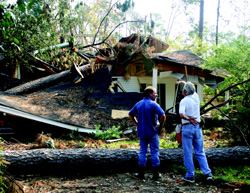
STARTING OVER: Loranger, La., builder David Reed (opposite page, left) and electrician Don Kennedy (right) inspect Kennedy's ruined house in Mandeville, La., on Sept. 13, along with State Farm insurance adjuster Jesse Curtis (center). Builders and tradesmen are as heavily affected as others in the community by storm damage. At the time of this picture, Kennedy had found an apartment and was working part-time; his destroyed home was 100% covered by insurance, including tree removal, personal belongings, and temporary living quarters. Reed, who rode out the storm at his mother's house on the family farm, was in permitting for a new 20-unit subdivision of 1,500-square-foot homes. “We know they're going to sell,” says Reed.
Wilkerson's main office, a block from the beach on Cowan Road in Biloxi, Miss., took on just 4 or 5 inches of water: “We're very lucky it's standing,” says Wilkerson. The surrounding scene was one of near-total destruction, he says: “It's everywhere. It's everywhere. In fact, what really helped us was that the wind pushed so much of the trash from the buildings that were destroyed up against us before the wave came on shore, and it really helped shed the water from our building.”
ASSESSING THE DAMAGEVery few area builders were as lucky as Wilkerson. “Our members, the home builders in the affected area, are just as devastated as any other business,” NAHB executive vice president and CEO Jerry Howard told a gathering of reporters in late September. “The home building infrastructure in the areas devastated by Hurricane Katrina is just as damaged as any other type of infrastructure.”
Howard estimates that about 9,000 NAHB builders live and work in the Gulf Coast region hammered by the storm. “We don't yet know the extent of their ability to go back to work or not,” he said in September. “We are still trying to take inventory.”
Many of the builders worst hit by the disaster were not yet in a position to help with cleanup and recovery, noted Howard. But he pointed out that the region's established builders will be at the forefront of the coming effort to rebuild the cities and towns of the Gulf Coast.
“The first priority of our organization is to get the home building industry back on its feet,” said Howard. “We've appropriated monies from our budget to send down to our members in the affected region to try to get their lives and businesses back in order. For two reasons: One, it's the right thing to do for our members, and secondly because we are going to have to rely on them to do the rebuilding when the time comes.”
DOWN BUT NOT OUTGetting back on their feet is not going to be easy. Builder Steve Shivers, working in the Pass Christian and Long Beach areas, lost 11 homes under construction, according to Rachel Branch, executive vice president of the HBA of the Mississippi Coast. “Of the builders on my board,” says Branch, “every one of them lost either their own homes or their offices, and many of them lost both. My last year's president, John Ruble, is living on his boat right now—his home was destroyed, but the boat made it. And his office is OK.”
Builder Carl Hamilton's own home in Ocean Springs got 8 feet of water, says Ricky Wilkerson. New homes and homes under construction took a beating: Of the Porteaux Bay subdivision, a 200-plus-unit development, Wilkerson says, “There is not a house in there that [was] not destroyed.”
Michael Fearn of Biloxi's Champagne & Fearn Builders is current president of the HBA of the Mississippi Coast. Fearn's own house escaped the flooding, and the company's office survived. “But Clinton Champagne, my partner, owned two properties and lost them both. The saleslady that works for us lost her home—there's nothing there but the piers standing.”
Champagne & Fearn intends to continue with a planned 21-unit condominium project near the ocean that escaped flooding. But as of late September, says Fearn, his company was about 25 percent functional. “We are getting all of our labor force back on line, but it's going to take a while. We're going to go three or four months and not make a dime.”
Champagne & Fearn expects to finish out a fourth phase of its Brodie Crossing subdivision in D'Iberville; flood waters did not reach that portion of the neighborhood. But the company's finished homes in Brodie Crossing now represent a huge cleanup challenge. Speaking on his cell phone from a street there, Fearn said, “There is no way to describe it.” Almost every house in the neighborhood of modest one-story homes was flooded by the storm surge. “A lot of them don't even have flood insurance,” said Fearn.

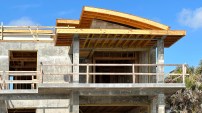
CARRYING ON: A crew papers the roof of a new home under construction in a north Gulfport, Miss., subdivision on Sept. 12 (top). In contrast to the total devastation on the coast, damage to partially built homes in the development north of the interstate was relatively light (bottom). Gulfport builder Ricky Wilkerson, whose business properties escaped serious damage, says, “We are continuing to build the houses we had going, and we are putting in for permits to start new homes. People have got to have a place to go.”
Four finished but unsold houses in the tract were flooded also. “We're going to repair those and sell them at a loss to people in the company who need housing,” Fearn says. “We'll just take our losses and move on.”
UNEXPECTED FLOODINGThe force and depth of the storm surge surprised everyone, says Wilkerson. “We all live in a flood zone,” he notes, “but the zone you want to live in is Flood Zone C—that's the one that supposedly never floods. But some people living in Flood Zone C got 8 or 9 feet of water in their house.” Wilkerson owns a lot in one subdivision where the incoming wave reached 18 feet. “All the houses around it are gone,” he says. “They were basically crushed by the water, not the wind. The water just took 'em.”
Carrying a contractor's pass from emergency authorities, Wilkerson has been able to personally view much of the area's devastated coastline. From the roof of the Gulfport federal building, he says, there's destruction as far as the eye can see. “What we know as Old Town Gulfport—Second Avenue, and all down through that—there is nothing left of it. It's gone. The coast will never have the same look to it. It will be completely different. But, you know, we'll build back. The attitude of the people is very strong right now.”
COPING WITH DIFFICULTIESPeople will need strength, notes Wilkerson, to persevere in the face of the obstacles that now litter their path. Wilkerson and partner Halle, along with lead superintendent Keith Guy, have been out every day since the storm giving estimates for repairs. “We are also continuing to build the houses we had going, and we are putting in for permits to start new homes. People have got to have a place to go, and so we're trying to get as many houses started and get them going as fast as we can.” But labor and material issues are already starting to impede the company's efforts.
For one thing, many employees and subcontractors were made homeless themselves by the storm. Wilkerson has made property available at his satellite office north of Gulfport for subs and employees to park small camping trailers. “They can operate out of there until they can rebuild their houses,” says Wilkerson. “We want to keep our construction going, but we have to give them time to rebuild, too.”
Now, however, some of Wilkerson's labor force is jumping ship—lured away by attractive offers from out-of-state companies coming in to repair commercial and industrial facilities. “I lost four employees last week to a company that is repairing a plastics plant that went under water,” he says. “They come in making promises, and these guys are looking at the money, looking at their families and their situation, and they're leaving.” It couldn't come at a worse time for Wilkerson, who has turned estimates in for insurance work on dozens of houses in subdivisions he has built. “Now I've promised all this work to be done, and we don't have the people to do it.”
NEW CONNECTIONSBut Wilkerson finds a silver lining in his community's newly energized sense of belonging. Dealing with the storm's hardship has brought people closer together, he says: “I'll be honest with you, before this happened, I couldn't tell you but one person that I actually knew in my entire neighborhood. And if nothing else, because of this storm, I can tell you everybody that lives around me now.
“We went through about two and a half weeks with no power and no water,” Wilkerson continues, “and we all got together and helped support each other. We'd work on one house one day, and we'd go work on the next house the next day. We all shared food, you know, and it was just a good time. And we all just thank God that we survived.”
BATON ROUGE, BOOMTOWNIf there's one Gulf Coast city that is destined to become a new boomtown, it's Baton Rouge, La. The city's population doubled overnight, from 400,000 to 800,000, as New Orleans residents fled the approaching Hurricane Katrina, according to city officials. Current estimates say Baton Rouge's population may now be as high as 1.2 million.
“The storm came through and knocked everything down in the affected areas,” says Baton Rouge builder Ronnie Kyle, the president of the HBAof Louisiana, “and basically the whole state of Louisiana that wasn't affected sold all of their inventory of houses. In Baton Rouge, there were 3,500 homes on the market the day of the storm, and today there are 300 homes on the market. So now our builders are scrambling to put inventory back on the ground.”
But with basic services to many areas still knocked out, and municipalities overloaded by recovery tasks, Kyle says the daily work of builders is “problematic at every turn.” Baton Rouge's building department, which handled perhaps 1,500 new-home permits last year, received 500 applications in one week following Katrina. “My local department of public works has a new acting director, and the staff has changed some too,” says Kyle. “Now here they have 500 permits on their desks. I'm working with them to try to figure out how we're going to expedite the process.”

PATCHING UP: Wes Williams, a supervisor with E&E Plumbing Co. of Covington, La., talks by radio with the company office from a lakeshore property in Mandeville. Williams was replacing a sewage lift station and water heater on the home. Built on pilings, the home escaped damage from the wind-driven storm surge that gutted the ground-floor stories of other structures (right). With nearby New Orleans properties mostly ruined by flooding, the higher, drier towns north of Lake Pontchartrain are expected to see a real estate boom. “This place is going to go crazy with people,” says Williams.
An even thornier issue is wetlands permitting, which affects huge areas in low-lying Louisiana. Kyle planned to meet in October with Army Corps of Engineers officials in Washington to discuss ways to expedite the permit process for new developments. “You know, you can spend three years with the corps trying to get your wet-lands stuff done,” says Kyle. “Well, we don't have three years.”
Utilities are a continuing problem, adds Kyle. “Our primary utility companies are in what they call ‘storm mode.' They are fixing lines that are down. They are not connecting new service. They're not hooking up temporary poles. So it's difficult to even get started.”
MUD BOMB EXPLOSIONChris Kornman is vice president of Southern Homes, one of Louisiana's few production-scale home builders, with annual sales between $30 and $40 million. The company has neighborhoods under construction near Baton Rouge, as well as in towns such as Slidell and Covington north of Lake Pontchartrain, and as far afield as Alabama. Southern Homes took a direct hit to some operations, but was relatively unaffected at other locations.
“My first post-Katrina experience was driving through Spring Hill, our neighborhood in Slidell, and that really blew me away,” says Kornman. “It looked like somebody had set off a mud bomb that blew garage doors out, caked all the cars with mud—it just looked horrendous.” Kornman's New Orleans house was not in a flooded area, but he isn't yet able to move back. “I'm still holding my breath,” he says. “I don't know where I'm going to be living myself now.”
Southern Homes is still trying to gauge the storm's direct effect on the company. The single-family portion of the Spring Hills neighborhood in Slidell was mostly completed and occupied, Kornman explains, but a neighborhood of duplexes called The Villas at Spring Hills had just started construction. “So we sustained all of that damage ourselves,” says Kornman. “We had a number of the villas under construction, and then we had two single-family models and one of the villas that were completely decorated. We lost all of that.”
Crews are working on repairs: “We have already ripped out all of the walls down to the studs, and we're drying them out and cleaning them up, because people need housing,” says Kornman. However, he says, the extent of the company's insurance coverage is still uncertain. “Like everyone else, we are still sorting out what is covered by what. But we are certainly going to have some losses.”
Meanwhile, work goes on at the company's other projects. “In our Covington neighborhood, all our subs are back at work,” Kornman says. “In our Zachary neighborhood we are up and running. In our Slidell neighborhood, with our subs who are waiting around for work, we're trying to use them on demolition so they can stay employed.”
Southern Homes is being cautious with pre-sales, says Kornman. “We don't know what our materials and labor cost are going to do. We don't want to get too far out ahead on sales, and then end up losing money.” For now, the company's adding prospective buyers to a waiting list.
Like other companies, Southern Homes is encountering plenty of frustrations: “We're trying to replace our construction trailer that was destroyed,” Kornman says, “but FEMA has snapped up all the trailers.” FEMA has also cornered the market in trucks: “They're paying truck drivers a lot more than what was the going rate. So now we can't get trucks to bring in dirt, and we can't get trash containers onto any of our sites.”
Yet Kornman remains optimistic. “Every day is a new day—you've made a little progress, but also there's a whole new set of problems each day. But it's exciting.”
BUILDERS GET ORGANIZEDLessons learned from Florida.
One of the big challenges for the Gulf Coast building industry will be hooking up homeowners and buyers with contractors able to do the needed work. Rachel Branch of the Mississippi Coast HBA points out, “The public doesn't always know what they need to ask for, what requirements to hold a contractor to.” In Louisiana, builder Ronnie Kyle, president of the state HBA, says he was already hearing reports of fly-by-night contractors taking deposits from people and leaving or doing shoddy work at rip-off prices.
“We need to tell the homeowners, ‘Check and see who you're dealing with,'” says Kyle. “Make sure that the person you're dealing with is licensed, make sure that they have the proper insurance, and make sure that they have the experience in what they're doing.”
HBAs in the region are already gearing up to help homeowners connect with contractors and negotiate the maze of contracts, regulations, and insurance requirements. In late September, HBA executive officers from Louisiana, Mississippi, and Alabama held a summit meeting in Jackson, Miss., where they heard from representatives of the Florida HBA.
“What we did was provide builders and local executives from those HBAs the tools that we use after hurricanes come through our state,” says Edie Ousley of the Florida HBA. The prime tool FHBA plans to share is its online Disaster Contractors Network (DCN), hosted at www.dcnonline.org. “The DCN is a virtual emergency operations center that really corrals the construction industry,” says Ousley. “It allows construction professionals to go online, to register and post their labor and skills availability, and then it allows professionals in need of those skills and key labor and key materials to go online and post what they need, and then the system matches the two up.” All of Florida's construction industry associations are now partners with DCN, says Ousley, along with the state's emergency operations agency. FEMA also recognizes the system and called on it to help respond after Florida's four-hurricane fall season in 2004. Ousley says the Florida group had already added pages for Mississippi to the Web site and was ready in late September to go live “as soon as they give the green light to flip the switch.”

Florida's other innovation after the 2004 storms was to host “Operation Rebuild Construction Fairs” at affected communities. “We found a location and put up a huge tent and brought all the key organizations together at one location,” says Ousley, “so that consumers could go and communicate with all of these groups in one day and find out everything they needed to know on how to go about repairing or rebuilding their home.” The events included state and federal officials, local building officials, FEMA personnel, the local HBA, and their member contractors. “The state insurance agency was there, emergency management folks, hurricane mitigation groups—and we even had ready a model rebuild contract, something that homeowners could use before they allow any contractor to begin work on their homes.”
Marty Milstead, executive vice president of the Mississippi HBA, said in late September that Mississippi plans to implement the Florida methods immediately. “Our priorities are the disaster contractors network, which we should have up this week, second is putting together a meeting of our builder members, and the third phase is the community fairs.”
But considering the huge numbers of homeowners with critical repair and building needs and the extent of general damage in the communities, hosting the big-tent events in coastal Mississippi will be a serious challenge.
“We are definitely going to do it,” says Branch of the Mississippi Coast HBA, “but the timing has to be right. We want to have the disaster contractor network up first so we can tell people about that when they come. And then, too, we have to find a place to have it—you know, most of the parking lots around here have campers and things in them. People are living there. So just to find a parking lot is a challenge.”
For out-of-state contractors who want to help, Kyle of the Louisiana HBA counsels patience. “We don't need people right now,” he pointed out. “People are a problem for us in the short term, because they create traffic, and they create needs that we don't have the services for.” Rebuilding will be a slow and protracted process, he says. “There is plenty of work that is going to be going on for the next three to five years, so it's not like everybody has to run down here and try to get involved in it. It's better if they'll wait for the supply lines to be established, wait for the permit offices to be prepared, wait for the energy companies to be ready—you know, to where we can really go to work. Let us get it together first, and then let's go.”
MATERIAL IMPACTKatrina and Rita will have lasting effects on the supply and cost of building materials.
Back-to-back hurricanes in the Gulf of Mexico have seriously disrupted the supply of building materials to the areas directly affected by the storms. Longer-term effects on the entire U.S. building industry will be less extreme, but still significant.
Lumber: The U.S. Forest Service estimated that Hurricane Katrina had damaged or destroyed some 19 billion board feet of timber spread over 5 million acres in Mississippi, Alabama, and Louisiana. In theory, the huge quantity of downed timber could mean a short-term glut of lumber, with dropping prices. But in practice, the industry is struggling with the problem of salvaging the blown-down wood. In an increasingly mechanized industry, loggers with the chain-saw skills needed for salvage work have become scarce; and, in any case, sawmill capacity in the region reportedly can't handle a huge influx of logs in a short period. “The sawmills in the affected area already had full inventories before the storm,” says Mississippi State forestry professor Laura Grace.
Downed trees tend to provide lower-grade wood in any case. Says Grace, “When you get 140-mph winds, it can create internal damage to the tree that you don't notice when it's lying there, but you do notice when you saw it up.” Sawed wood that can't make grade could be chipped for pulp, notes Grace, “But you've already incurred the costs of sawing. Most sawmills do have a chipper on site, so they will make it into chips, but they've still got to be moved to the pulp mill. So they get to be expensive chips.”
Time is not the industry's friend: If not quickly salvaged, downed trees rapidly deteriorate. “It is a perishable product,” says Grace. “It's been down five weeks [as of Oct. 3], and bluestain has already started in the pine logs. Depending on the weather, we may have a few more months before the decay and rot starts, but basically by the end of the spring, it is going to be so soft that it's really not going to be useable for a solid product.”
Storing logs in sprinklered “wet decks” can stretch out the useable life of the timber. Georgia-Pacific, which has reopened two mothballed sawmills in Mississippi to process salvaged timber, is pushing to quickly set up wet decks for log storage, according to G-P spokesperson Melody Ruth.
But the practical problems of harvesting the downed trees may end up frustrating much of the salvage effort. Many roads are still damaged or blocked, some areas are still without power, and there's the potentially crippling problem of record high fuel prices—logging trucks get barely one mile per gallon on back roads, and just five MPG on the highway.
“If you can't pay your fuel bill, you're not going to be hauling wood,” says Grace. “We'd all like to help get this wood out, help the landowners establish some value for the forest that they were growing. But the challenge is going to be: Can we afford to do it?” For now, human problems are trumping the materials issue. “It's going to be months and years, but the region recovered from [Hurricane] Camille, and people will recover from this, too.”
Some trees, however, will not fully recover. “We'll be sawing stands of trees five or 10 years from now that are still going to show damage from this storm,” says Grace.
The hurricanes have also taken their toll on structural panel production. As of early October, two Louisiana-Pacific OSB plants near the Gulf were still sitting idle, their power knocked out by the back-to-back storms.
Cement: In the desperately tight U.S. cement market—32 states were reporting spot shortages of cement even before the storms—Hurricane Katrina has torqued the screws down a few notches tighter. The United States now imports 25 percent of its record-high cement consumption, and about a tenth of those imports have been flowing through the now-crippled port of New Orleans. Exactly where and how the cement moves to reach concrete mix plants in-country is not so clear; but a considerable amount has always gone up the Mississippi River by barge, a route that for now is partially blocked. According to Portland Cement Association economist Ed Sullivan, southern regions that rely more on river traffic may experience a 5 percent curtailment in supply; the national effect will be much slighter.
On the other hand, cement demand in the South will lag for six months or more while devastated regions clean up. It's next year, and the year after, that markets may really get tight, says Sullivan: That's when millions of tons of cement will be needed for rebuilding in the South, including the public works, commercial buildings, and industrial facilities of New Orleans
Gypsum board: Supplies of gypsum products such as drywall, tight nationally for years, will be very tight locally in the affected region as repair and rebuilding ramp up. Some production facilities in the area, such as U.S. Gypsum's 40-year-old New Orleans drywall factory, were directly knocked out by the storm and will take time to come back on line. Nationally, tight markets in wallboard are expected to continue. Although the industry's output has surged, nearly doubling in 10 years, plants around the nation are still operating at 90 percent capacity or higher.
Energy: The sharpest effect of the one-two Katrina-Rita punch was on petroleum. As of Oct. 3, 11 Gulf Coast refineries were still out of action, either because of storm damage or because they still had no electric power. The 3 million barrel per day shortfall pushed motor fuel prices skyward. Tight supplies are expected to continue through the winter, pushing up builders' own direct costs as well as the costs of all building materials. Most sensitive to oil and natural gas prices are the products made out of oil and gas, such as asphalt, PVC pipe, and plastic insulation. But upward pressure from fuel prices on shipping costs will ripple through every supplier industry, eventually taking a serious bite out of builder margins.
INDUSTRY AIDThere are many industry businesses helping in the aftermath of hurricanes Katrina and Rita. The following efforts are those BUILDER had learned about by press time:
Carlisle Syntec employees raised $16,299 for victims of Hurricane Katrina.Coldwell Banker Preferred Properties in Stephenville gave hygiene and baby products, as well as horse trailers converted into showers, to Biloxi, Miss.Fredericksburg Realty collected clothes, pillows, and water and delivered them to the Astrodome in Houston.Starting in mid-October, GAF Materials Corp.'s president and CEO, William W. Collins, took a six-month leave of absence to serve as senior vice president, Katrina recovery and industry alliances, at Habitat for Humanity International.The Greater Houston Builders Association worked with HomeAid Houston and HomeAid America to find space for FEMA staging. It also collected an inventory of homes available for lease and asked its members to post jobs on KHOU.com.Hanley Wood, LLC, publisher of BUILDER, has donated $30,000 to Habitat for Humanity. Contributions came from employees nationwide and were matched dollar-for-dollar up to $10,000 by the company.HGTV donated $50,000 through the National Trust for Historic Preservation's Hurricane Katrina Recovery Fund to assist the Preservation Resource Center of New Orleans in its work restoring historic buildings and neighborhoods in the devastated region.The Home Depot launched “Rebuilding Hope & Homes” to assist in long-term Hurricane Katrina recovery.Hovnanian Enterprises committed more than $250,000 to the American Red Cross for relief efforts. The company is also matching the personal contributions from its 5,000 associates.Lynd Residential Properties and its affiliate management company, The Lynd Co., is offering residents and nonresidents housing at any of its locations in Texas and the Gulf states, as well as food, toiletries, blankets, and other staples.
CLEARING OUT: Soaked insulation, dry-wall, and furnishings sit on the curb in front of a model home (above) at Southern Homes' partially completed Spring Hill neighborhood in Slidell, La. Standing in front of the house are (left to right) Spring Hill builder Kraemer Pittari, Southern Homes founder Adrian Kornman, and company vice president Chris Kornman. Wind damage to the neighborhood was minor, but storm-surge flooding ruined most of the community's ground-floor interiors (right). Subs on the site have stayed busy tearing out wet interiors, says Chris Kornman. The company has a long waiting list for repair work and new-home sales.
The NAHB contributed $500,000 to the American Red Cross and $500,000 to the Salvation Army; $1 million has been earmarked to help displaced or economically injured industry members.The National Association of Realtors and its members had raised $4,294,330 at press time for the Realtors Relief Foundation to provide relief for hurricane victims.Pulte Homes donated $1 million to the American Red Cross. Its employees added more than $200,000 in additional donations.Suncoast Roofers Supply donated $100,000 to the Red Cross and pledged to match Red Cross donations made by their more than 2,000 customers. The company also is offering jobs and relocation assistance to those who lost jobs as CDL Class A or B drivers due to the hurricane's effects.Therma-Tru to donate funds for hurricane relief to the American Red Cross in lieu of participating in the Association of Millwork Distributors' annual trade show, originally scheduled for Oct. 6–11 in New Orleans.Thomas Equipment to provide equipment needed in aftermath of Hurricane Katrina through a strategic initiative with United Rentals.Vested Holdings, a development and investment company, is offering reduced rents, month-to-month terms, and will waive security deposits for hurricane survivors.If your company has been involved in any post-hurricane relief efforts, BUILDER would like to know about it. Please e-mail your press releases to dleopold@hanleywood.com.
HOW YOU CAN HELPHome Building Industry
Disaster Relief Fund
1201 15th St., NW
Washington, DC 2005
www.nahb.org/disasterreliefAmerican Red Cross
National Headquarters
2025 E St., N.W.
Washington, DC 20006
1-800-435-7669
www.redcross.orgHabitat for Humanity
121 Habitat St.
Americus, GA 31709-3498
1-800-422-4828
www.habitat.org/donation/generaldonationSalvation Army
The Salvation Army
Hurricane Relief Fund
P.O. Box 36627
Dallas, TX 75235
1-800-725-2769
www.salvationarmyusa.org/usn/www_usn.nsf