Dan Ryan started Frederick, Md.–based Dan Ryan Builders in 1990, so the recent downturn in the housing market was his first. During the boom that preceded it, Ryan says his company, like many others, “threw our mission statement to create the best value for buyers out the window and priced [our homes] to our competitors, which [were] much higher than we anticipated.” He also chose to ignore warnings of an inevitable softening in buyer demand from his father, Jim, who founded Ryland Homes. “He'd remind me every chance he got that a downturn was imminent,” recalls Ryan. “He was absolutely right; it's just that he'd been saying it for eight years.”

Now that builders are settling in for what could be a prolonged slowdown in their sales and construction activities, they are assessing how their companies got swept up, sometimes uncontrollably so, by a palpable buyer frenzy. “I'd meet people in different places, and when they found out what I did they'd ask me ‘where should I buy?'” recalls Bert Selva, CEO of Walnut, Calif.–based Shea Homes. At the peak of the boom, salespeople for Daytona Beach, Fla.–based ICI Homes would strut into weekly sales meetings, holding 50 signed contracts. “We're only built for 1,500 homes a year—that's stretching it—and we were headed towards 2,000,” recalls Mori Hosseini, ICI's CEO.

The stark realization that the downturn would be more than a temporary pause in the action was like a cold shower for many builders, and debunked some myths that the boom had spawned: that housing wasn't as cyclical as it once was; that investors could be controlled as buyers; and that unbridled price hikes and spec building were compatible. “If I hear ‘soft landing' one more time, I'm going to beat somebody,” says Todd Stevens, president of Scottsdale, Ariz.–based Hacienda Builders, whose closings last year fell by 27 percent to 627 units and which pulled back its average home selling price 20 percent to around $350,000. He and other builders now say they should have responded sooner to signs of the decline that, in some markets, were evident in mid-2005, and rescaled their operations quicker. “In good times, you can hide all your organization's warts that come to the surface during bad times,” says Doug Smith, co-owner of McLean, Va.–based Miller and Smith.

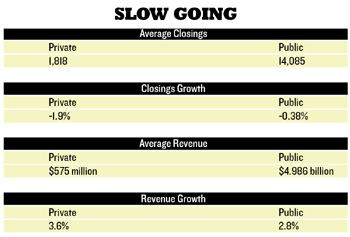
UP AND DOWN: Though public builders saw the total number of homes they closed in 2006 decrease to 366,205 from 367,600 in 2005, the same builders actually saw their average closings increase due to fewer companies being classified as public. Private companies saw both their total number of homes closed and average closings per builder decrease in a slowing market in 2006. Both publics and privates saw revenue growth in 2006.

That doesn't mean some of the excesses that builders lapsed into during the boom have disappeared or that builders have stopped dreaming about growth (see “Another Day,” page 147). But reality and perspective—rather than a hope and a prayer—do seem to be informing builders' business plans again. “You mean you can't have cake every day and not get fat?” asks Dean Ammon, vice president with Bensalem, Pa.–based Orleans Homebuilders, in a sardonic tone most builders would relate to. Ammon speaks from experience, as Orleans' cancellation rate stood at 90 percent for months in some Florida markets last year. “Now everyone in the industry is on grapefruit,” he quips.

WHAT GOES UP ...

During boom times, more than a few builders began to accept the proposition that the industry was no longer cyclical, or at least wasn't as subject to seasonal spikes as in the past. Several builders interviewed for this article now contend that public builders concocted this storyline to convince Wall Street to see their jobsites more as factories and to adjust their expectations accordingly. Wall Street, for the most part, wasn't buying, but the notion stuck as conventional wisdom in many quarters.

In retrospect, one wonders why. Ryan thinks the idea that the housing industry had shaken off its cyclical shackles was typical of builders' “notoriously short memories,” and “wishful thinking.” Anyone questioning cyclicality needed to look no further than Denver, where home buying has been soft since the first quarter of 2001. “It's very much a ‘manage your business week to week' kind of thing here,” says Cheryl Schuette, president and COO of Englewood, Colo.–based Village Homes, whose closings were flat in 2006. “You can't make assumptions that next month is going to be better.”

“It's still a cyclical business; we just got lulled into a false sense of security for 10 years,” says David Weekley, chairman of Houston-based David Weekley Homes, who still cringes at the thought of how his headquarters' market collapsed in 1985, when starts fell 80 percent during a six-month period. That experience taught him the value of geographic diversification—Weekley moved into three markets last year: Phoenix, Tallahassee, Fla., and Bluffton-Hilton Head, S.C.—and when buyer demand slackened this time, his company laid off only 4 percent of its workforce, because it could offer employees relocation opportunities to less-volatile markets.

Geographic diversity wasn't always a protective shield, as several giant builders with national profiles reported significant erosion in their profitability last year. But it did cushion the blows from the downturn for some companies. Chicago-based MCZ Development saw sales in its headquarters market's six counties fall to 300 units from 700 in 2005, according to Crain's Chicago Business. Yet MCZ, which builds in six states and the District of Columbia, more than tripled its closings last year, according to its CEO Michael Lerner. Austin, Texas–based Main Street Homes was mired in a slump from 2001 through 2004, but its fate changed once it expanded to sizzling San Antonio. Last year, Main Street's total closings in three Texas markets more than doubled to 1,031 units, primarily because its communities in San Antonio grew to 11, from one in 2005. “The industry is cyclical, but we're on a different cycle,” says David LeBoeuf, Main Street's CEO and co-owner.

While builders might not deny cyclicality, some still insist its impact isn't as severe anymore because, says Hosseini of ICI, “companies are being run more professionally.” Doug Bauer, president and COO of William Lyon Homes in Newport Beach, Calif., adds that builders are better capitalized than they were a decade ago and can weather even gale-force storms. “I read that the big builders wrote off something like $3 billion in impairments last year; that would have killed a lot of companies in the '90s,” he observes.

UNDETECTED INVESTORS

Builders say this downturn was harder to predict than those in previous eras because it lacked the recessionary triggers that have caused buying to stop in the past, such as rising interest or unemployment rates. By process of elimination, builders attribute this downturn, at least partly, to investors who were difficult to spot this time around because many seemed like average-looking couples buying a second home.

Builders generally aren't opposed to investors as customers. “I'd still sell to investors today,” says Bauer, and he's not alone. But Bauer isn't eager to see a repeat of what happened in Phoenix, where William Lyon's cancellation rate hit 60 percent at one point last year. “It's like what they say about some athletes: you can't stop them, you can only hope to contain them,” says Mike Conley, president of Eastwood Homes' division in Charlotte, N.C. Other builders, though, admit their efforts to put a lid on investor purchases pretty much failed. In markets where investors swarmed, they wound up buying far more homes than builders intended to sell them, and consequently, wreaked more havoc when they saw their opportunities to flip homes at a significant profit diminish and walked away from deposits.

Don White, CEO for Pageantry Homes in Las Vegas, says that when his daughter bought a new house in that market last June, “she was the third owner and the first to actually live in it.” Pageantry tried to limit investors to 10 percent of its sales, “but it was probably more like 25 percent because people would misrepresent themselves.” Maher Kilajian, Dan Ryan Builders' COO, says his company took a board-mandated position to limit investors to 20 percent, but now he says “we should have lowered that to 10 percent because it was very hard to ID them.” And when asked how long investors usually stayed in the house they bought, CEO Ryan of Dan Ryan Builders laughs and says, “about an hour.”

Keeping investors in check depended on how rigorously builders enforced contracts that prohibited renting or selling a house within the first year of its purchase. Dublin, Ohio–based Epcon Communities, for one, held investors to 10 percent of its sales in all of its communities except those in some resort areas, such as Catawba Island on Lake Erie. “Even there, it wasn't too bad,” says Tom Rothrauff, Epcon's president of franchising. “We learned some lessons from the last downturn, and one was that buyers are drawn to a community's personality. Investors change the complexion of a community.” In Sacramento, Calif., Dunmore Homes wrote a provision into its contract that gave it the right to buy back a house, at the price the buyer paid for it, if it were put back on the market within a year, a bad option for investors when prices were still rising. “That at least gave our contract some teeth,” says the company's CEO Sid Dunmore.

LOOKING BACK: BUILDER 100 companies were asked to rank the importance of these factors in advancing their positions during the last 10 years. Not surprisingly in a year when many of the BUILDER 100 were taking impairments to adjust land valuations to market prices, stronger balance sheets took the top spot. Regional diversification and diversifying products followed close behind, showing builders were attuned to market conditions and felt that growing in depth and breadth of operations gave them a big leg up. Due to increased cancellations driving their own speculative inventory up, Pulte cut back on spec building from roughly one-third of all starts at the beginning of the year to less than 5 percent by year's end. Yet, in spite of increased cancellations and examples from some of the biggest builders, less emphasis on spec building finished ninth in relative importance.

As a disincentive to cancel a contract before closing, ICI requires a minimum 10 percent deposit from every buyer. Investors could buy in, but had to put down 20 percent for the first house, 40 percent for the second, and 60 percent for the third, and if they walked away from any of their purchases, they relinquished the deposits for all. ICI couldn't keep investors from buying (it would be discriminatory), but didn't want to sell a lot of its homes to investors, so it established this increasing down-payment scale, in essence, to discourage investors from buying more than one house. Some builders, when informed about this policy, thought it was impractical because it would stifle sales too drastically. And while it's true that ICI's closings were off 34 percent last year, it's hard to knock a policy that limited cancellations to 7 percent in 2006.

SPECCED OUT

However, “where it all went wrong” for ICI, says Hosseini, was letting speculative building get out of hand. His division presidents, he says, succumbed to market exuberance, and he wasn't paying much attention to how many specs ICI was building. “So, almost by accident, we let specs get well over 20 percent.”

Only in the later stages of last year's downturn did most builders turn off their production spigots, and even today builders say they need to build some specs to meet demand. Last year, Main Street Homes increased its spec building to 40 percent of its construction, from 30 percent historically, so it wouldn't lose business to larger competitors that co-owner LeBoeuf claims were throwing up unsold houses like they were going out of style. “Realtors want instant gratification and dragged buyers to other builders when we didn't have enough spec inventory,” he laments.

Pageantry Homes prefers to limit its spec building to 10 homes per project, but in Las Vegas its specs are higher by necessity because 60 percent of what it builds there is attached, which takes longer to complete. It doesn't bother Winston Salem, N.C.–based Shugart Enterprises that up to three-fifths of its production are spec homes because, explains owner Grover Shugart, more than half of its sales come from referrals or Realtor recommendations, so there's less risk.

“We'll always build spec homes because not every buyer can wait or wants to go through the construction and design process,” says Selva of Shea Homes. His company became a “big spec builder” in Arizona during the peak of the boom there, when home prices were appreciating by more than 3 percent per month. But when that market slowed, “we recalibrated very quickly,” Selva is quick to note. Stevens says Hacienda Builders pulled permits and built homes without buyers because approval delays were extending the time it took to break ground beyond 75 days. “That's just too long for some buyers,” he says. When those markets softened, though, Hacienda found itself with 200 unsold spec homes, a number that stood at 110 in early March 2007.

In many markets, builders' spec inventory increased exponentially, if unintentionally, when buyers walked away from contracts in droves. That forced builders to finally slam on their production brakes. Between September 2005 and January 2006 “we didn't build a single house, and then we built to sales velocity,” says Dunmore. Weekley told BUILDER in late February that, in some markets, “we haven't started a home in months.” And one lesson that Weekley says his company took from this latest downturn is that it must “go deep, faster” in cutting back on spec building in order to minimize unsold inventory.

After incurring a 39 percent cancellation rate that was double its usual level, Suwanee, Ga.–based Winmark Homes now gives each community it starts a smaller spec target. For example, its River Stone community in Lilburn, Ga., is limited to 10 spec homes, half of what that number would have been a year ago. “We don't want to miss the spring selling season, but we're not overbuilding into it, either,” says Winmark's president Michelle Jenkins.

REASSERTING VALUE

This year, Winmark expects to close about 500 units, or nearly 20 percent fewer than in 2005. It went through two rounds of layoffs—in October and January—that reduced its workforce by one-fifth. Still, 2006 was this company's most profitable, and Jenkins says the downturn “was not necessarily a bad thing,” because it forced Winmark to make improvements in production and warranties.

Myriad builders that loosened their disciplines during boom times see a silver lining in the downturn: more time to strengthen their operations again. ICI initiated an “action plan” last summer that Hosseini describes as “a huge re-engineering of our company,” in terms of costing, pricing, and construction. He didn't provide many details, but Hosseini says the goal “is to get our pencil really sharp because we started to lose what we were good at: offering a home that was a good value.”

What “value” means to buyers now, though, has mutated—irreversibly so, in some builders' minds—due to the rash of incentives and price discounts that raised uncomfortable questions in buyers' minds about what a house is actually worth. Incentives “turned this industry into used car salesmen, eroded our credibility, and insulted buyers' intelligence,” fumes Stevens of Hacienda Builders. “It was like every buyer got the same e-mail at the same time that told them not to buy a house because it would be cheaper in 12 months,” says Dunmore, who claims the main instigators in Sacramento were national builders such as Centex, which “was offering incentives of $75,000 to $150,000 on a house where its profit margin was probably around $40,000.”

LOOKING AHEAD: When asked to think about how important these 10 factors would be in improving the competitive position of the BUILDER 100 over the next 10 years, getting houses built quickly moved to the top of the list, the second straight year it made the top spot. Cycle time grew in 2006, from an average of 126.8 days in 2005 to 132.5 days, underscoring the need to cut it back. Builders also seem focused on the positive economic factors, such as population growth and tracking demographic shifts.

As incentives and lower prices prevailed, some buyers gave a second look to builders with reputations for selling entry-level and first-time move-up houses. “That pushed a lot of buyers toward our product,” says Michael Monahan, a spokesperson for Tampa, Fla.–based Jim Walter Homes, the on-your-lot builder whose average sales price actually rose last year by 22 percent to $90,000.

It remains to be seen, though, whether builders will return to an affordable sector that many abandoned when prices were soaring. But there's no question that they're rethinking how they've been selling their products. “There's a critical need for everyone in the organization to concentrate on the customer's experience,” says Schuette of Village Homes, the implication being that hasn't been the case recently. William Lyon Homes is implementing a comprehensive sales training program to re-educate sellers who had become, says Bauer, “order takers who acted like bouncers; we rated buyers A through D, and bounced the ones who weren't A's. Now it's back to basics because the days when builders could sell any product on a piece of land are over. Now you have to know who your customers are and design for that consumer.”

ANOTHER DAY

A soft market hasn't kept builders from exploring expansion options, albeit more cautiously.

Las Vegas–based Pageantry Homes began 2007 actively looking to buy a competitor in either Phoenix or the Pacific Northwest to expand its presence in one of those areas. Walnut, Calif.–based Shea Homes has been searching for land to start up its first division in Florida. Uncertain buyer demand notwithstanding, builders need to scratch their itch to grow, and some think a soft market might be easier to probe for expansion. “We're always looking for growth opportunities in a down market,” says Miller & Smith's co-owner Doug Smith, who lately has seen evidence of large builders offering land in Virginia at lower costs.

Since last fall, many builders have stopped purchasing land and started winnowing real estate portfolios that no longer matched their conservative construction goals. In its 10(k) annual report, for example, Standard Pacific Homes disclosed that in the fourth quarter of 2006 it had reduced its lot position by 20 percent and would focus on “strengthening our balance sheet and improving our liquidity.” Hacienda Builders recently paid $27,000 per acre to pick up 120 finished lots from Standard Pacific at Johnson Ranch in Pinal County, Ariz. Hacienda's president Todd Stevens estimates that StanPac bought that land raw for $70,000 per acre and spent another $30,000 per acre on improvements.

AFFORDABLE OPTIONS: Dunmore Homes countered rampant incentives marketing in the Sacramento, Calif., area with more affordable products, such as those in The Villas at Monterey Village, with six house plans priced from $200,000 to the mid-$300,000s. The Sacramento BIA named The Villas Community of the Year in its price category.

Large builders and landowners have been selling dirt even in robust markets such as Charlotte, N.C., where Eastwood Homes—whose closings in 2006 jumped 45 percent to 1,275 units and are expected to hit 1,350 this year—has added land acquisition personnel. Eastwood also launched a coastal division encompassing Myrtle Beach, S.C., and Wilmington, S.C., that will start selling homes next January.

But, chastened by the recent downturn, builders are modulating growth plans. “We coach our franchises to keep their overhead under control and not to staff up like they're running three communities at once,” says Tom Rothrauff, president of franchising for Dublin, Ohio–based Epcon Communities. Grover Shugart isn't projecting major increases in closings for his company, Winston-Salem, N.C.–based Shugart Enterprises, even as North Carolina's Triad area flourishes economically. “The more focused we are, the better.”

Expansion-minded builders just aren't jumping into land with a blind eye to price, as they once did. “It got to the point where people acted like they were doing you a favor selling land,” says Mori Hosseini of ICI Homes in Florida. Last year ICI avoided land priced above $50,000 per acre. “We passed on deals that a lot of big builders picked up and are now trying to get rid of. So we're back buying again.”