The home building business takes an extraordinary amount of drive and dedication, so it's not surprising that most builders eat, breathe, and sleep housing. But life is composed of so much more than what happens at work, and without the balance of a life well-lived, the challenges of the business can drain rather than energize a person. We asked builders to tell us how they spend their spare time; the responses were as creative and diverse as the home building business itself. Their passions extend far beyond closing a land deal or watching a house come up out of the ground. We heard about builders who collect Russian art, travel the world, and mentor children. Many have a passion for sports; we heard from two hockey players, three race car drivers, two water-sport enthusiasts, a breeder of racehorses, and a college basketball referee. Some pour themselves into the welfare of others, building schools in Africa and protecting endangered animal species.

We wish we could have featured all of them, if for no other reason than it was wonderful to sit and talk with them, soaking up the feelings they have for their pastimes. Bound by space limitations, we settled on five.

AIRBORNE ACROBAT

Rick Porter can describe what aerobatic piloting means to him in one word: escape.

“The first time I did it, it was just the most delightful thing I'd ever done,” says the owner of Atlanta-based Richport Properties. “Here, 25 years later, I still feel it's sort of the epitome of three-dimensional freedom. It really is a ballet with an airplane.”

Porter not only flies an aerobatic plane, but also competes at the advanced level. In the world of aerobatic flying, only unlimited category pilots fly more difficult routines. In competition, advanced-level pilots must perform three flights inside a 3,300-foot cube between 800 feet and 3,500 feet above the ground. A panel of five judges scores the pilots on a series of maneuvers that must be done inside the cube, which is marked on the ground.

While air show routines are done for the “wow factor,” Porter says, competitive routines are all about precision. And even though he may be flying upside down at nearly 200 miles per hour, Porter says he doesn't consider himself a thrill-seeker.

“It's not about risk,” he says. “There probably is a bit of bravado involved in it, but it's truly about the expertise and control it takes to do it. You're flying an airplane that will do whatever you tell it to do and stay there until it falls out of the sky. It's very exhilarating. When you add the freedom aspect and the competition, it's something I really enjoy.”

He also enjoys the camaraderie of the community of aerobatic pilots; only about 400 to 500 pilots compete at this level and every competition is a bit like a family reunion. He looks forward to spending weekends hanging out with people who share his passion for the sport.

“There is a kid-like passion in all of us who do it,” he says. “I'm not sure any of us fully wants to grow up.”

EMOTIONAL RESCUE

At work, everything Phil Fankhauser does is about doing the best he can. He wants to be competitive, exceed expectations, and get things done faster than the time he's been given. It's not necessarily because anyone is telling him he has to do things that way; it's just part of who he is.

When he's painting, it's as if he's entered a new world. “It is so radically different to sit down and be spontaneous rather than calculating,” says Fankhauser, who is a principal at Dublin, Ohio–based Epcon Communities. “It's a very different experience for me. I view art as a therapeutic, pleasant experience.”

It's not the first time that Fankhauser has painted. Decades ago, he did still lifes, with the goal of essentially copying what he saw so that it looked as close to the actual item as possible. Today, he is focusing on abstract art and has been painting a series of canvases about emotions. He thought it would be interesting, he says, because by not having anything to look at, he would have to look inside to express himself artistically.

He works with acrylic paints, a medium that he says is “very playful and very forgiving. You can accomplish a lot of different techniques without a lot of skill. If you make a mistake, you can just paint over it.”

Fankhauser is looking into classes at a local art college to learn some different techniques, such as painting with knives, to give himself more tools and skills to work with. He doesn't think his paintings will ever have value to anyone outside his own family, and that's fine with him. He's not painting to achieve any goal other than personal satisfaction.

“I think art is a form of meditation,” he says. “It takes me to a place where I don't spend most of my time. It's enjoyable and relaxing and that's a really, really nice change of pace.”

A PASSION FOR WINE

Ed Bacome never had much of a taste for wine until he and his wife, Julie, took a trip to Italy. They fell in love with the country, the scenery, the people, and how Italians live and eat. “A meal takes on so much more importance in Italy than here in the U.S.”

They also found what would become a passion for wine. They started by learning as much as they could about Italian wines, which gave them a great excuse to go back to Italy. “We enjoy very much going directly to the vineyards, meeting the people involved, and going down into the cellars,” says Bacome, who is Epcon's co-founder with Fankhauser.

After exploring Italy, Bacome began to learn about California wines. He visits the Napa Valley wine-producing region a couple of times each year. He also belongs to a wine club called Napa Valley Reserve, which designates rows of grapes for each of its members and then produces bottles of private-label wines just for them. “You don't own it, but you can go there as often as you like,” Bacome says. “You can help with the harvest, help with the sorting and the blending, or you can let them decide. You can have as little or as much involvement as you want.”

Bacome's involvement included coming up with a name and label for his wine. He settled on Melange, which means “a mixture,” he says. The wines are for private enjoyment or to give to friends but can't be sold.

Bacome keeps his growing wine collection in a state-of-the-art cellar that is organized by country. (In addition to the Italian and Californian wines, he's also spent considerable time learning about French wines.) The cellar, which will hold 3,500 bottles, is 75 percent filled, a fact that has not escaped his 6-year-old.

“My daughter said, ‘Dad, how are you ever going to drink all this wine? You sure are going to have to have a lot of parties, aren't you?'” And that's exactly what he intends to do.

“We love to entertain,” he says. “It's nice to be able to share a nice bottle of wine with people. We buy it to enjoy ourselves, not as an investment to sell later. It's just to enjoy and share with friends.”

GARDEN OF DELIGHT

Dean Bennett takes his organic gardening pretty seriously. He's against using pesticides; he favors llama poop over chemical fertilizers, uses drip irrigation to conserve water, and even prefers a push mower to a gas-powered version. “They put out a lot of emissions, and the push mower is quiet,” says Bennett, who owns Dean Bennett Design and Construction in Castle Rock, Colo. “So much of what I do all week is noisy, I don't want any more noise on the weekend. It's kind of fun. The neighborhood kids make fun of me.”

The neighborhood grown-ups, on the other hand, often stop by to ask him about his displays of wildflowers, annuals, vegetables, and herbs. “We have a big front yard, which is fun for me because I like showing off a little,” Bennett says. “It was fun all summer. Almost every day, someone would stop at the house and they'd want to talk about all the flowers.”

His love of gardening started in childhood. His family always had a big garden while he was growing up. And he appreciates the balance it offers his life from the stress of building houses. “There are no deadlines,” he notes. “The garden does what it's going to do. I like the payoff, too.”

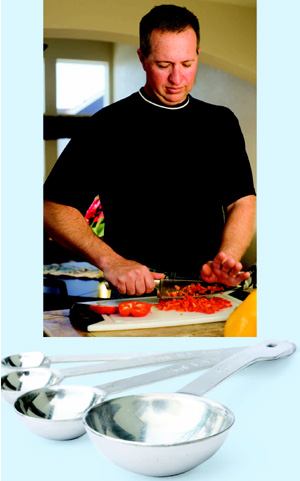
Bennett's passion for gardening naturally extends into cooking—“Anything I grow, I get to eat,” he says—and virtually every meal he cooks incorporates something from his garden. He's terrible with recipes and won't use them, he says. Instead, he starts from scratch for every meal, making it up as he goes along. “I love to see what's [available] and figure out what I'm going to do with it,” he says. “It's very artistic.”

NATURAL HIGH: Houston-based builder Lambert Arceneaux has been climbing mountains since his college days. The concentration and commitment required to succeed as a builder leave little time for anything else, he says; climbing fills a deep need in his life. “When you leave work at the end of the day, you really need a grand, great challenge to let you know you're alive.”

Without question, his favorite ingredient is tomato. “I live for those,” he says. “If I could grow nothing else, it would be tomatoes.”

ON TOP OF THE WORLD

Ever since Lambert Arceneaux was a kid growing up on a farm in East Liberty, Texas, he's been fascinated with climbing. “We'd drive by hills, and I'd always want to get out of the car and go climb them,” he says.

As a college student, he discovered Enchanted Rock State Natural Area, a pink granite dome that rises 425 feet from the ground, and in 1989 started a rock-climbing club called the Texas Mountain Raiders that is still active today. But Arceneaux, who is president and CEO of Houston-based Allegro Builders, had his sights set much, much higher.

Since his college days, he's climbed regularly in Colorado. The two biggest highlights have been his ascents on Mount Rainier in Washington and Mount McKinley in Alaska, the tallest peak in North America at 20,320 feet and “pretty much the coldest mountain in the world,” he says.

Most people who climb Mount McKinley go up and come down along the same route, Arceneaux says. It's easier because it allows climbers to stow supplies along the way on the ascent and pick them up on the way back. His team traversed McKinley, which involved climbing up one route and coming down the treacherous back side. The park service no longer permits climbers to traverse because of the danger, Arceneaux says.

The 30-day expedition was, by far, the most physically and mentally demanding thing he's ever done. “I weighed 177 when I left and I came back [weighing] 140,” he says. “I had a size 28 waist. It was ridiculous.”

The mountain he would really like to climb is the 22,841-foot Aconcagua, in Argentina. The ultimate challenge, of course, is the world's tallest peak, Mount Everest (29,035 feet), in Nepal and Tibet. He sees those kinds of events as something he'll do once every 10 years, in between regular climbs at a vacation home in Durango, Colo., at about 9,000 feet.

The attraction, he says, is the challenge and the focus required to achieve it.

“It's like riding a motorcycle,” he says. “You can't take your hands off because you have to pay attention to the road. I know I'm alive because I'm out there. ... I guess I have an agenda with my life, including things I don't know if I'll ever be able to accomplish, including Mount Everest. It drives me to do better, to do more.”