TO PEOPLE IN THIS ORGANIZATION deeply rooted in the Christian tradition, the Jan. 31 firing of Habitat for Humanity founder Millard Fuller was nothing short of sacrilege.
After all, 70-year-old Fuller and wife Linda had unflaggingly dedicated three decades of their lives to what one follower called an “audacious goal”: providing a safe, decent home for every person on the planet.
While the worldwide demand for modestly priced housing remains enormous, few would question what Habitat for Humanity International (HFHI) has accomplished since the Fullers started the nonprofit group in the small Southwest Georgia city of Americus in 1976. By August, Habitat will have built 200,000 houses in 100 countries for a million people who otherwise could not afford a home.

IN CONFLICT: For nearly three decades, Millard and Linda Fuller served as the inspirational leaders of Habitat for Humanity. In recent years, the founders increasingly butted heads with the nonprofit's board.
Equally important, observers say, is that Habitat has raised the consciousness of the public—as no other group has ever done—about the urgent need for affordable housing. The result: a flood of donated time, money, and materials for the cause.
Each year, tens of thousands of volunteers ranging from college students to former President Jimmy Carter work alongside prospective homeowners at building sites all over the world. Meanwhile, donations keep pouring in—nearly $500 million in the last five years alone, making HFHI America's 19th largest nonprofit organization.
“It is a tremendous tribute to Millard's hard work and entrepreneurial style that he has built such a great organization and that so many people have bought into his vision,” says David Williams, president of Make AWish Foundation and former COO at Habitat.
Parting Of The WaysSo what happened?
Accolades for Fuller still echo loud and clear from a host of sources: staffers at the Americus headquarters, directors of affiliates around the world, leaders in government and business, and ordinary citizens. Even so, as Habitat sought to transition from a passionate movement dominated by one man to a large, complex organization with far-flung commitments, it was becoming increasingly evident that Millard Fuller's days with Habitat were numbered.

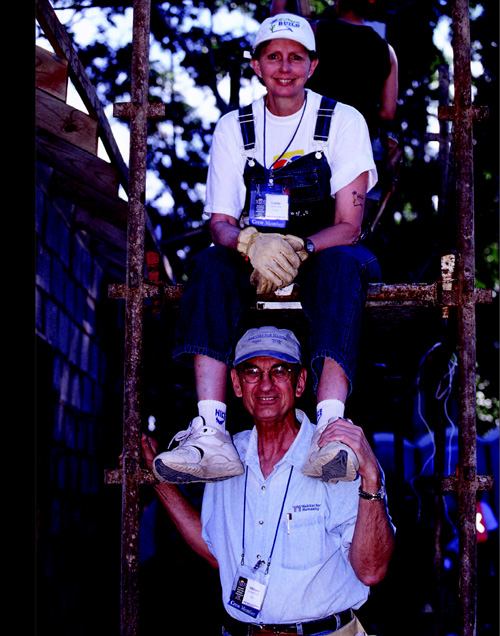
WORKERS UNITED: Each year, tens of thousands of volunteers work alongside prospective homeowners at more than 1,700 Habitat affiliates in the United States.
Insiders at Habitat and Fuller himself recall frequent clashes on strategy between the founder and the board of directors. David Snell, former head of Habitat's education ministry, remembers Fuller jumping up on a table during a board meeting to push for an eight-year campaign to rid Sumter County—Habitat's home area—of poverty housing. “He was arguing that this was our home and [that] we needed to demonstrate to the world that we could achieve this goal here,” recalls Snell.
Having won that battle, the founder then lobbied hard for the board to back construction of a controversial project: the Global Village and Discovery Center, a $2 million demonstration site in Americus that shows rows of slum shacks juxtaposed with 15 examples of the type of homes that Habitat builds in poor countries. Other battles were waged over such issues as whether to expand in new overseas areas that Fuller advocated such as Bosnia and Ukraine versus erecting more homes in areas where Habitat is already established.
“I am an expansionist and have always tried to push the organization to the next level,” Fuller told Builder. “But we have a lot of top corporate people on the board now, and they think in a corporate way. They don't see Habitat as a movement—God's work. A movement can be a little bit on the messy side, and they don't like that messiness. They want everything to be all neatly tied up with airtight financial statements.”
Board members, however, paint a different picture—one that involves the need for more careful planning and new approaches to maximize building opportunities in an era of soaring land costs and growing regulations. Paul Leonard, named interim CEO of HFHI last October, says a big priority for the board in 2005 as it tackles the next five-year plan is considering what can be done to achieve “exponential growth” rather than the 5 percent to 10 percent growth of recent years.

WORKING GLOBALLY: The Global Village and Discovery Center, located in Americus, Ga., shows Third World slum housing next to models of Habitat homes built for needy families overseas such as this home that sells for $3,500 in Botswana.
Aside from strategy differences, the board had to contend in the past year with allegations that Fuller had sexually harassed a female former 15-year employee of Habitat. Although Fuller categorically denies any wrongdoing, the board's and Fuller's lawyers last April asked Jimmy Carter to look into the matter as well as mediate differences between the founder and the board on philosophy and management style. Carter, whose Plains, Ga., home is just a few miles west of Americus, has served as Habitat's most celebrated supporter, devoting a week each year to building Habitat homes in the United States and overseas through the Jimmy Carter Work Project.
The Nobel Peace Prize winner ultimately fashioned an agreement, announced last October, in which Fuller would relinquish the CEO title to Leonard, who would run Habitat until a new CEO could be found by a search committee. Fuller, with the new title of founder/president, would serve as the chief spokesperson for Habitat. As part of the agreement, allegations of sexual impropriety against Fuller would be dropped.
That understanding, however, was short-lived. The Fullers began to give interviews to the press in November 2004, expressing dissatisfaction with the events and the board's decisions. When the Fullers did not heed the board's requests to refrain from public remarks that the board felt were “damaging to the organization,” Millard and Linda were terminated.
In a letter to Habitat employees and local affiliates, Leonard said: “In the end, with an 11-month history of promises made and broken, the board believed, despite long-term admiration and respect for the Fullers and their commitment, that they had no choice but to end their employment.”
An Emotional ReactionNot surprisingly, the firing of the couple triggered an immediate response—both from Fuller supporters and those who backed the board. A group called Habitat Partners, led by former education director Snell, established a Web site and gathered petitions requesting the reinstatement of the Fullers. On the opposite side, David Rowe, a Connecticut minister and former board president of Habitat, sent an e-mail to 1,000 Habitat affiliates alleging instances of employee abuse by Fuller as far back as the late 1980s.

TSUNAMI RELIEF: Habitat rebuilding efforts have already begun in Sri Lanka. The nonprofit is raising $25 million to house 25,000 families in areas destroyed by the tsunami.
Indeed, this is not the first time Fuller has been accused of impropriety. In 1990, several women employees of Habitat claimed he sexually harassed them. Fuller admitted the actions—a kiss, a hug, a compliment—but insisted they were innocent gestures. Ultimately, the issue was settled internally.
This time, Fuller, deeply shaken from being “fired from my life's work,” continues to hold out hope for a compromise. “I have my arms outstretched and am hoping and praying for a reconciliation with the board's executive committee,” he told Builder.
Some observers worried that firing the charismatic Fuller, popular with Habitat affiliates for his speaking and fundraising talents, could be damaging to the organization. But many others, both within Habitat and in the general public, believe that the organization's mission has become much bigger than the influence of one man.
“There is no question that this organization is very strong and that it will continue to grow,” says Williams of Make AWish Foundation. “It's a tribute to Millard's genius that he established a network of autonomous local affiliates who are empowered to make things happen.”
Nevertheless, some of those affiliates noted that they would continue to invite the Fullers as guests in their areas to support their programs, and Millard himself says his schedule is already booked well into 2006.
A Full PlateWhile members of the Habitat family voiced their “sadness” over the departure of the Fullers, most were adamant that the mission continues full throttle. For example, on the international front, by mid-February, Habitat had already raised $22 million of the $25 million needed for its plan to house 25,000 families in the areas devastated by the Dec. 26 tsunami. Donations included $1 million from the Mortgage Bankers Association and the National Association of Realtors. Lowe's also committed to matching up to $1 million in employee donations to the Habitat tsunami relief effort.

THE GREAT MEDIATOR: Jimmy Carter has become Habitat's most celebrated volunteer, working one week each year on a building site since 1984. The former president was asked to mediate disputes between Habitat's board and the Fullers.
“We are amazed at the opportunities that are surfacing,” says Michael Carscaddon, executive vice president for Habitat's international operations. “This is by far our biggest disaster response ever.”
In the United States, HFHI encourages its local affiliates to “tithe” by donating a portion of the funds they raise to Habitat's international programs—a practice that funnels about $10 million annually into global programs. Now, in a new “house for a house program,” headquarters is urging local affiliates to donate $4,200 internationally for every home they build in the United States.
Affiliates also are joining hands with builders on the most ambitious “builder blitz” program ever: constructing 1,000 homes in a single week in June 2006. Unlike most Habitat building projects, which rely heavily on unskilled volunteers, this blitz will feature professional builders using their own subs and suppliers. Tom Gipson, the Raleigh, N.C., builder who is spearheading the program, hopes to find an average of 10 builders in 100 cities willing to sponsor a house.
“Builders are anxious to give something back to their communities, and this is a way for them to make an incredible contribution,” says Gipson. “It's an unbelievable experience to see the look of joy in the eyes of these new Habitat homeowners.”
Moving OnDespite the flap over leadership changes, Jimmy and Rosalyn Carter have pledged their ongoing support to Habitat and will conduct another Jimmy Carter Work Project in Detroit and Benton Harbor, Mich., this fall. “It was Jimmy Carter who really put Habitat on the map when he became involved in 1984,” recalls Swisher. “It took us six years from Habitat's founding to get to 22 affiliates. But with the credibility that President Carter gave to the program, we were at 330 affiliates by 1988.”

ON A MISSION: Millard Fuller moved from pursuing riches to pursuing a dream of providing a decent home for everyone on the planet.
With more expansion to come, a big priority for Habitat's next CEO will be building effective teams all over the world, says board member Larry Prible, co-chair of the search committee. “Finding a successor to Millard Fuller is like trying to find a successor to St. Paul,” says Prible.
Habitat's agenda has become so ambitious and its name so well-known that the organization seems certain to overcome the emotional anguish of the recent leadership changes. “Habitat for Humanity has become an institution,” says management expert Michael Wakefield of the Center for Creative Leadership. “The whole world wants it to go on.”
Lawrence D. Maloney is a freelance writer based in Ashland, Mass.
Habitat At A GlanceYear founded: 1976Nonprofit rank: 19th largest U.S. nonprofit groupHeadquarters: Americus, Ga.Staff: 500 full-time employees worldwideAffiliates: 2,303 worldwide; 1,745 in North AmericaTotal homes built: About 175,000 worldwideHomes built in 2004: About 20,000 worldwide; 4,500 in North AmericaTotal population housed: More than 900,000Average home price: $58,000 in North America; $4,200 elsewhereAnnual donations: $160 million (latest available, 2003)Annual volunteers: More than 250,000Source: Habitat For Humanity International
Millard Fuller: The Theology Of The HammerSome may question his dominating leadership style, but few would doubt the intense passion that Millard Fuller has brought to Habitat for Humanity.
A graduate of Auburn University and the University of Alabama law school, the tall, wiry Fuller initially had only one burning ambition: to get rich. And that he did, amassing his first million by age 29 through direct-mail businesses and real estate. As Fuller recalls it, he had all the material possessions he could ever want—land, homes, cars, boats, horses, cattle—but they weren't making him happy. In fact, his family life was falling apart, and his wife Linda was considering divorce.
That crisis led the young businessman to reevaluate his life and his values. The upshot: The Fullers decided to give their money and possessions to the poor and join Koinonia farm, a Christian community near Americus, Ga., that for years had been a target of the Ku Klux Klan because it promoted racial equality. There, the Fullers first began building homes in 1969 on a nonprofit, no-interest basis for low-income families who were expected to put many hours of their own sweat into the projects. Fuller took the same concept to Africa in 1973, before returning home to Americus in 1976 to start Habitat.
The rest is history: tens of thousands of Habitat homes built worldwide, nine books published on his experiences, and countless awards and honors—including the 1996 Presidential Medal of Freedom, the nation's highest civilian honor.
Recently fired from the organization he started, Fuller shared his thoughts in a recent interview with BUILDER. Some excerpts:
Reaction to his firing. “Today, Habitat for Humanity is a house divided, and it needs to be a house united. There is too much important work to be done.”
His ideal role. “Several years ago, I gave up management duties, feeling it was a better use of my time to speak and inspire people and take Habitat into new countries.”
Roots of his ministry. “While we were at Koinonia, we saw so many people—the descendants of the slaves—in that rural area of Georgia who were living in shacks. Here was a specific need that nobody was taking care of, and it would be our niche.”
Housing's impact. “The first family we built for was the Johnsons. When we got ready to do the paperwork for the home, the father couldn't sign his name. He was illiterate. Today, that man's daughter is a lawyer. When you put people in a good house, it gives them a foundation. They can blossom and grow, and children can become what God intended for them [to become].”
Habitat's growth. “It's been an amazing story. Absolutely heady. Right now, we are building a house every 24 minutes somewhere in the world.”
His hero. “Clarence Jordan, the founder of Koinonia farm, was the closest person to Jesus I have ever met. Being able to live with him and learn from him was awesome.”
Jimmy Carter. “He is an incredible person. I have an enormous respect and appreciation for him. He has been such a blessing to Habitat and to so many people.”
Habitat's Christian focus. “It is the heart and soul of the movement. Our No. 1 partner from the very beginning has been the churches, of all denominations. ... “We may disagree on issues like homosexuality or abortion, but we can all agree that it is a good idea to build houses for poor people. It's the theology of the hammer.”