Meritage Homes recently got a glimpse of what the future of home building might be like if stringent homeland security and immigration reforms that are pending ever become law. In the fourth quarter of last year, the federal border patrol relocated one of its checkpoints in Arizona to within a stone's throw of Meritage's active adult community in Green Valley, 19 miles south of Tucson. As a result, “we were scheduled to close 40 homes but couldn't because we didn't have enough labor,” recalls Steve Hilton, Meritage's CEO. It seems that immigrant workers there–some, if not most, of whom lack proper documentation—weren't eager to be seen in public. “The cops were getting their coffee at the same Dunkin' Donuts as the immigrants,” Hilton says.

The housing industry's dependence on the nation's mushrooming immigrant workforce is now at center stage, as lawmakers grapple with what to do about the millions of undocumented workers already in the United States and hundreds of thousands more who dash across the U.S.-Mexico border illegally every year. That immigration wave, say builders, has been critical to their companies' abilities to meet buyer demand and keep home prices from escalating higher than they have already. But the country's live-and-let-live attitude toward undocumented workers mutated into skepticism and fear after the terrorist attacks on New York and Washington five years ago. Immigration policies got mixed up with homeland security, and the ensuing debate struck a nativist nerve about the shrinking job prospects for unskilled native-born workers.

“Unauthorized” immigrants now number nearly 12 million versus just under 3 million two decades ago. They hold one in 20 jobs in America, and one in seven construction jobs, according to a highly regarded study that the Washington-based Pew Hispanic Center released in March (see “Filling the Gaps,” above). That report helped humanize what for many Americans may have been an abstraction, but it also provided ammunition for hardliners who adamantly oppose granting legal status to anyone who entered the United States illicitly, no matter how badly some industries might need these workers. In the March 23, 2006, edition of News-week, the magazine's economics columnist, Robert Samuelson, wrote that legitimizing this constant flow of workers from other, poorer countries into the United States is akin to “importing poverty.” He notes that since 1980, the number of Hispanics with incomes below the government's poverty line—around $19,300 in 2004 for a family of four—has risen 162 percent, while the number of non-Hispanic whites in poverty rose 3 percent.

BD060701090L1.jpgCLICK HERE FOR IMAGE GALLERY

BD060701090L1.jpgCLICK HERE FOR IMAGE GALLERY

BD060701090L1.jpgCLICK HERE FOR IMAGE GALLERY

BD060701090L1.jpgCLICK HERE FOR IMAGE GALLERY

DRAWN TO CONSTRUCTION: The Pew Hispanic Center estimates that undocumented workers account for 4.9 percent of America's total labor force, with a much heavier concentration in a handful of sectors, including construction. The U.S. Census Bureau estimates that these sectors will require e at least 5 million more workers over the next decade, a target that many companies fear they won't hit without an immigrant workforce. SOURCE: PEW HISPANIC CENTER, TABULATIONS OF AUGMENTED MARCH 2005 “CURRENT POPULATION SURVEY”

DRAWN TO CONSTRUCTION: The Pew Hispanic Center estimates that undocumented workers account for 4.9 percent of America's total labor force, with a much heavier concentration in a handful of sectors, including construction. The U.S. Census Bureau estimates that these sectors will require e at least 5 million more workers over the next decade, a target that many companies fear they won't hit without an immigrant workforce. SOURCE: PEW HISPANIC CENTER, TABULATIONS OF AUGMENTED MARCH 2005 “CURRENT POPULATION SURVEY”

The Illinois Coalition for Immigrant and Refugee Rights estimates that there are 8 million legal immigrants now eligible for U.S. citizenship, including as many as 600,000 in political swing states. In May, the U.S. Citizenship and Immigration Services Web site received 6.3 million hits, up 12 percent from May 2005, and 140,000 citizenship application forms were downloaded, an 18 percent increase over the previous year. The U.S. Census Bureau projects that Hispanics will constitute 24 percent of the nation's population (numbering 102.6 million) by 2050.

The Illinois Coalition for Immigrant and Refugee Rights estimates that there are 8 million legal immigrants now eligible for U.S. citizenship, including as many as 600,000 in political swing states. In May, the U.S. Citizenship and Immigration Services Web site received 6.3 million hits, up 12 percent from May 2005, and 140,000 citizenship application forms were downloaded, an 18 percent increase over the previous year. The U.S. Census Bureau projects that Hispanics will constitute 24 percent of the nation's population (numbering 102.6 million) by 2050.

Grassroots demonstrations in local markets fed into the rush of nationwide protests that culminated this spring. In March, workers and their families held a candlelight vigil outside Sen. Arlen Specter's Pennsylvania home in opposition to legislation proposing to criminalize undocumented immigrants. “We're concerned about issues of human rights and families being broken up,” says Manuel Portillo, an organizer with the Open Borders Project in Philadelphia. “Families are central to the Latin American culture and value system. It's completely unnecessary to make people suffer because the U.S. is immersed in a long-term conflict in Iraq and security concerns. We can't be scapegoats.”

Grassroots demonstrations in local markets fed into the rush of nationwide protests that culminated this spring. In March, workers and their families held a candlelight vigil outside Sen. Arlen Specter's Pennsylvania home in opposition to legislation proposing to criminalize undocumented immigrants. “We're concerned about issues of human rights and families being broken up,” says Manuel Portillo, an organizer with the Open Borders Project in Philadelphia. “Families are central to the Latin American culture and value system. It's completely unnecessary to make people suffer because the U.S. is immersed in a long-term conflict in Iraq and security concerns. We can't be scapegoats.”

Guatemalan and Salvadoran immigrants represent a significant share of the day laborers in and around Washington. Whereas day laborers in other markets are more likely to find work with individual homeowners, 67 percent of those in the nation's capital say that they are hired primarily by contractors, subcontractors, or private companies, according to a UCLA study.

Guatemalan and Salvadoran immigrants represent a significant share of the day laborers in and around Washington. Whereas day laborers in other markets are more likely to find work with individual homeowners, 67 percent of those in the nation's capital say that they are hired primarily by contractors, subcontractors, or private companies, according to a UCLA study.

A sizable number of home building companies also object strenuously to letting more immigrants into the United States illegally, based on our “Immigrant Worker Impact Survey” of nearly 800 builders and contractors that BUILDER conducted in February and March. Half of the respondents admit to having at least some undocumented workers on their jobsites. But they differ—dramatically so, in some cases—about the impact that the flood of immigrants into the United States has had on their ability to compete for jobs with companies that use this lower-paid labor, on the quality of homes being built, on jobsite supervision, and on the ethics—and even the morality —of hiring people who have entered the country illegally. One contractor in Boston, whose population has been transformed by mass arrivals of Brazilian immigrants, complains that his company was outbid for two multifamily projects by a competitor who, he claims, regularly hires undocumented workers. Another builder laments, “You become less competitive when you follow the law” by hiring only native-born workers.

Forty-five percent of the survey's respondents maintain that they could not sustain their current production levels if the illegal immigrant work-force suddenly disappeared or was seriously reduced by new laws. Jerry Wade, president of Artistic Homes in Albuquerque, N.M., says that his company would have to cut its production by one-third without undocumented workers. Several respondents and other builders who were interviewed also expressed concern that the loss of immigrant labor would lead to higher wages as well.

Angelo Amador, director of immigration policy for the U.S. Chamber of Commerce, which supports a guest worker program, says that the problem with current immigration laws is that “they don't reflect worker demand.” Some builders and contractors couldn't agree more and say that even if they wanted to hire legal workers exclusively, there simply aren't enough Americans willing to tear off a roof or sheetrock a wall for the “prevailing wage” that contractors are paying and have been under little pressure to raise as long as they can draw from an illegal immigrant workforce that is in no position to demand more money. “We need labor. The American labor force isn't providing it. Immigrants ... appreciate the chance to work, and they work hard,” says another of the survey's respondents.

Others, though, reject any suggestion or evidence that undocumented workers fill jobs that Americans don't want. “By employing illegal workers, subcontractors are complicit and encourage the influx of illegal immigration, [which is] a severe threat to our national security in more ways than can be discussed in this forum,” says one respondent.

OUT FROM THE SHADOWS

The current immigration debate brings to mind a scene from Mel Brooks' movie Blazing Saddles, in which townsfolk grudgingly accept a black man into their community. “But no Irish,” shouts one citizen, to the raucous applause of his neighbors. The United States has a long history of welcoming, and then showing hostility toward, new arrivals. Still, hordes continue to seek opportunity or refuge here: Over the past decade, America granted permanent legal status to 900,000 immigrants per year, and 12 percent of our population is now foreign born.

What's causing all of the commotion is the ease with which people are coming into the country without going through proper channels. Pew estimates that since 2000, a net average of more than 500,000 per year has entered illegally and stayed, mostly to escape their own countries' crushing poverty and to find employment.

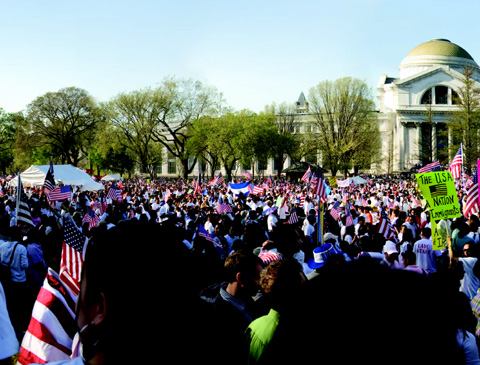
That “silent minority” rose up in force this spring at some of the biggest rallies in America's history to support migrants' rights and to protest a federal bill that threatens to criminalize undocumented workers and those who help them, and to militarize the U.S.-Mexico border. Those rallies poured gasoline onto an already emotional debate—one of the builders polled compares resentment against undocumented workers to “a lynch-mob mentality”—that Congress is struggling to sort out (see “Immigration Impasse,” below). What makes this national dialogue fascinating, and at times perplexing, is that both sides have valid points, making the debate far less cut and dried than what strident politicians and apoplectic talk-radio hosts or news anchors have been braying about.

Consider the claim that lower-paid undocumented workers take jobs from unskilled Americans or push them out of certain sectors, a perspective espoused by such organizations as the Center for Immigration Studies and the Americans for Legal Immigration. One respondent to our survey, Denver-based contractor Chris Blackstone, says that two years ago he advertised for a “multi-skilled” worker and had no trouble finding interested Americans. “I got 400 calls within 10 days,” he recalls. Still, two of Blackstone's five foremen (whom he pays between $18 and $30 per hour) are Mexican, and one is undocumented, as are several subcontractors his company employs. “I'm as patriotic as the next guy and I understand the need for security, but I'm on both sides of the fence on this issue,” says Blackstone.

This ambivalence is common among builders and contractors, as is their touchiness about the topic: Twelve of the industry's 15 largest builders declined to be interviewed or didn't return phone calls, and one out of every eight respondents to BUILDER'S survey declined to answer the question about whether they employ undocumented jobsite workers. Those who would speak on the record assume one of three positions: emphatic denial, tacit admission, or silence. “We don't have anyone working on our sites who is undocumented,” asserts Tom Noon, president of D.R. Horton's California region, noting that his company's contracts require subcontractors to be able to verify their workers' legality.

But outside of taking subs' word for it, builders aren't doing background checks on their laborers: Two-thirds of the respondents to our survey don't have systems in place to verify their subs' legal status. “I don't want to be a policeman,” says David Anderson, who owns David Anderson Homes in San Antonio and who, like many builders, is concerned that the onus for stemming this immigration tide—and the penalties for failing to do so—would fall disproportionately on employers (see “Checking In,” page 98).

His fears might be justified, as several states are considering legislation that places the burden of verification on employers. Many builders, though, insist that they aren't qualified to spot forgeries. “I've had INS [Immigration and Naturalization Service, now known as Immigration and Customs Enforcement] guys come in, and even they can't say for sure if a document is fake, so how the hell are we supposed to know?” asks Wade of Artistic Homes.

MORE PAY, MORE WORKERS?

Builders and contractors oppose anything that would disconnect them from immigrant laborers, who are often these companies' best employees. “I had a guy working for me from Poland who, in essence, was illegal,” notes Alfred van Swearingen, whose Ovieda, Fla.–based company builds six to eight homes per year. “He was a very hardworking young man, and his work ethic revolved around staying in this country.” But using foreign workers—legal or not—is a double-edged sword when those workers speak little or no English. Carmel Morris, who owns All-State Electrical, a leading contractor in Jacksonville, Fla., says that the size of the crews his company sends out on a job is often dictated by the subs' English proficiency. “You can only supervise so many people if they don't speak the same language.” Nearly half of the BUILDER survey respondents say that Spanish-speaking workers require more supervision for two reasons: One, the language barrier makes it tough for supers to instruct unskilled laborers on what needs to be done at each stage of a construction project; and two, Spanish-speaking supers are hard to come by. One respondent cautions that the industry's addiction to low-paid workers with deficient language skills will lead to more construction defects.

The conventional wisdom is that companies put up with these inconveniences because this labor is cheap. But more than a few builders and contractors say that's bogus. “I get tired of hearing that undocumented workers are working for nothing,” says Wade. Another of the survey's respondents notes that while he's paying undocumented workers 75 percent of what he'd have to pay legal laborers, “it's all cash, so I can't deduct it.”

Still, builders and contractors have felt little pressure to increase wages because they've had a robust migrant workforce to draw upon. “Many contractors have unwittingly created the very situation we complain about [because of] our unwillingness to support a healthy, well-paid labor force,” says one of BUILDER'S survey respondents. Bruce Norton, a general contractor in Truckee, Calif., made $25 per hour as a carpenter in 1975; now, he says, some framers in his area accept $15 an hour. “It's no wonder [builders] have trouble attracting workers who are citizens,” he states.

However, some builders are unconvinced that native-born workers will start pouring out of the woodwork if construction jobs paid better, and they warn that higher worker pay would translate into higher home prices. Larry Webb, CEO of Newport Beach, Calif.–based John Laing Homes, who favors legalizing immigrant workers “as quickly as possible,” says that his company's construction costs have risen between 12 percent and 20 percent annually over the past three years. “That can't all be materials,” he declares. Like other builders, Webb insists that some markets would be short of labor no matter what the pay scale. “Every contractor I know is looking for help.” Without access to immigrant workers, Hilton thinks that Meritage Homes' labor costs might double. Kathy Wade, Standard Pacific Homes' regional president in Phoenix, says, “It's about supply and demand. Labor costs would go up because there wouldn't be enough people to do the work.” More than four-fifths of the respondents to the BUILDER poll say that home prices would rise if they didn't have access to immigrant labor—and more than half of these builders say that the increase could be between 6 percent and 30 percent.

This could explain why a slim majority—56 percent—of the respondents favor a guest worker program that would remove the taint of illegality from their subs and allow them to stay here. “The construction market has been the entry point for immigrants into this country, going back to the Irish and Italians,” says Jerry Howard, CEO of the NAHB, which backs a guest worker program similar to the one that President Bush has outlined, which would legalize undocumented workers already here but doesn't automatically lead to citizenship.

Morris of All-State Electrical, whose company sponsors an apprenticeship program for high school students (see “Fresh Blood,” page 126), says that he sympathizes with those who say that a guest worker program is little more than amnesty. But like many builders and contractors, Morris wants practical solutions, not rhetoric, from elected officials. “It's hard to swallow, but what's done is done,” he says about undocumented workers already here. “We've got to stop the bleeding, but we also have to be realistic because we aren't getting Americans coming through our doors to do this work.”

IMMIGRATION IMPASSE

As Washington debates two competing reform bills, many states are enacting their own immigration statutes.

Now the hard part begins.

When the U.S. Senate passed sweeping immigration reform in late May, it set the stage for what could be a battle royal with the U.S. House of Representatives, whose own security-first bill is at odds not only with the Senate's version, but also with President Bush's position.

After staying on the sidelines for months, Bush delivered a speech to the nation on May 15 in which he called immigration reform an issue of “national importance.” He then stated five “objectives” that he urged Congress to incorporate into any reform legislation:

  • To appease his conservative base, Bush asked Congress to approve $1.9 billion to fund the hiring of 6,000 more border patrol agents by 2008; the installation along the U.S.-Mexico border of high-tech fences, motion sensors, and cameras; and the deployment of unmanned aerial vehicles. Bush also wants to use 6,000 National Guardsmen along the border in an unspecified, non-law-enforcement capacity;
  • Without offering specifics, Bush wants Congress to create a program that allows “guest workers” from other countries to enter the United States temporarily for a period of time;
  • To hold employers accountable for who they hire, Bush called for a “reliable” system to verify workers' documents and eligibility;
  • While he opposes “amnesty,” Bush favors allowing millions of undocumented workers who have been in the country for several years to earn legal status if they pay a “meaningful” fine and pay taxes; and
  • Bush talked about upholding “the great American tradition of the melting pot,” but he also wants to ensure that English stays the national language.
  • Bush's recommendations followed a script that had been laid out earlier by the Senate Judiciary Committee. However, there was some serious tweaking in the final Senate bill, which reduced the number of nonfarm guest workers who would be admitted into the United States annually to 200,000 (from up to 400,000 in the McCain-Kennedy bill). The Senate bill made concessions to security along the U.S.-Mexico border by adding provisions for 350 miles of fencing and 500 miles of vehicle barriers and increasing Border Patrol agents by 2,400 per year through 2011. But the Senate bill would give illegal immigrants who have lived here for two or more years—all but around 1 million of the estimated 12 million undocumented immigrants in the country at present—different paths to eventual citizenship.

    The Senate must now reconcile its bill with what the House passed last year, which has no provisions for legalizing undocumented workers, no provisions for guest workers, and would make it a federal crime to live in the United States illegally. Many representatives in the House are adamant about securing the border first before they are willing to even talk about setting up a system that would allow more workers into the country legally.

    While Washington girds for this showdown, many states are devising their own laws to put the squeeze on undocumented workers and their employers. For example, the Boston Herald reports that the Massachusetts Senate passed a proposal in May that, if enacted, would bar illegal immigrants from taxpayer-funded housing. The Chicago Tribune reports that between January and early April, 42 states introduced nearly 400 immigration-related bills, including the Georgia Security and Immigration Compliance Act, which went into effect July 1, 2006, and mandates that employers verify their workers' legality under the threat of fines and possible criminal charges. Georgia denies undocumented workers access to certain social services, as would a bill pending in North Carolina, which also would make employers provide medical coverage to these workers.

    CHECKING IN

    Builders could be on the hook to verify employees' legal status.

    The May 9 raid on three of Fischer Homes' jobsites in Kentucky, where federal agents arrested 76 undocumented workers and four of Fischer's own supervisors, was a loud and unsubtle warning shot fired by the government across the bow of the housing industry, that builders are going to be held directly accountable for the legal status of the people they hire to build their homes.

    The government's complaint against Fischer's superintendents stated unambiguously that builders are responsible for ensuring that their contractors employ documented labor. What's less clear, though, is how builders are supposed to do this, especially when what subs present as “papers” are often fake but hard to detect. In March, 11 defendants were charged in Los Angeles with running a counterfeit mill that supplies fraudulent documents to immigrant workers. Those arrests were the result of a four-month investigation by U.S. Immigration and Customs Enforcement and showed that the government is finally getting serious about tracking down phony identity paperwork.

    The public is demanding that legitimacy be restored to the documentation process. The Pew Hispanic Center polled 2,000 adults in March, and more than three-quarters favor some form of national identification card. Two-thirds also favor the creation of a worker database. Future federal budgets include more money for workplace investigations and enforcement. All of this seems to be leading toward holding employers more accountable for validating the legality of their workers.

    Given the current mood of the country, more builders might find themselves registering with the federal “Basic Pilot” program, which has been around since 1996 and is run by the Department of Homeland Security and the Social Security Administration. Within three days of hiring someone, employers enter the worker's information—social security number, address, driver's license, etc.—into Basic Pilot's database, which flags discrepancies with existing records. Employers in the program agree to fire anyone whom this system doesn't confirm.

    Congress wants all employers in Basic Pilot within five years. But critics say that the program still has computer and data problems. “We're not talking about American Express here,” quips James Carafano, senior fellow with The Heritage Foundation, a Washington-based conservative think tank, comparing AMEX's seamless capability to verify cardholder information for such things as bill payment or Internet purchases with the government's still-archaic computer systems that don't permit critical interagency communication. Carafano also poses a question that most builders don't want to hear, but which might resonate with the larger public: Shouldn't housing and other industries where the vast majority of undocumented workers gravitate bear the cost of any national verification system?

    SURVEY METHODOLOGY

    BUILDER's “Immigrant Worker Impact Survey” is based on 795 responses to an electronic survey that was sent out to 42,902 of the magazine's readers in February 2006.The response rate was just under 2 percent.Specpan,a market research firm, disseminated the survey by e-mail, collected the results, and developed the report.Responses from participants are held in strictest confidence, but some respondents chose to speak on the record for this special report.Accuracy of the data is +/- 5 percent.

    Click here to read the next article in this Special Report.