BRIAN PATRICK, A BUILDER BASED IN NORTHERN California, remembers that when he was growing up in Southern California in the 1960s, his uncle was a mason and always had Mexicans working for his company. The workers would be on hand during the height of the building season and then go back to Mexico in December for the holidays. While there were abuses in the industry at large, Patrick says that the Mexicans who worked for his uncle were accepted and treated fairly.
As time passed, Patrick gravitated to the framing business, but he opted to become a general contractor about 10 years ago because he couldn't compete with framing contractors who hired undocumented workers, paid low wages, and provided no workers' comp or other benefits.
“When I was a framing contractor, I tried to do everything legal,” he says. “I offered good wages, workers' comp insurance, and other benefits like health insurance, but I couldn't be competitive,” explains Patrick.
Today, as the owner of Northern Development, a builder based in Yuba City, Calif., north of Sacramento, Patrick says that he puts his subcontractors through a thorough screening before signing them on. Subcontractors have to fill out a qualification package that fully documents a sub's auto insurance, general liability insurance, workers' comp, and his overall financial standing.
But even with such strict guidelines and good faith efforts, Patrick says, it's impossible to police every jobsite—especially since his company builds 500 to 1,000 homes each year.

BD060701110L1.jpgCLICK HERE FOR IMAGE GALLERY

BD060701110L1.jpgCLICK HERE FOR IMAGE GALLERY

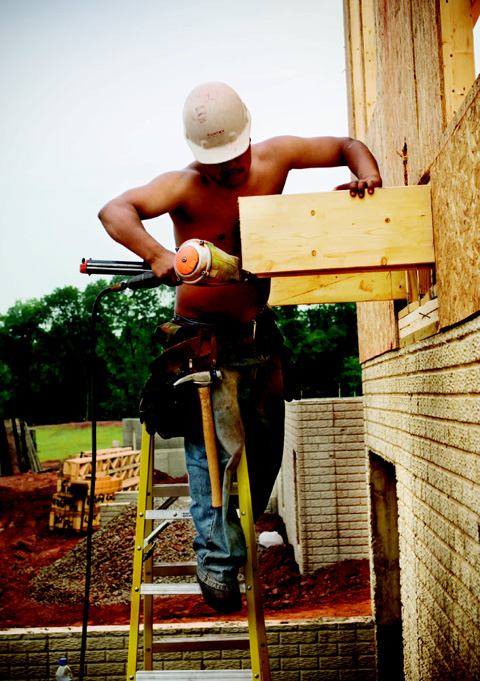
Framers at a luxury-home site in Ashburn, Va., include a handful of day laborers hired from a nearby gathering place. Hailing from Guatemala, Honduras, and El Salvador, they count among the 18.3 million legal and illegal foreign-born Hispanics now living in the United States.

WORD'S OUT: Massachusetts launched a series of print, radio, and television ads informing companies in the building trades that they must have workers' comp insurance.

TOUGH STANCE

CLAIMS HAPPEN
“I've got 100 landscapers and 400 framers working at any given time, so how do I keep track of them all?” asks Patrick. “I'll pull one of the guys aside and ask him ... if he is legal, and he'll say yes, but you can see it in his eyes that he's lying—he says yes because he doesn't want to be deported.”
Subcontractors neglecting to provide workers' comp and other benefits to undocumented workers present a serious ethical dilemma to home builders. Do they join the crowd and hire subs who use undocumented workers? Or do they try to stay completely within the law? Home builders we interviewed say that it's impossible to compete with builders who knowingly hire illegals and don't pay for workers' comp and other benefits.
The situation forces builders to make some hard choices about the kind of companies they run. After all, each builder has to be able to sleep at night. The rampant use of undocumented workers has forced some building industry people to shift gears. (BUILDER'S “Immigrant Worker Impact Survey” shows that 50 percent of the respondents admit to having at least some undocumented workers on their jobsites.)
Northern Development's Patrick became a general contractor because he couldn't compete as a framer against subs who didn't pay workers' comp insurance. He also didn't want to be forced into hiring undocumented workers.
Mike Reynolds, the owner of Melrose Building and Remodeling in Nacogdoches, Texas, says that he became a remodeler because he couldn't compete with local home builders who hired undocumented workers and didn't provide them with workers' comp. “It's hard to compete unless you're building a high-end house,” explains Reynolds. “That's why I moved to remodeling. I got cut out of the market.”
Mike Garfield, the proprietor of Garfield Builders in East Canaan, Conn., says that builders who want to stay in the business have to step up and say they're going to do it legally. Garfield, who builds three to four $1 million-plus homes a year, says that he pays his people $45,000 to $50,000 before benefits (company benefits include medical insurance, paid vacations, paid holidays, and a 401k retirement plan).
“We're competing against companies that pay workers $12 an hour with no insurance,” Garfield says. “These people work seven days a week, 10 hours a day. We can't legally do that. People ask me why my competitors can build a house in three months and I take four months. The only thing I can say is that we're a completely legal company.
“When I submit a proposal, I supply the customer with a certificate of insurance, both workers' comp and general liability, and I even include my truck insurance,” Garfield continues. “If we want to be treated like professionals, we have to act like professionals.”
LAW SUIT THREATEthical considerations aside, there are outside forces threatening to make builders think twice before they do business with subs who don't carry the proper insurance coverage. Builders also face the threat of lawsuits from injured undocumented workers, and—at least for purposes of workers' comp insurance—courts are ruling against builders and employers in general.
According to the National Immigration Law Center, a research group and advocate for low-income immigrants, state courts in California, Florida, Georgia, Maryland, Minnesota, New York, and Ohio have all ruled that an injured worker's legal immigration status does not preclude him from being eligible for a workers' comp claim. None of those cases directly involved home builders.
The highest-profile workers' comp case involving home builders took place in Jefferson County, Ala., last fall, when Judge G. William Noble ruled that Henry Lambert Construction must pay workers' comp benefits for life to Omar Santos-Cruz—an illegal Hispanic worker who was 17 at the time of his injury in March 2004. Santos-Cruz, who is now partially paralyzed, was framing a house when he slipped through a window opening and fell 12 feet to the ground.
Santos-Cruz returned to live with his family in Mexico, but not before Judge Noble ruled that Lambert must pay him $240 a week for life as well as all medical expenses resulting from the fall. Essentially, the judge ruled that an alien is an employee regardless of his legal status and is entitled to workers' comp benefits.
Attorneys for Henry Lambert and the HBA of Alabama tried to argue that Santos-Cruz was employed by a sub, but the judge ruled that even if an illegal worker is hired by a subcontractor, for the purposes of workers' comp insurance, the builder is ultimately responsible for the workers on its jobsites.
“What's clear is that undocumented workers have constitutional rights,” says Vicenta Bonet Smith, the attorney who represented Santos-Cruz.
She continues, “You don't want to have workers working for an employer and an employer taking advantage of that worker, thinking he has no rights,” adding that “illegal immigration would double—because why would anyone bother to hire anyone with legal papers?”
Esther Lopez, deputy chief of staff for Gov. Rod Blagojevich of Illinois, says, “Our understanding is that the labor laws do not exclude undocumented workers from workers' comp, minimum wage requirements, and unemployment insurance.”
Over the past year, Illinois has initiated a formal fee schedule for workers' comp claims; increased benefits; formed a fraud unit that's charged with cracking down on both employers and workers who try to defraud the system; and created a panel charged with speeding up workers' comp claims.
“You can't make someone work 70 hours a week and not pay overtime,” Lopez says. “And if he gets injured, all of a sudden he's not eligible for workers' comp?” She adds that it's “alarming” that anyone would work side by side with workers and yet deny them equal protection under the law and a basic benefit such as filing a workers' comp claim for an injury.
Alarming though it may be to someone such as Lopez, who has worked hard to reform the workers' comp system, that some builders would argue to deny benefits to undocumented workers, 59 percent of the respondents to our survey say that undocumented workers should not have access to workers' comp benefits. And 57 percent say that undocumented workers shouldn't even have access to the U.S. court system.
Given that home builders, as a group, tend to be conservative, their tough stance comes as no surprise. But not all home builders take such a harsh view.
“If they are working here, [then] they need to be insured at least for workers' compensation,” says Patrick of Northern Development.
“I feel that undocumented workers are a victim class just waiting to be taken advantage of,” says William Welte, president of Welte Construction in San Francisco, who says that he is reasonably confident his subs use only documented labor. His subs are also required to present proof of workers' comp and general liability insurance.
“What protection do [undocumented workers] have that they will get paid, or not be sent into an unsafe situation, or both?” asks Welte. “Would you really want to have health care for yourself and deny it to others? And would you really expect to be able to exploit anyone in 2006?” Welte says that the United States opened the door to undocumented workers years ago, and now we don't want to deal with the consequences: real pay for real work.
Now that he's had some time to reflect on the Santos-Cruz case in Alabama, Frederick Fohrell, the attorney who argued the case on behalf of the Alabama HBA, says that national legislation is needed.
“We have got to have a new national policy to deal with undocumented workers,” says Fohrell. “They are here in such numbers that both states and the federal government need to get a handle on this. The status quo does not appear to be working. There are tens of thousands of undocumented workers here in Alabama—and they are contributing to our economy.”
STATES GET TOUGHAt press time, the national debate on immigration policy was mired in an election year and presidential politics. The plight of undocumented workers has become a serious popular movement, with large demonstrations in major cities around the country. Since it's an election year, it's certainly possible that Congress could hammer out an immigration bill and send it on to President Bush in time for November's midterm elections. But it could also be several months, and possibly years, before politicians sort out which guest worker policy, if any, makes sense, the best way to manage such a program, and what to do about the 12 million undocumented immigrants living here already.
At least for the short term, builders should be aware that state and local governments are cracking down on companies that don't carry workers' comp insurance or try to defraud insurance carriers. Too often, builders simply don't carry workers' comp insurance for their workers, undocumented or otherwise; or, looking to shave costs on insurance premiums, they will classify illegals as managers or as clerical workers who don't work in dangerous jobs.
In Florida, the state passed legislation in 2003 that stiffened penalties in workers' comp fraud cases and provided funding for an additional 35 investigators in the Bureau of Compliance in the state's Division of Workers' Compensation. The state also gave investigators added enforcement tools, such as the ability to issue stop work orders if employers conceal information or misclassify workers.
The result: Fines issued by the Bureau of Compliance jumped from slightly under $16 million in fiscal 2004 to in excess of $46 million in fiscal 2005. And the number of stop work orders jumped from 1,776 in fiscal 2004 to 2,672 in fiscal 2005. State officials estimate that workers' comp premiums have been reduced by as much as 30 percent in Florida because tougher enforcement has forced more people into the insurance pool and lowered prices. As the market grew, prices came down.
Andrew Sabolic, bureau chief and policy coordinator for the Bureau of Compliance, says that roughly 75 percent of the fines and stop work cases involve employers in the construction industry.
In some cases, Florida officials find employers paying undocumented workers in cash off the books, a practice that also violates Florida's workers' comp law. “We can issue stop work orders to employers who underreport or conceal payroll,” says Sabolic.
Bill Taupier, deputy director of administration for the Massachusetts Department of Industrial Accidents, says that Massachusetts changed its approach from focusing on issuing stop work orders to providing its 10 investigators with enhanced law enforcement training and working more closely with violators to bring them into compliance. The goal is to achieve compliance without having to be punitive.
“We'll give companies 10 days to come into compliance, or else we'll take other steps—such as a stop work order, criminal complaints, or restraining orders—to enforce compliance,” says Taupier.
Law enforcement officials in the San Diego area have not been as apt to use the carrot-and-stick approach. In early March, 12 officials of Mayer Roofing Co. of Escondido, Calif., were indicted on charges that they defrauded California's State Compensation Insurance Fund of $4.5 million over three years.
At press time, all those charged in the case had pleaded not guilty, and no trial date had been set. Mayer Roofing is alleged to have classified 97 percent of the company's 450 workers as high-wage roofers, as opposed to low-wage roofers with less experience. In California, high-wage roofers tend to be journeymen or supervisors, employees who are less likely to be injured on the job, making their workers' comp premiums lower.
Ernie Marugg, the deputy district attorney assigned to the case, says that the Mayer Roofing case is one of 10 such prosecutions of building contractors in San Diego County over the past three years.
Marugg says that the majority of the workers at the contracting companies are Hispanic. While Marugg has no hard facts, he says that it appears a number of them are undocumented workers. Marugg says that home builders will not be prosecuted in these cases. However, he did say that in discussions with the contractors, they contended that they are just one piece of the problem. Marugg states that many subs complain that the real problem is the home builders who knowingly hire subcontractors who don't provide insurance and other benefits. The subs contend that so long as builders hire the low bidder, it's impossible for companies that pay fair wages and benefits to compete.
What will happen next? A home builder in Alabama has been forced to pay workers' comp benefits and medical expenses for life to an undocumented worker employed by a subcontractor. Framing and roofing contractors are being prosecuted in San Diego County. It's just a matter of time before a home builder somewhere is tied to a serious workers' comp fraud case.
Click here to read the next article in this Special Report.