With land prices spiraling out of control in so many housing markets across the nation, it's hard to think about how to achieve affordability without first sorting out the dirt part of the equation. But there are other factors at play that can directly affect the base price of a home, not to mention the ability to gain project approvals. How do you honor the existing vernacular of an old-growth neighborhood on a shoestring budget? How can simpler building forms and construction techniques keep labor costs down? What kinds of pre-existing amenities (be they natural or manmade) can add value to a home or neighborhood without requiring any additional capital outlay? And then there's the question of what affordability truly means to the home buyer. Mortgage payments aside, how can utility, maintenance, and transportation costs be controlled to ensure the home purchase really is wallet-friendly? With better design, that's how.
Victorian Lite
Simplified architecture translates into cost savings in a California coastal enclave.
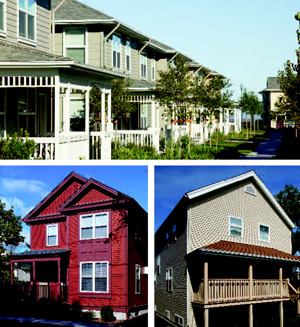
At first glance, you wouldn't peg the 132 residences of Victoria Green in Hercules, Calif., as affordable rental housing. With their deep overhangs, hipped roofs, and crisp fretwork, they look too pretty. And with their panoramic views of the San Francisco Bay, one might easily assume these coastal beauties come with a much higher price tag. After all, they're part of a larger master plan that includes market-rate homes selling for upwards of $1 million.
Spectacular views are a luxury that only the wealthy can afford in some waterfront locales, but things are a bit more democratic here, thanks to a thoughtful site plan that capitalizes on a dramatically sloping terrain. The eight-acre “pad” on which Victoria Green is perched is the farthest parcel from the water in the larger master plan for Victoria by the Bay, a 260-acre brownfield redevelopment on a site once occupied by oil, asphalt, and petroleum refineries. But it's also the highest topographical point in the plan—giving it the distinct advantage of overlooking rooftops farther down the ridgeline.
Making the most of this prime vantage point, planners at BARArchitects oriented a series of eight-pack buildings (each four units over four units) around a central green that offers unobstructed sightlines to the Bay. Parking mostly skirts the periphery of the neighborhood, so as not to impede the view. With leases for the one-, two-, and three-bedroom units ranging from $418 to $1,400 per month and a location within walking distance of public transit (bus lines), the homes have become quite popular among local firefighters, teachers, and police officers.
Drawing inspiration from nearby historic homes, the architecture at Victoria Green is best described as, well, Victorian, albeit a modest rendition of it. Thanks to nature providing such a killer backdrop, excessive ornamentation was unnecessary, notes Paula Krugmeier, a principal with BARArchitects. And in this case, whittling down the bells and whistles translated into cost savings.
“The geometry and massing of the buildings is very basic,” Krugmeier says. “It's more or less a repetitive typology that was simple to draw, bid, build, and market.” The configuration proved so economical to build, in fact, that the initial construction came in under budget. The resulting savings were reallocated toward upgraded kitchen cabinetry, additional landscaping, playground equipment, outdoor lighting, and nicer finishes in the community center, including Pergo flooring and motorized clerestory windows.
“People take their views seriously in this part of the country,” Krugmeier says. “The richness of the site plan is what makes this project work. Even folks who do not live at the edge of the parcel and enjoy views from their units have a place they can go to experience a relationship with the San Francisco Bay.”
Project: Victoria Green, Hercules, Calif.; Size: 7.8 acres; Total units: 132 homes; Density: 17 units per acre; Rental price range: $418 to $1,400 per month; Square footage: 793 square feet (one-bedroom units); 929 square feet (two-bedroom units); 1,171 square feet (three-bedroom units); Builder: Oliver and Co., Richmond, Calif.; Architect: BAR Architects, San Francisco; Developer: Eden Housing, Hayward, Calif.
Part and Parcel
Patchwork development rebuilds the fabric of community in an inner-city Providence, R.I., neighborhood.
Opportunities for urban revitalization seldom come in neat little packages. Consider the turnaround of Providence's downtrodden Smith Hill neighborhood—a five-year effort involving three construction phases, two nonprofit developers, two builders, and a handful of non-contiguous lots to produce a mix of low-income, workforce, and market-rate housing. Phase one alone introduced 28 affordable rental units (some new, some rehabbed) on 13 scattered infill sites.
Carrying out the vision required a complicated system of moving parts and funding sources. Fortunately, Smith Hill had many of the necessary ingredients for an affordable renaissance, including proximity to public transit, zoning for tight lot configurations, and a legacy of mixed housing types, including duplex and triple-decker homes that were intrinsically affordable by nature of their size and shared walls.
As in all infill ventures, sensitivity to the existing neighborhood was paramount. And in Smith Hill, there were precedents worth honoring, notes architect Donald Powers, whose locally based firm photos: donald powers architects created the master plan for the revitalization effort. “One thing I've observed is that when you are working in a city context on standard sized lots of 50 feet by 100 feet, the good solutions were already arrived at a hundred years ago in terms of overall building dimensions,” he says. “Our role wasn't so much to reinvent the wheel as to tweak the formula.”
Some of the tweaks were cost-savers. For example, while older homes on the block were highly compartmentalized on the inside, new dwellings dispensed with unnecessary interior walls to open up communal areas. This move not only brought the new homes up to contemporary lifestyle standards, but made them easier and less expensive to build.
“With engineered lumber, the spans are much greater, so we were able to eliminate intermediate load-bearing walls,” Powers explains. “You don't need to have a center stick ... carrying the joists. That gave us more flexibility in opening up the ground floor with an open plan and fewer discrete rooms. This had cost implications because every wall you eliminate is money saved.”
Another secret to staying on budget was a sensitive, but less-than-literal interpretation of the area's prevailing architectural styles. Take bay windows, which would have been too expensive to pull off had they been framed and trimmed the traditional way. As an alternative, carpenters with Stand Corp. simulated the dimensional look of bays by “packing out” layers of 2x4s on the face of the plywood and then adding decorative brackets. These faux bump-outs maintained the rhythm of the streetscape and created an 8- or 10-inch-deep sill on the inside of each house for plants or pictures.
“Often the dead giveaway for affordable housing is flatness and lack of shadow,” Powers says. “Any chance you get to create an overhang or recess that adds depth to the construction, you should do it.”
Front porches were the one area where the team opted not to pinch pennies—the thinking being that authentic features such as double columns, sturdy turned posts, decorative railings, solid chrome mailboxes, and brick piers would convey a feeling of quality and permanence at eye level.
Phase two of the transformation involved the total rehab of five historic worker cottages (originally built for immigrant mill workers, circa 1891) into affordable rental housing. The third and final phase of redevelopment, now nearing completion, replaces a string of vacant lots and a dilapidated, one-story commercial building with 13 attached units of market-rate and subsidized for-sale housing, plus 8,000 square feet of retail space with mom-and-pop storefronts. The seven affordable residences in this mixed-use enclave (known as Capitol Square) will be reserved for individuals making 80 percent to 120 percent of the area's median income, with a price tag of $159,000. Market rate units will go for $239,000.
“Our philosophy is that creating affordable housing is only partially about creating a house; it's also about creating or repairing a whole neighborhood,” says Powers, noting that investments in relatively small things, such as landscaping and street lighting, can generate a momentum that is priceless. “It's not just a matter of putting roofs over people's heads. When a place is designed well, residents feel proud of where they live and they are more likely to take good care of it.”
Project: Smith Hill Revitalization, Providence, R.I.; Size: 53 acres (scattered site infill); Total units: 44; Density: 6.3 units per acre; Price range: $159,000 (affordable for-sale homes); $239,000 (market-rate for-sale homes); Square footage: 1,050 to 3,250 square feet; Builders: Stand Corp. (phases 1 and 3), Warwick, R.I.; Vasco Construction (phase 2), Seekonk, Mass.; Architect/Planner: Donald Powers Architects, Providence
Energy Wise
A Chicago housing venture redefines sustainability with economics in mind.
For many first-time home buyers, affordability concerns don't stop once the initial down payment is scrounged up, or even after monthly mortgage amounts have been calculated. How a house is designed and built can also influence its net effect on the household budget long-term. “You don't want to put someone in a home who will then lose it because they can't afford to pay their utility bills,” says Angela Hurlock, executive director of Claretian Associates, a nonprofit developer in Chicago.
It was this logic that led Claretian to begin offering starter homes that were not just affordably priced but also green built and energy efficient for low-income buyers in Chicago's economically stagnant 10th ward nearly a decade ago. To date, 30 new single-family and duplex homes in the New Homes for South Chicago program have been built on vacant city lots, featuring high-performance mechanical systems and appliances, structural insulated panels, rooftop photovoltaic systems, low-flow toilets, and eco-friendly finishes such as cork floor tiles, carpet made from photos: john gress recycled plastic bottles, and composite decking made from sawdust and recycled shrink wrap. Sustainable features have been made possible with grant funding.
Clustered mostly within a five block radius, the pioneering homes are simple by design, but they are nothing to sneeze at when you consider that they consistently surpass Energy Star standards by 30 percent and exceed the city's building code for moisture management. Solar panels (oriented east-west to maximize gain) offset approximately one-third of the electricity consumed per household, and homeowners receive credits for any electricity they generate that's fed back to the grid. The neighborhood is located within walking distance of a number of public transportation options, including three bus routes and light rail.
Entering its fourth phase of construction—which will result in 23 new homes—New Homes for South Chicago still offers the lion's share (more than 90 percent) of its new homes to low-income buyers, many of whom qualify for up to $40,000 in municipal down-payment assistance from the City Department of Housing. But the neighborhood's rebirth has also begun to capture the interest of individuals in higher income brackets, and two of the new homes in phase three were sold to market-rate buyers. Single-family homes start with a base market price of $195,000, and duplex homes featuring twin stacked flats start at $265,000.
Next up: The developer is now preparing to build 28 LEED-certified, two-flat condos on neighboring city lots. But sustainability also has a social component, notes Hurlock, whose organization provides not just housing, but also classes on financial literacy, credit, identity theft, how to qualify for a home, and how to choose the best mortgage, as well as community leadership training and after-school programs for kids.
“We've learned that you can't just do housing and then move on to the next neighborhood,” Hurlock says. “We are rooted here in the community, and we're in it for the duration. A lot of families need education to move from the renter mindset to the homeowner mindset and to become assimilated. We had one purchaser who literally had $15,000 in his mattress because he didn't trust banks. Education is a necessary part of the process.”
Project: New Homes for South Chicago, Chicago; Size: 4.2 acres; Total units: 30 built; 23 more under construction in phase four; Density: 7 units per acre; Price range: $195,000 to $265,000 (market-rate, not including down-payment assistance); Square footage: 1,500 to 1,700 square feet; Builders: South Chicago Workforce, Chicago; Fragoso Construction, Chicago; Architects: Sam Marts Architects and Planners, Chicago; Landon Bone and Baker, Chicago; Developer: Claretian Associates, Chicago; Building Science Consultant: Steven Winter Associates, Norwalk, Conn.; Funding Sources: City of Chicago (donated land), City Department of Housing (housing subsidies), Illinois Housing Development Authority and Federal Home Loan Bank Affordable Housing Program (down-payment assistance); Illinois Department of Commerce and Community Affairs, Chicago Department of Environment, ComEd Production and Incentive Program, and Illinois Clean Energy Community Foundation (photovoltaic systems)